

331 – Alvin Green of Chicago, IL Founder Of Al’s Cookie Mixx, Father of Two Including A Son With Autism
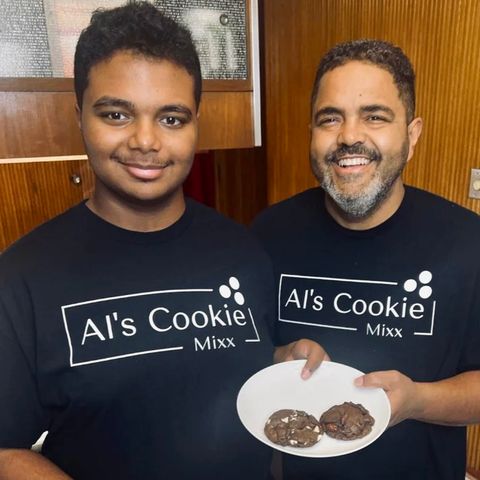
Our guest this week is Alvin Green of Chicago who is a chef, founder of Al’s Cookie Mixx and father of two including a son with Autism.
Alvin and his wife, Angella Ferguson, have been married for 27 years and are the proud parents of two: Asa (23) and Aiden (20), who is Autistic and was also diagnosed with Hyperlexia.
Alvin has directed his culinary skills and love for baking into creating Al’s Cookie Mixx, a social enterprise created in 2018, that makes delicious custom home baked cookies and provides employment to young adults with disabilities.
One of the company’s catch phrases is: “Your Enjoyment Provides Employment.”
We also learn about the impact that Special Olympics and Victory Reins Equestrian Therapy have had on Aiden’s life and personal development.
Alvin’s an incredibly positive guy and we’ll hear his family story on this episode of the SFN Dad to Dad Podcast.
Show Notes –
Phone – 773-474-8295
Email – alvin@alscookiemixx.com
LinkedIn – https://www.linkedin.com/in/alvin-green-98523915/
Al’s Cookie Mixx – https://alscookiemixx.com/
Transcript:
Tom Couch: Special thanks to Horizon Therapeutics for sponsoring the Special Fathers Network Dad to Dad Podcast. Working tirelessly to research, develop and bring forward medicines for people living with rare and rheumatic diseases. Discover more about Horizon Therapeutics mission at horizontherapeutics.com.
David Hirsch: So why is it that you’ve agreed to be a mentor father as part of the Special Fathers Network?
Alvin Green: Because they’re our kids. Simple as that. I mean, they’re all our kids, so they’re family. You have to do it.
Tom Couch: That’s our guest this week, Alvin Green, a chef and founder of Al’s Cookie Mixx, providing delicious custom homemade cookies. Al is a chef and is working with his son Aiden to provide these delicious treats. And Aiden, by the way, is autistic. Alvin’s an incredibly positive guy and we’ll hear his family story on this Special Fathers Network Dad to Dad Podcast. Now say hello to the founder of the Special Fathers Network and host of the Dad to Dad Podcast, David Hirsch.
David Hirsch: Hi, and thanks for listening to the Special Fathers Network Dad to Dad Podcast presented by the Special Fathers Network, a dad to dad mentoring program for fathers raising children with special needs. The Special Fathers Network Mastermind Group experience is the most comprehensive program the 21st Century Dads foundation offers. Dads raising children with special needs, meet virtually on a weekly basis and form meaningful relationships while sharing weekly wins, discussing books and sharing heartfelt challenges. One of the highlights of the year is attending an in-person weekend retreat. We’re launching 10 new SFN mastermind groups in January 2024 with 10 dads per group. That means we’re only looking for 10 like-minded dads in each of the following locations. Anchorage, Alaska, Bellevue, Nebraska Chicago, Illinois Denver, Colorado, Georgetown, Grand Cayman, Houston, Texas Indianapolis, Indiana London, England Nashville, Tennessee and Reykjavik, Iceland. If you’re a dad raising a child with special needs in one of these cities, we hope you’ll join the local SFN Mastermind group and make the investment to become the best version of yourself. For more information, please see the show notes or simply go to 21stCenturyDads.org.
Tom Couch: Now let’s listen in on this tasty conversation between Alvin Green and David Hirsch.
David Hirsch: I’m thrilled to be talking today with Alvin Green of Chicago, founder of Al’s Cookie Mixx and father of two, including one with autism. Alvin, thank you for taking the time to do a podcast interview for the Special Fathers Network.
Alvin Green: Well, thank you for having me.
David Hirsch: You and your wife, Angella Ferguson have been married for 27 years and are the proud parents of two, Asa, 23 and Aiden, 20, who is autistic and was also diagnosed with hyperlexia. Let’s start with some background. where did you grow up? Tell me something about your family.
Alvin Green: Okay. I was actually born in Clarksdale, Mississippi, home of the Blues, Muddy, Waters and all those good folks. We moved to Rochester, New York when I was six, years old and grew up in the northeast. So I always say I’m a southerner at heart, but my wife say, there’s a little bit of that northeast in there too.
David Hirsch: So my recollection was you had some siblings.
Alvin Green: Yes, everyone’s always surprised. I have. I’m the youngest of 16. My parents were both married before, so my dad had four, my mom had four, and they connected and they had eight more. So we are like the Brady Bunch on steroids. And so. And I’m the youngest.
David Hirsch: So you’re the caboose on a 16 car, train there. That’s amazing.
Alvin Green: Yeah.
David Hirsch: So, what’s the age range? Out of curiosity, from oldest to youngest?
Alvin Green: My oldest living sibling just turned 79. I had two, older than her. And they would be in their late 80s, early 90s now because my mom was 44 when she had me and my dad was 56.
David Hirsch: Gotcha. That’s wild.
Alvin Green: My son Aiden, he’s 20, he’ll be 21 in November. He has a first cousin who’s 70.
David Hirsch: That is a non traditional looking family tree, that’s for sure.
Alvin Green: Yes.
David Hirsch: So out of curiosity, what did your dad do for a living?
Alvin Green: He actually was one of those jack of all trades. He built houses, did some sharecropping in Mississippi at a young age. He said he worked on riverboats. When he first left home, he drove trucks. He was one of those early truck drivers. I mean, you know, like how the old guys, they did whatever it took to put food on the table and the roof over their heads, so they did a little bit of everything.
David Hirsch: Well, if you had 16 kids, I imagine that would, that, would motivate you to keep working a little bit. Yeah,
00:05:00
David Hirsch: yeah, that, that’s fabulous. So how would you describe your relationship with your dad?
Alvin Green: It was actually, it was really good because he retired when I was elementary school and so I was really the only one out of the 16 that was, he was home for. I mean, because he worked so much and he was gone a lot on the road and everything and so. But we had a really good relationship. And with him being a lot older, it was a lot of great wisdom that he gave me because he had seen a lot in Life, especially being an African American of biracial ancestry in the South. He was born in 1911.
David Hirsch: Wow.
Alvin Green: And so he gave me a lot of good advice about things. My grandmother was African American, and my grandfather was, Irish. He was born in. Out of Dublin. Came over when he was, like, two or three years old.
David Hirsch: Okay.
Alvin Green: But, I mean, most African Americans have on average, 35, 40% European heritage. Mine is a little closer.
David Hirsch: Absolutely. When you’re thinking about your dad, any important lessons, takeaways that, you think about when you think about your dad?
Alvin Green: I was just actually talking to someone today. One thing that always takes me. He was. I was upset about something, worried about something, and he goes, no matter how bad it gets, you’re not on the block. And I’m like, what does a block mean? He said, you’re not on the auction block. No one’s selling you. Oh. I’m like, that’s a hell of a perspective. And my wife, actually, she said, think about it. He was born in 1911. He knew people who had been slaves, so he knew how important it was. And he also told me about. He said, you have to vote in every election because he said, sometimes he’ll be the only African American voting in Coahoma County, Mississippi. And they would give him, because he was biracial and, like, some of his relatives were affluent, they would give him an easier poll test. So then they would give other African Americans. So he was like. He said, you have to vote.
David Hirsch: Yeah. Well, that’s two very profound things that you’ve just shared. You’re not on, the block, which has a totally different meaning from what most people would think today.
Alvin Green: Yes.
David Hirsch: And, you know, the importance of voting. Right. It is a privilege, and, you know, we maybe take it for granted, like, oh, what. What would one vote make a difference? Right. I’m sort of busy. I don’t know if I can get over there before work or after work or. I don’t know if it’s raining. You know, I don’t want to, you know, get wet or make the extra effort. So, you know, very insightful. Thank you for sharing.
Alvin Green: Oh, no problem.
David Hirsch: So, I’m thinking about your grandfathers. You made reference to one. The one on your dad’s side, he was the one from Ireland. Is that what you said?
Alvin Green: Yes, but he died when my father was. Was, very young, so we never got to know him or his family. And so. But my mom’s dad, we got to know him because he actually lived with us in his last few years. So I was in junior high school when he passed. But he lived with us for a few years.
David Hirsch: And what did he do for a living?
Alvin Green: When his father passed he became the man of the family. And he was the only one of his siblings except. And I think he had one brother that didn’t go to college, which. And he always wanted to be an architect. The story was that he built houses. Actually, him and my father built houses together. And he would actually design the house. Build a house.
David Hirsch: Wow.
Alvin Green: He loved building things.
David Hirsch: It sounds like you’ve come from some really good quality, heritage. Right, with the, men in your family.
Alvin Green: Yeah.
David Hirsch: Any other father figures, growing up, people that you looked up to?
Alvin Green: I mean, I had older brothers, of course, so they were more like fathers, because I know, one brother, he actually just passed last September. He was 18 when I was born. So we were really close in that he was almost like another dad. And he was always even till, the last moment, always super protective, super supportive and everything. The art was a good guy. Anybody else all kind of like, would give you those little nuggets of advice. Like one of my dad’s older sons, his thing was really about family. It was like, we’re all family. Family is super important. You have to take care of family. So that’s why, like, we’re all super close. I mean, we don’t see each other as much as we used to. Me being the youngest. Now it’s like it’s not as many here as it used to be because I’m almost 57, so getting closer to 60. So some of those other ones have gone on. But family is extremely important. And a lot of people in the family say, you might not like your relatives, but you gotta love them.
David Hirsch: Absolutely. So my recollection was that you went to school at Colgate, took a degree in economics, and I’m wondering, where did your career take you?
Alvin Green: Actually, I never really used my economics degree. I ended up getting into transportation. Worked for Roadway Express, which is now defunct. It was the time was a Fortune 500 transportation company. And then when, worked there for 10 years, my wife and I went to New, Orleans for a quick second for a year or so, and then we came to Chicago. And then I ended up working with my brother and his best friend. They started an ethnic hair company. So I worked with them for a few years, and with their encouragement, I started a catering company. And we did that for a few years until Aiden. It was like Aiden got his diagnosis. And so I had the more flexible Schedule. So my wife and I decided that it would be easier for me to be his primary caregiver. And so after that, did some private stuff stuff. But for the, for a few years there it was, me getting him to where he needed to be. So we had like therapies, which a lot of people would know. We had therapies five, six days a week all over Cook County. And we were all over the place, but made it work.
David Hirsch: So, I’m curious, how did you and Angella meet?
Alvin Green: We actually met at a friend’s party in New York City. And so that would be this October. It would be 33 years.
David Hirsch: And you came to Chicago because of your brother’s business. Is that what brought you to Chicago?
Alvin Green: As you know, Angella’s from Chicago. We met on the east coast, we moved to Savannah and then, we just so happy she had a job opportunity to come to Chicago. And me having family here, we came and they were an upstart business. They needed help. So I kind of jumped in and helped him with family. Family needs help. Family takes care of family.
David Hirsch: That’s fabulous. So let’s talk about special needs. first on a personal level. And I’m, sort of curious to know, prior to becoming parents, did you or Angella have any connection to the world of disability or special needs?
Alvin Green: I do. I have a niece. Tina is, I think so. We’ve always had that connection. So like my sister, I said, the one that just turned 79, she’s always been a great resource to go to. I mean, one reason why we started the company, Alice, Cookie Mixx, is because she said you have to plan for the next step. Always plan for that next step. And so ever since he was in elementary school, she’s been drilling into us. Planned for when he’s, when he ages out after 22 or as some people say, when the bus stops coming, what happens then?
David Hirsch: Or when you get to the cliff. Yeah, when you get to the cliff. Right, yeah.
Alvin Green: Yeah. But as like say as a family, we’ve always been super supportive of her, basically, like they, we never talked to her any different.
David Hirsch: Well, thanks for sharing. So, what is Aiden’s diagnosis and how did it come about?
Alvin Green: Aiden had. His diagnosis is autism. And he is, ah, also hyperlexic, which, some kids are either fixated on numbers or letters. And his is letters. He’s been reading since 3. Comprehension wasn’t always there, but he could read. And he taught himself phonics, taught himself sign language. He was having some delay issues because he was Hyperlexic part, able to read and stuff. We kept getting misdiagnosed. So we finally ended up at La Rebida and they diagnosed him right before he turned three as having autism and hyperlexia until that’s where our journey began.
David Hirsch: So you can remember way back, when he was 3, what were some of the fears that you and Angella had as young parents?
Alvin Green: I mean, as a dad, since we were talking about dad, it was like, can’t remember if I read it somewhere or spoke to someone. And he said, you have to grieve as a grieving process, because he’s like, you don’t know where the journey is going to take you. He might not be the typical kid. He might not learn to tie his shoes, which he still really m. Can’t do. He’s not gonna probably drive a car. It’s all these things that you have and you envision as a dad for your son that probably won’t ever happen. But he’s a great gift. I mean, we tell him every day, your gift from God.
David Hirsch: Yeah. Well,
00:15:00
David Hirsch: it’s a great advice to get early on, right to the importance of grieving the loss that either you anticipated for your son or the relationship that you might have anticipated to have with your son. And the sooner you can do that, make those adjustments, and then just say, hey, it’s just a different path. It’s not good or bad. It’s just a different path. And like anything in life, you have to make the most of the situation. And just the fact that you had emphasized and you re. Emphasize that to him on an, ongoing basis, that he’s a gift. Right. That’s what he’s gonna know. That’s what he’s gonna understand. And, aren’t, ah, all of our kids gifts?
Alvin Green: They are.
David Hirsch: Don’t we need to remind them of that as well?
Alvin Green: Yeah, they are. I mean, they are. We always tell Aiden especially we tell both my kids, but we tell Aiden especially. And like, he repeats it. We like, what can you do? I can do anything. He said. Why? Because God made me special.
David Hirsch: I love it. Well, that’s just something he’s going to internalize for the rest of his life.
Alvin Green: Yeah.
David Hirsch: So you mentioned earlier that, you decided to be more of a stay at home dad. That was an important decision. Any other decisions, looking back that you thought with the benefit of hindsight, those were important decisions as well.
Alvin Green: I’m trying to think back, you know, as we get old, our memory isn’t as good as it used to be. Just to, be present in the moment. And one of the biggest things is to always be positive. Because everyone used to always say, you’re running from here to there. You’re this and this. And I’m like, him and my son, they feed off of the energy that we put out. But if I’m negative and I’m upset, they’re going to feed off of that. And I’m like. And me getting upset isn’t going to change the situation. Of course, we all go through that. We, we have our moments, we have our days, but I’m a very positive guy. So just to always focus on the positivity of every situation is okay, how are we going to solve this? Let’s figure it out and let’s keep going. The goal was to raise both our boys.
David Hirsch: Yeah, well, you touched on one of my passions, which is the importance of being present. Not just physically, but emotionally, spiritually. And, it’s something that you need to be intentional about. Right? The importance, of being positive.
Alvin Green: Yeah.
David Hirsch: You know, obviously not everything that happens in your life is positive, but, you know, hopefully you can look at the situation and try to see past what the challenge is. And in some cases, it’s one step backwards, two steps forwards, but you don’t, you know, maybe realize it at the time and, not to focus on the negative. But what have been some of the biggest challenges that you’ve encountered?
Alvin Green: It is hard to say because, like I said, we’ve been very blessed because we have a tremendous village. And as, African proverbs said, it takes a village to raise a child. And so we’ve had a lot of support raising both our boys, but especially with Aiden. And so, I guess, know the educational system, sometimes, they always aren’t responsive. But I learned a long time ago being a chef and baking good cookies, you feed people and they’ll come around. They’re a lot nicer when you feed them.
David Hirsch: So, let me just try to read between the lines. Is it possible that you might have brought something to eat to your IEP meetings?
Alvin Green: Even before the IEP meetings? Even before you bring things in. I mean, like frontline people. I mean, frontline teachers, things like that, therapists. They’re people like us. And they always hear people complaining what they aren’t doing what they are doing. And we used to take time out, like when Aiden was in elementary school, we would take us and some of the other parents. We would provide them. When I would do the cooking, we would provide them with lunch. The whole staff of the school once a year. And it’s like people always yell at what you’re not doing. But we want to say thank you because it takes a special person to do special education and to deal with kids who learn differently, who, act differently, who might have behavior issues. And I know I couldn’t necessarily do it. I think it’s hard enough as a parent with one child, let alone you have a classroom with seven, eight, nine, ten kids in there. Each one is totally different.
David Hirsch: Yeah, well, I don’t know if I mentioned this to you, but my mom was a career educator. She worked in Chicago public schools for 38 years. And, her career trajectory was a little bit different than most. She started in second grade for about a dozen years, and she went down to first grade for a dozen years. And then if that wasn’t challenging enough, and this is like back in the 60s and 70s and 80s, and, you know, Chicago public schools were a lot different than
00:20:00
David Hirsch: they are today. And I don’t want to say they were a lot better either. I mean, the classrooms are, like 40 students and, you know, no teachers helper type of deal. And I remember going to visit her, and, you know, it seemed like she was a glorified babysitter. You know, with all due respect, I mean, there’d be a group of kids messing around over here. She’d go over there to reprimand them, and then the other ones over here, it’s like playing whack a mole. Anyway, she spent the last third of her career in the special ed classroom, right? So this woman had the patience of a saint. I’m telling you, you could not get her to yell and scream. Right? That just was not her nature. She was so patient with these young students. Anyway, your point was a good one.
Alvin Green: She’s somebody that I would be like, here’s some cookies.
David Hirsch: Anyway, I’m sort of curious to know, what impact Aiden situations had on his older brother, your marriage, or your extended family, for that matter.
Alvin Green: His brother, you know, like most siblings, they have issues, but his brother is super protective. Most times. He’s overprotective. He’s very caring and very empathetic because of his brother. But our marriage, it just made us stronger because we’re a team. We’re like, this is gonna. We’re gonna do this together. And as a, family, we’re like, okay, this is what we got to do. And he’s part of the village, and his needs are this. And we’re gonna figure it out all together. And it’s great because if coming from a large family and having, like I said, not even just a genetic blood family, but all the friends and things like that, that part of the family, it’s great because if you need something, somebody’s going to jump in, you need help, somebody’s going to jump in. If you need somebody to go to battle for you, you just like call them up and they’ll do it.
David Hirsch: Yeah. Well, thanks for emphasizing, the fact that your older son has been protective and very caring and empathetic. you’re relationship, your marriage relationship is even stronger. You know, you’re in it as a team and that there are so many people to help support you. Right. How could that not be of assistance? Right. So that you don’t feel like you’re shouldering the day, to day on your own.
Alvin Green: Yeah.
David Hirsch: You know, it is really evident to me that you have a loving, caring family and a very large one at that. So I’m thinking about supporting organizations and I’m wondering what organizations has Aiden benefited from or your family benefited from?
Alvin Green: I know definitely Chicago Park District. He has been involved with their special rec program since he was, was it four, like the toddler and me swimming another one. He did equestrian, horseback riding. He did that for like 10 years and he, he fell one day and, and he wanted to get back on the horse but he got back up. But after that he was always so nervous and tense and then after that season he just didn’t want to do it anymore. And also a Special Olympics, I mean he did Special Olympics equestrian, he’s done snowshoeing and especially through Chicago Park District because we’re out in Beverly and Mount Greenwood park has a tremendous and amazing special rec program.
David Hirsch: Yeah, well you’re very fortunate to have those type of programs and that, you know, it’s something, it sounds like he enjoyed it for quite a few years.
Alvin Green: Yeah, yeah. I mean he’s even like say Friday, evenings they do. He doesn’t want to do bowling so we don’t do that. But they have a social club for 18 and over and like they’re doing something with I think Second City tonight. It’s like a four part series. They’re doing Second City and improv and stuff like that. So he has a lot of good friends from there.
David Hirsch: So that’s fabulous.
Tom Couch: We’ll be back with more of the conversation on the Special Fathers Network Dad to Dad Podcast in just a few moments. But first this quick message. Please help 21st Century Dads gather research on families raising children with special needs by having them complete the Special Fathers Network Early Intervention Parents survey. A link to the survey can be found in the show notes. As a token of our appreciation, each person, mom or dad, who completes the survey will receive a great dad coin. Thank you. Now back to the conversation.
David Hirsch: So let’s talk about Al’s Cookie Mixx. What’s the backstory? When did it start?
Alvin Green: Well my older sister said always think of the next phase, next step, what happens when the bus stops coming, what you say when you get to the cliff. And so we’ve been thinking about trying to figure out as a family what we were going to do because there’s several of us that are entrepreneurs, what we’re going to do for him
00:25:00
Alvin Green: to make sure he had something in place for him after 22, but also his friends and other kids with disabilities, special needs. And so we came up with and like I said, I always loved baking. So we came up with the name of Al’s Cookie Mixx in 2018. So we registered with the state. Didn’t really do anything with it. Still like no, life is busy. And then Covid hit and then so we had to shut down our commercial kitchen because I shared it with another caterer and on a regroup my wife, we were just kind of playing around with ideas and my wife said why don’t you combine your two loves, your love of baking cookies. I started baking cookies when I was 6 years old and the love of Ayton and his friends. So my brother, my sister in law, my nephew, my wife Aiden and myself. So okay, let’s do Al’s Cookie Mixx. So we probably now it’s almost what, 18 months, two years that we’ve been doing it full time.
David Hirsch: So where does the mixx come from?
Alvin Green: It’s because people think it’s you can, we’re going to sell you the cookie dough mix but it’s actually not, it’s they’re pre baked cookies. But our point of difference or niche is you can customize your own gourmet cookie. You go on and you pick your base, chocolate, vanilla, oatmeal and you add your mix ins and that’s where the mix comes from. So you, we have up to 20 something now and we’re going to add a few more. You can create a custom cookie and we say you mix, we bake, we ship. So we ship everywhere in the country and then we also every month we do a limited edition for a month or so. We came up last year with A limited edition. It’s a lemon blueberry cookie for autism awareness month. It was so popular we kept it until July. So we brought it back this April and it’s a permanent part of the house favors now. And with that cookie, part of the proceeds will go to organizations that support individuals with autism.
David Hirsch: I love it. So who are the customers? Give me a sense for the range of customers that you have.
Alvin Green: We decided to get a little bit more into the wholesale part and like large orders. We just did an order for flyover experience out of Navy pier. We did 700 packs of two cookies. but the average consumer is probably a mom, grandma, someone in there, probably late 30s to 60s and like the average customer. But we’re all trying to work on some other avenues to have a few, different revenue channels and talk about the employees.
David Hirsch: Who are the people that work for Al’s Cookie Mixx right now?
Alvin Green: It’s all special needs. We have kids with down syndrome, so a lot of them are friends of Ayden’s, classmates, friends of the families. Jasmine Glover, her dad went to undergrad, with my wife. Jazz has down syndrome. But Jazz is, Jazz is great. She’s in her late 20s. And as we say, our tagline is your enjoyment provides employment. So and we tell people the more cookies we sell, the more employees we can hire. They’re like family. It’s like members of the family.
David Hirsch: Well, I love that tagline, your enjoyment provides employment. And how many, people do you employ at Al’s Cookie Mixx right now?
Alvin Green: Part-time special needs is about like 10. I mean, and so it’s kind of like ebbs and flows as we get big orders. They come in as or like this. And like now it’s getting warmer. We’re doing more pop ups and do more festivals, more outdoor events. We’ll start bringing some more of them on on the weekends. Some more employees that come out counting money, selling and just being in front of the public.
David Hirsch: Would you be at events like Taste of Chicago or not?
Alvin Green: Not now. But we never discount anything. Never known. In a few years. We actually trying to fill out an application for Lollapalooza and get the cookies down there and bring some of the kids who necessarily like the noise. Like I know, Aiden, he’s not super sensitive, but 100,000 people, he would not like that.
David Hirsch: Yeah, that would be a little bit overwhelming even for a typical person. That’s a little bit overwhelming.
Alvin Green: Yeah, it is.
David Hirsch: So I’m sort of curious to know what role spirituality has played in your journey.
Alvin Green: Definitely believe in higher power and one of those people that
00:30:00
Alvin Green: it’s the same God, no matter what name you have it. You can call it Jah Allah, Jehovah, whoever, but it’s someone that guides us and someone that’s there. And as I’m not sure you, you hear it if it’s actually in the Bible or not, but it says God doesn’t give you anything you can’t handle, doesn’t give you more than you can handle. And combine that with my father’s, advice. Says you’re not on the block. So I’m like, I can handle this.
David Hirsch: So I’m thinking about advice and I’m wondering, what advice would you share with parents and specifically dads, if they find themselves with a, ah, child with a, more recent diagnosis?
Alvin Green: Be easy on yourself. For both parents, dads and moms, there’s nothing we did wrong. There’s nothing we could have done differently. It is what it is. God, the universe gave them to us to take care of. It’s going to be hard, but there will be joy. Find joy in every day. Find joy in like, the little things, like them learning to potty train, tie a shoe, ride a bike, whatever. Just say I love you. Give you a, hug. Thank God for what you have, not what you don’t have. Don’t worry about what you don’t have. Thank him for what you do have. And because there’s always somebody that has less than you and is going through a lot, especially with special needs folks. Like I said, it might be a rough day, but I’m like, Aiden’s a pretty chill kid, so. Or young adult now. It’s like, I mean, he has one friend that has violent outbursts, behavioral issues. So just be thankful that they’re here, they’re ours. And it’s gonna be hard and. But always seek out support. You don’t have to be super mom, super dad. Seek out support. And if you can find someone that’s farther down the road than you are, ask for help. Because there’s a ton of us out there now.
David Hirsch: Pearls of wisdom.
Alvin Green: Yeah.
David Hirsch: So, why is it that you’ve agreed to be a mentor father as part of the Special Fathers Network?
Alvin Green: Because they’re our kids. Simple as that. I mean, they’re all our kids. So, they’re family that you have to do it.
David Hirsch: Well, we’re thrilled to have you. Thank you for being involved. Is there anything else you’d like to say before we wrap up?
Alvin Green: Thank you guys for having us and for creating another avenue for support and for dads. Like a lot of times we’re kind of in the background, but a lot of us there and we’re doing what we supposed to do. We don’t necessarily always get the praise, but you’re not there for the praise. You there make sure your child is taken care of. And like you said, be strong and find your village because that makes life a lot easier. And it might seem, especially for a new parent, it might seem daunting. It might seem you alone just reach out, reach out because there’s a bunch of us out there and we’re willing to, to lend a hand.
David Hirsch: Yeah. Well, thank you. Let’s give a special shout out to our mutual friend Alita Williams, president of Rotary Club of Chicago, for helping connect us. If somebody wants to learn more about your work, Al’s Cookie Mixx, or to contact you, what’s the best way to do that?
Alvin Green: go to the website. It’s www.als A L S no apostrophe Cookie Mixx M I X X .com Als Cookie Mixx no apostrophe 2 X’s long. There is a message button on the website. Shoot us a message. And my nephew, he monitors that every day and he forwards everything to me. If they people want to order cookies, they can just go online and order cookies. They say we ship anywhere in the lower 48s. We haven’t gotten Hawaii and Alaska yet. Wait, lower 48? We can get there and we usually do it in like, three days. If it’s really far, maybe four. But it’s usually like three days. Two or three days you can get your cookies.
David Hirsch: I’ll be sure to include that information in the show notes so it’ll make it as easy as possible for somebody to reach out or place an order. Alvin, thank you for your time and many insights. As a reminder, Alvin is just one of the dads who’s part of the Special Fathers Network, a mentoring program for fathers raising a child with special needs. If you’d like to be a mentor father or are seeking advice from a mentor father with a similar situation to your own, Please go to 21stCenturyDads.org. Thank you for listening to the latest episode of the Special Fathers Network Dad to Dad Podcast. I hope you enjoyed the conversation as much as I did. As you probably
00:35:00
David Hirsch: know, the 21st Century Dads foundation is a 501c3 not for profit organization, which means we need your help to keep our content free to all concerned. Would you please consider making a tax actable contribution. I would really appreciate your support. Alvin, thanks again.
Alvin Green: Thanks again Dave.
Tom Couch: And thank you for listening to the Special Fathers Network Dad to Dad Podcast. The Special Fathers Network is a dad to dad mentoring program for fathers raising children with special needs. Through our personalized matching process, new fathers with special needs children match up with mentor fathers in a similar situation. It’s a great way for dads to support other dads. To find out more, go to 21stCenturydads.Org.
David Hirsch: And if you’re a dad looking for help or would like to offer help, we would be honored to have you join our closed Facebook group. Please go to Facebook group facebook.com groups and search dad to dad. Lastly, we’re always looking to share interesting stories. If you’d like to share your story or know of a compelling story, please send an email to david@21stcenturydads.org.
Tom Couch: The Special Fathers Network Dad to Dad Podcast was produced by me, Tom Couch. Thanks again to Horizon Therapeutics who believe that science and compassion must work together to transform lives. That’s why they work tirelessly to research, develop and bring forward medicines for people living with rare and rheumatic diseases. Discover more about Horizon Therapeutics at horizontherapeutics.com.
00:36:33