

332 – Mastermind Group Monday With John Fela of Lyons, IL
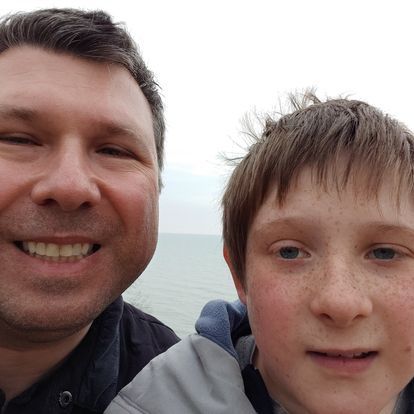
This is part of a special series of interviews within the SFN Dad To Dad Podcasts known as the SFN Mastermind Group Monday Podcasts. Each Monday host David Hirsch interviews one of the SFN Mastermind Group dads on the impact the mastermind group has had on him and the wellbeing of his family.
This Monday’s guest is John Fela of Lyons, IL who works in Chicago for Joni & Friends, the global Christian disability ministry. John is also the father of a teenage son with Autism.
John and his ex-wife, Elizabeth, were married for 15 years and are the proud parents of Christopher (16), who is Autistic and non-verbal. The couple divorced about five years ago. More recently, John is happily married to Faith.
John was part of the original SFN Dad To Dad Mastermind Group community. He was previously featured in episode #65 of the SFN Dad To Dad Podcast in August 2019.
It’s an uplifting conversation about perseverance, overcoming life’s challenges and advocacy, all on this episode of the SFN Dad to Dad Podcast.
Show Notes –
Phone – (847) 722-5273
Email – jfelageller74@gmail.com
LinkedIn – https://www.linkedin.com/in/john-fela-0b839920/
SFN Dad To Dad Podcast #65 – https://www.spreaker.com/episode/dad-to-dad-65-john-felageller-of-highwood-il-father-of-a-son-with-autism-school-teacher-blogger-and-writer–18772596
Favorite Mastermind Group Books –
The Voice Of Victory, by Wayne Messmer – https://tinyurl.com/5n8uhku6
The Secrets of the Bulletproof Spirit, by Azim Khamisa –https://tinyurl.com/5bztw4cm
About the SFN Mastermind Group –
WHAT- SFN Mastermind Group dads meet weekly by Zoom for 75 minutes. Each meeting:
- starts with a round of wins from the past week,
- includes a discussion of the current book (6 per year) being reviewed,
- has two Dad-In-The-Middle sessions for dads to share a challenge, and
- ends with a recap and look at the week ahead.
WHO – SFN Mastermind Group Dads are those:
- seeking meaningful friendships with like-minded dads,
- willing to invest their time and make a financial commitment,
- looking for a safe place to be open and authentic, and
- who realize seeking advice is a strength, not a weakness.
WHY – SFN Mastermind Group Dads benefit by:
- realizing they are NOT alone,
- having better relationships with their spouse,
- developing improved understandings of their child(ren)
- tapping into the experience and wisdom of others,
- getting weekly encouragement from like-minded dads, and
- creating a pathway to become the best version of themselves
21st Century Dads Foundation is looking to provide 100 special needs fathers with the opportunity to be part of the class of 2024 Mastermind Group.
Curious to learn more?
Are you looking to meet like-minded dads?
Do you feel like something is missing?
SFM Mastermind Group FAQs – https://21stcenturydads.org/sfn-mastermind-group/
Schedule A Call – https://21stcenturydads.org/sfn-mastermind-group-inquiry-form/
Transcript:
John Fela: You can take whatever tragedy or trauma you’ve experienced and turn it into purpose. And most of these guys, if not all of them, have done that in a variety of ways. So the stories and I think just the experience of being with these guys on a weekly basis is really phenomenal.
David Hirsch: Hi, I’m David Hirsch, host of the Special Fathers Network Dad to Dad Podcast. Now, with more than 300 weekly episodes every Friday since 2018, we’ve been shining a bright light on the positive and uplifting aspects of raising children with disabilities and inspiring dads, stepdads, granddads and father figures to be more present physically, emotionally and spiritually. Welcome to the new Special Fathers Network Mastermind Group Monday Podcast. I’ll be interviewing Mastermind Group dads who will reflect on the positive impact the Mastermind Group experience has had on them and the well-being of their families. As a reminder, the SFN Mastermind Group experience is the most comprehensive program the 21st Century Dads foundation offers. Dads raising children with special needs meet virtually on a weekly basis and form meaningful relationships while sharing weekly wins, discussing books, and sharing heartfelt challenges. One of the highlights of the year is attending an in-person weekend retreat. We’re launching 10 new SFN mastermind groups in 2024 with 10 dads per group. That means we’re only looking for 10 like-minded dads in each community. If you’re a dad raising a child with special needs, we hope you’ll join a local SFN Mastermind group and make the investment to become the best version of yourself. For more information, please see the show notes or simply go to 21stCenturyDads.org. Happy listening.
David Hirsch: I’m thrilled to be talking today with my friend John Fela of Lyons, Illinois, who works for Joni and Friends, the global Christian disability ministry. John is also the father of a son with autism. John, thank you for taking the time to do a Mastermind Group Monday interview for the Special Fathers Network.
John Fela: Absolutely. David, great to be with you again.
David Hirsch: You and your wife Faith been married for less than a year. You and your former wife Elizabeth were married for about a decade and are the proud parents of son Christopher, 16, who has autism and is nonverbal. You’ve also been involved with the Special Fathers Network for more than five years. Your Special Fathers Network data dad podcast episode 65 aired in August 2019. You’re one of the first members of the Wednesday night Mastermind Group and even though you’re not currently involved with the group, because life is taking in some different directions, we’re thrilled to have you join us today. A lot has changed since we recorded your initial podcast interview over five years ago. Please provide a little bit of an update.
John Fela: Absolutely. Well, I think I should begin by clarifying that little confusion with the last name, because if you look up podcast number 65, it’ll still be under John Felageller. And I can assure you I’m the same person, but the name is different because Felageller was my married name from my previous marriage. Again, as you referenced to my wife Elizabeth. We were married for, about 15 years, divorced about five years ago. Of course, I’m now very newly remarried, but my original last name was just plain old Fela F E L A. And so now that I am newly married, we’ve decided to go back to that name. So it’s my new old name, but I’m still the same person. And, as you also pointed out there, newly married to my wife Faith, who actually is a longtime volunteer with Joni and friends with our organization. So she’s actually served for many years, technically more involved longer than I have been, to be quite honest. And my son Christopher, who is 16, with autism and is non verbal, is currently living at a residential and therapeutic day school facility called Heart Spring, which is located in Wichita, Kansas. And we moved him there actually just about a month ago due to just some, choices his mom and I had to make concerning his educational needs and behavioral needs that seemed to be the right fit at this time. So that is where he is. It’s a wonderful place. And yes, I am continuing to be dad just at long distance right now.
David Hirsch: Well, thank you for the clarification, John. What attracted you to get involved with the Special Fathers Network way back when?
John Fela: Well, that’s a long story. I’ll try to keep as short as possible. But, you and I were originally introduced by another podcast dad, Adam Levy, and, his lovely wife Lauren of the NORA Project that my son Christopher had been involved with. And, I recall we had met all the way back during, during the time of the dinosaurs in 2018, when Special Fathers Network was still just kind of building momentum. And I remember being invited to a very early, board meeting and, being able to meet you and some of the other board members, including our longtime friend Brian Rubin. And, just getting an idea of the vision and what it was you were trying to do really based on the just great volume of work that you’d already done in the fatherhood
00:05:00
John Fela: community, locally and around the country. And now Special Fathers Network was the next evolution of that. So, I remember being involved from that point on. I certainly remember being involved with every yearly conference that we’ve done beginning in 2019, which, you know. Oh, by the way, for some of you newer folks, that first conference was an in person one before the days of COVID I recall vividly. it was only about five minutes from where I lived in Northbrook at the time. Guess whose idea it was to host it there? Just saying. But, you know, I’ve been excited to be a part of the yearly conference, helping also with some of the leadership and coordinating for that as well. And then, of course, moving on, into the mastermind group and the growth of that.
David Hirsch: Yeah, well, thanks for that brief flyby. It seems like it was just yesterday that we did that first in person conference in Northbrook in 2019. One of the reasons it was so special is that Wayne Mesmer was able to join us and he actually sang the national anthem to this little group of about 25 or 30 guys, which was really special experience. So, speaking of the mastermind group, what did you understand about that before you joined?
John Fela: Well, not a whole lot. My understanding was really that it’s a concept that we’ve kind of inherited from the corporate leadership world, and it’s a model of a support group that allows guys to connect in a very structured way, but also in a way that I think you get a lot of meaning out of, and you get a lot of value out of going to use those terms. And so, having been in many men’s groups, fatherhood groups, some that I’ve done myself and some that I’ve just belonged to over the years, I’m first of all interested in meeting with guys, period, especially dads and special needs dads. And I was very interested in this model to see exactly what would that really look like to put dads together in this fashion and to see what would really be the benefit of that. So while I didn’t have a lot of free firsthand experience of it, I said, you know, I’m very intrigued as to how this model is going to apply to working specifically with our population and see what that looks like.
David Hirsch: Yeah, well, thank you. So do you remember what it was like attending those first couple meetings where nobody had any idea what was going on?
John Fela: Well, I do remember, first of all, that, there were faces that were vaguely familiar, which I will say, having been to all of the virtual conferences, you know, there were guys in. And I think from the Chicago area there might have Been myself and might have been two other guys. I’m not sure if it was one or two others, but, you know, so there were some guys that I knew and some guys that I had only seen on a video screen kind of a thing. And, and a lot of it, I think, was guys just kind of learning the, the sandbox, as it were. You know, it’s like, what, you know, how are we supposed to operate here? And. And I think, if the Mastermind format has a benefit, it’s that it does provide a structure, whereas it’s not just a bunch of guys being as uncomfortable as they can be, just being thrown all together, which I’m sure we’ve all had of that. And. Okay, now talk. Well, you first. As opposed to, we have a format. We’re going to lean into that format and structure, and we’re going to allow for a space for everybody to share in a controlled way and in a way that’s going to make guys feel safe emotionally, but also let them know that they have a voice. And when they’re kind of, you know, get to use the analogy when it’s their turn at bat, then, you know, everybody is going to kind of be there to, you know, put their listening ears on and really, you know, absorb what’s going on for them kind of a thing. So in that way, it actually kind of helps some of those early growing pains of not knowing guys or maybe not feeling as comfortable.
David Hirsch: I think your point is a good one, that the structure allows a lot of, interaction and flexibility, but it’s something that a lot of, groups, Dad’s groups, lack. They just get guys together and it’s rather informal, not better or worse. But I think that the staying power for our group seems to be the structure. Right? There’s sort, of method to the madness, if you will. So what did attending those weekly Mastermind group meetings mean to you?
John Fela: Well, I think there were a couple things I took from it. One is that, and I’m going to say this as an overall comment of the Mastermind group in total, which is that Mastermind is really a commitment, right? It is not something that you just kind of show up for and say, well, maybe I’ll come this week, maybe I’ll come this month. If I don’t, my life’s not going to change, you know, either way. Masterminds a commitment. So, one, it was knowing that every Wednesday night I was with those guys and, you know, I was looking forward to seeing those guys if there was something on my heart I knew I could share it with those guys or vice versa, they could share with me. And if I had, you know, something to, an opinion to give or not kind of a thing, but, you know, that we would be there for each other kind of a thing. And so it provided that structure. Again, it was something to look forward to. It was something that was just on the calendar and it was just your night for that. And also too,
00:10:00
John Fela: it was also the relationships that extended out of goes far beyond just those two hours that you spend on a Wednesday. It’s the relationships that build on after the call’s over. It’s the text chains and the other interactions you have with guys throughout the week and over the course of weeks and months, quite honestly. So the Wednesday is kind of, you know, okay, well, we can all kind of get back together and huddle up. And to be fair, some guys, including myself, couldn’t be there all the time. But nonetheless, you still have that to look forward to. Building on relationships that then will extend beyond just that, you know, that timeframe.
David Hirsch: So we read books, six books a year, about one every two months. Do you remember way back when, because it’s been a couple years, a favorite book or books that, you remember reviewing?
John Fela: Yeah, I’ve actually considered this question a little bit before doing the interview here and a couple of books that really stood out to me and I think rightfully so. And just to highlight again, you know, as part of this mastermind group, yes, we read books about disability, yes, we read books by dads, but we read books that also have value in terms of leadership or one of my favorite topics that I’m always wrestling with, which is forgiveness because, you know, we’re always wrestling with either forgiving ourselves as parents for something we didn’t do or forgiving others that have hurt us. And again, for myself, as, you know, a remarried dad who was a single dad for several years and going through a divorce, you know, you wrestle with a lot of these, you know, issues of forgiveness and type of things. So a couple of the books that were most powerful to me were books that really highlight that forgiveness, which of course is our friend Wayne Messmer’s book, Voice of Victory. I guess I shouldn’t say there isn’t a more powerful example of forgiveness because the other guy’s book that I was going to highlight, we read Secrets of a Bulletproof Spirit by Azim. That was such a powerful book too, because then you’re talking about someone who actually did lose his son. Right. And so Wade almost lost his voice. Azim did lose his son. Talk about forgiveness on a level to which not only you can forgive that person, but you actually embrace them and you let them know not only are they forgiven, but then there’s a relationship that even develops after the tragedy has been perpetrated to you. Right. So those were very powerful examples of that. That also, I think, gives a very. Just, a sense of wholeness in the Mastermind group, because again, you’re not just going to read another book about disability. You’re going to read books that are going to take you through life from some different perspectives to really address all of those things that we’re wrestling with. Even though it might not be the most obvious thing, there’s still things that we’re all deal with on some level.
David Hirsch: Yeah. Very well spoken. Thank you. At the heart, of the Mastermind Group experience is what we call dad in the Middle, where two dads per meeting share a challenge they’re wrestling with. What are those dad in the middle segments meant to you and why?
John Fela: Well, again, going back to this idea of the structure of the group, the nice thing about the dad in the middle is that, you know, we, we always do a recap at the beginning of each group. We always kind of want to know what’s, you know, up top or in front, however you want to put it for. For guys kind of a thing or your wins. But at same time, you also want a space where if you have something that you’ve really been dealing with for an extended period, something that’s very heavy, that’s weighing on you, and something that you really want guys to really sit with and kind of help you process, that’s the value of that time because it really allows you to just, you know, kind of vent, you know, there’s no better way to put it. And again, you know, the idea of the group is to be supportive, to provide, you know, meaningful feedback, resources, a direction to go. And again, sometimes it could just be as simple as, you know, we’re here for you, or I’m going to text you later, I’m going to call you tomorrow. That’s great, too. But the man in the middle provides that space to know, okay, listen, I really need these guys to hear me. So, you know, now that I know that it’ll be this week or next week again, not that maybe you can’t reach out to guys before that or whatever, but, you know, you have that dedicated time space, and within that structure, then, you know, you can really, work through some, some things. Again, with, with guys that, you know, will be able to relate to you.
David Hirsch: Yeah, well spoken. And, it’s not in lieu of therapy, but it sort of has some of the aspects that, therapy might include. Right. Where you’re able to get things off your chest. Right. And, what’s different about it, I think, is that, a therapist may understand from a professional perspective what you’re going through, but might not be able to relate from a firsthand, ah, experience what you’re going through. And that’s what these dads all have to offer, is that they’ve been there and done that. Right. They’re in the trenches. Right. So it, really is a dad to dad type of an experience. So regarding the financial commitment, the, Special Fathers Network mastermind group, dads invest anywhere
00:15:00
from $50 to $200 per month according to their financial wherewithal. What would you say to a dad who’s interested in the mastermind group but, concerned about the, financial commitment?
John Fela: Again, going back once more to a previous point, which is that mastermind group is a commitment. Right. And the thing about a commitment is that, you know, again, it’s not something you just show up for once and, I’ll see you again in six months kind of a thing. I understand how challenging our times are. Certainly as a father of a child with a disability, having been a single dad, remarried, you know, what, whatever phase of life you want to put me, and I’ve been there, done that, so another financial commitment is not what you want.
David Hirsch: And changing jobs in that mix as well.
John Fela: And. Yeah, right, right, yes. And going, going from one career path to another. But, you know, the, the point I would make to anybody considering this is that again, it’s a commitment. Now, does that mean that you need to break your budget or go beyond your, your margins in order to make it work? No, but understand that, you know, that kind of is, you know, what you are committing to. You’re committing to these guys, you’re committing to this group. And likewise, it’s something that, you know, you want to show that by also, you know, helping to support an organization that really reaches out to dads in a very unique and special way. Now, it might not be all of us to give a certain amount, it might not be all of us to give at a certain season of life. But again, that’s where, you know, I encourage you to talk to David, reach out to him, you know, see what’s possible. You know, this, this is not any kind of a conversation of, you know, if you don’t pay, we don’t want you, you know, or you don’t have value. It’s, we’re going to try to make it work. But also too, the fact is, is that, you know, there, there are a lot of dad groups out there. There are a lot of support groups or even other special need dad groups out there. None are exactly like this. And I think because of the uniqueness of it and again, the structure that it provides. Yes, that is an expectation, but it shouldn’t be an expectation. That should keep you from exploring it or at the very least having a conversation about the value it might provide for you.
David Hirsch: Yeah, well, thank you for the insights. So I’m thinking about advice and I’m wondering what advice you can share with a dad who might be on the fence about joining the mastermind group.
John Fela: Well, it is a very unique experience. We have veteran dads like our friend Ancient Rich. Shout out to Ancient Rich. Hi, Ancient Rich. Hopefully you hear that at some point. but we have dads who are very experienced and we have dads who are newer on the road. But you know, I think it’s. It’s like that analogy of the sports team. In whatever your favorite sport is, the best teams are usually the right mix of veterans and young guys and you get that right mix together and you do some special things. So that’s the value in there as well as, you know. Oh, by the way, you know, I think what’s great about these groups is that you get guys who not only are living the life you’re living for the most part, but, you know, they are also showing how you can take whatever tragedy or trauma you’ve experienced and turn it into purpose. And most of these guys, if not all of them, have done that in a variety of ways. So the stories and I think just the experience of being with these guys on a weekly basis is really phenomenal. So you’ll get a lot out of that. You will get a lot out of the content of the book material, which. Oh, by the way, we should say that those authors always come on for a Q and A when we’re done reading the book. It’s not every group. You could say you get to do a Q&A with a Temple Grandin or a Wayne Messmer or, you know, any of these, you know, just phenomenal leaders or, you know, again, people who are really doing incredible things. just check it out, you know, I mean, it doesn’t hurt to check it out. But m understand that it is a very, very Unique concept. And I think in terms of the quality of the guys, you’re probably not going to find that you know much anywhere else.
David Hirsch: So very, insightful. Thank you. Is there anything else you’d like to say before we wrap up?
John Fela: Well, I would just say again that if you don’t have support of any kind, that you need to get yourself some support. As I always famously say, at least for myself, one of my taglines is always, you know, living the special needs life is a 1A, 1B conversation. 1A for me is my faith, but 1B is community. You may not be a person of faith, but you must have community. You must have support. You must have other guys that are walking this road with you. And, oh, by the way, if, if you just want to start with one guy, hey, the Special Fathers Network has a met program. Did you know about that? Well, you can find out all about that on a different podcast, I’m sure, but I’m just going to focus on Mastermind here and just say that if you like the group concept and you like the group model, please give this a try. Because again, it is unique, it is different, but if you don’t have anything, it won’t hurt you to at least try it out with a bunch of guys who
00:20:00
John Fela: really have shown up. They’ve shown up in my life, they shown up in the lives of a lot of the other guys in the group. And it’s worth your time, and really, it’s worth your family’s time if you’d at least just give it, give it a try, give it a go. Try it once. Even if you think David might, you know, be trying to give you a sales pitch because he’s a salesman, by the way, but no big deal. The point here is that there are other guys who can also show you the value of this group, and they can show it to you in terms of what they’ve gotten out of it on a personal basis. So give it a try, but don’t do life alone.
David Hirsch: Yeah, well, I think your message about, we’re better together is a really powerful one. If somebody wants to contact you, what’s the best way to do so John?
John Fela: Well, they can reach out to me on social media and don’t let again the last name fool you, because you can still find me on social media either by the old last name or the new one. So I’m all over social media. Put me into the Google machine, as I say, you know, Facebook, Instagram, Twitter, etc. I do have a website, which is still JohnFelageller.com although I did just purchase the domain rights for the new name of JohnFela.com so that’ll change over eventually. But you can still find me at JohnFelageller.com Otherwise all over, the Interweb and the social media.
David Hirsch: I’ll be sure to include that in the show notes, so it’ll make it as easy as possible for somebody to reach you. John, thank you for your time and many insights. As a reminder, John is just one of the dads who’s agreed to be a Special Fathers Network Mentor father and who has been involved with the Special Fathers Network Mastermind Group. For more information on, the Special Fathers Network and the Mastermind Group, please go to 21stCenturyDads.org. Additional links can also be found in the show notes. John, thanks again.
John Fela: Thank you, David.
00:21:39