

309 – Jon Ghahate of Placitas, NM A Pueblo Indian, Vietnam Era Veteran, Father To A Blind Child & Former Educator
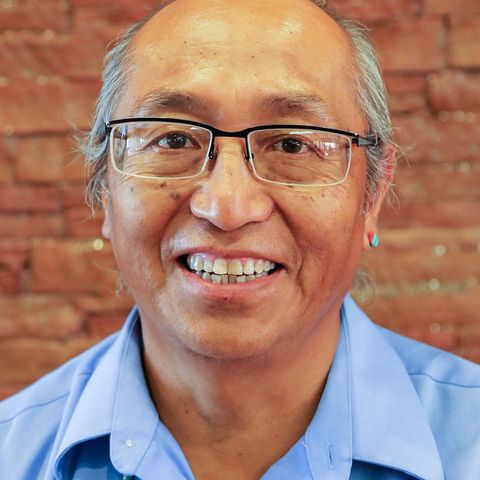
This week’s guest is Jon Ghahate of Placitas, NM a Native American and a member of the Pueblos of Laguna and Zuni and of the Badger and Turkey clans. Jon is a Vietnam-era veteran, a former educator, healthcare practitioner, journalist and father of three, including one who is blind.
While in the U.S. Army Jon served as a physician’s assistant. He went on to be a public middle school and high school math and science educator as well as athletic coach for the public school system.
He has also been a journalist for a national radio talk program and more recently an educator at the Crow Canyon Archeological Center in Colorado where he works with students and patrons to develop accurate, credible, and respectful narratives of Southwest cultures.
Jon has a lot to say about being a Native American and is a wealth of knowledge about Native American culture.
That’s all on this episode of the SFN Dad to Dad podcast.
Show Notes –
Email – badger_pro@msn.com
LinkedIn – https://www.linkedin.com/in/jon-ghahate-13a5a2250/
Website – https://crowcanyon.org/people/ghahate-jon/
YouTube – 1680 Pueblo Revolt – https://www.youtube.com/watch?v=dPOEKN5Mb4Q
Transcript:
Tom Couch: [00:00:00] Special thanks to Horizon Therapeutics for sponsoring the Special Fathers Network Dad to Dad Podcast, working tirelessly to research, develop, and bring forward medicines for people living with rare and rheumatic diseases. Discover more about Horizon Therapeutics mission at HorizonTherapeutics.com.
Jon Ghatate: In Illinois or Native Americans in Florida, you’re going to see these Seminoles or Muskogees or whatever, but that’s not the name in their language that they will call themselves unless we speak English. If I say I come from the Pueblos of Laguna and Zuni those names are given by the Spanish, but we already have names that we identify in the languages we speak.
David Hirsch: Are you telling me that the Illinois were not the names that you would refer to yourself as the… I know there’s no Illinois, Illini. That was not the original name. That’s what you’re saying. Okay. This is going to be for the Native American 102 class or the Native American 201 class.
Jon Ghatate: [laughing] Sign up for credit.
Tom Couch: That’s an excerpt from today’s conversation between special father [00:01:00] Jon Ghahate and host David Hirsch. Jon is a Native American and lifelong resident of New Mexico. He’s from the Pueblos of Laguna and Zuni and is a member of the Turkey and Badger clans. He’s also an Army veteran, a teacher, a coach, a journalist, and educator at the Crow Canyon Archaeological Center in Colorado. He has three children, including Jennifer, 37, who is sight-impaired. Jon has a lot to say about the Native American community, and we’ll hear his thoughts on this week’s Special Fathers Network Dad to Dad Podcast.
Tom Couch: Now say hello to the founder of the Special Fathers Network and host of the Dad to Dad Podcast, David Hirsch.
David Hirsch: Hi, and thanks for listening to the Dad to Dad Podcast, fathers mentoring fathers of children with special needs, presented by the Special Fathers Network.
Tom Couch: The Special Fathers Network is a dad to dad mentoring program for fathers raising children with special needs. Through our personalized matching process, new fathers with special needs children connect with mentor fathers in a similar [00:02:00] situation. It’s a great way for dads to support dads. To find out more, go to 21stCenturyDads.org.
David Hirsch: And if you’re a dad looking for help, or would like to offer help, we’d be honored to have you join our closed Facebook group. Please go to Facebook.com, groups, and search “dad to dad.”
Tom Couch: So let’s hear this illuminating conversation between Jon Ghahate and David Hirsch.
David Hirsch: I’m thrilled to be talking today with Jon Ghahate of Placitas, New Mexico. Jon is a Native American and a member of the Pueblo of Laguna and Zuni of the Badger and Turkey clans. Jon is a Vietnam- era veteran, a former educator, healthcare practitioner, journalist, and father. Jon and I met in 1993 and were two of 50 individuals selected into Group 13, class of the W.K. Kellogg Foundation National Fellowship Program. Jon, thank you for taking the time to do a podcast interview for the Special Fathers Network.
Jon Ghatate: First of all, thank you very much for the invitation and letting me contribute to what you [00:03:00] do, David, because I know that what you have done and what I’ve heard, the things you’ve contributed to your community has been very helpful, especially to fathers who certainly oftentimes aren’t necessarily prepared for taking on the role of a father.
David Hirsch: Yeah thank you. You and your wife, Erica, have been married for 10 years and are the proud parents of three children: Jennifer, 37; Joni, 35; and Ian, 31. Let’s start with some background. Where did you grow up? Tell me something about your family.
Jon Ghatate: Sure. Just for clarification, these are my children, not her children, but we are now pretty much a family now, in a sense, I guess you’d say.
Jon Ghatate: I grew up on a Native American reservation in the state of New Mexico. My mother is from one distinct tribal group, and my father is from another distinct tribal group. They speak different languages. However, at the time my parents had us as a family certainly they spoke English, but they both spoke their own individual languages. So I speak both languages, although not completely fluent.
Jon Ghatate: [00:04:00] When I was growing up, I lived with my grandmother, who at the time was going on 90 years of age. My mother felt that she needed help, so she asked me or directed me to live with my grandmother different or separate from the rest of my siblings. And I lived with my grandmother until I was ready to go to high school. At the time, my grandmother had her own home. It was a stone and mud structure. We didn’t have indoor plumbing at the time. We had water source and electricity, but majority of the roads in our community were still not yet paved.
Jon Ghatate: I started school in a single one-room school, much like you would see in Little House on the Prairie, where all the different grades and students would gather in one big room. Our tribe, our Native American community, did not build or establish a large elementary school until I was in the third grade. And at that time, we were [00:05:00] all then bused to one big school from all the different smaller communities on our tribal reservation.
Jon Ghatate: At some point in time, my mother felt that perhaps myself and my older siblings would benefit more from going to a boarding school. I attended a boarding school off my reservation in a community in northern New Mexico called Española. And from there I had a greater experience beyond just a small environment of my Native American community. And basically, that’s allowed me to… and contribute to the fact that there’s always unique opportunities outside and we just need to be mindful of them and then sometimes take those chances to exercise that interest and expectation.
David Hirsch: Yeah, thank you for sharing. If I can paraphrase you lived with your grandmother when you were younger. The school that you went to initially was a single room school. And then you ended up going to a boarding school which provided you with some broader understanding of what’s going on in the bigger world. That’s what I think I heard you say. [00:06:00]
Jon Ghatate: Certainly, and greater opportunity. Much more greater opportunity, and certainly the influence of others who had no idea of what it meant to be on an Indian reservation. And as a result of that, they could certainly instill and contribute to an understanding of a greater world.
David Hirsch: So out of curiosity, what did your dad do for a living?
Jon Ghatate: My father served in the military. He’s an army veteran during the second World War. And a unique thing about that at the time my parents were born, they were born before 1924. So at the time my parents were born, they were not US citizens yet they both served the US United States government: my father in the United States military in World War II and my mother in public health service as a registered nurse for the Indian Health Service.
Jon Ghatate: Perhaps maybe when my father returned back from World War II, he had post-traumatic stress syndrome and was unable to really fully [00:07:00] contribute to our family life. And as a result, his alcoholism got the best of him. And as a result, my mother and he separated. And my mom was a single mom until she no longer was with us, and my mother passed away when she was 92. But my father had a number of vocational kind of jobs, nothing really professional. I don’t think he ever had the opportunity to go to college, but my mother did.
David Hirsch: Yeah. Thank you for sharing. It is remarkable, just based on the time and the circumstance that they both served the country, right? Your dad in the military and you said your mom was a RN in the Indian Health Services, even though they weren’t American citizens at the time. And did they get their citizenship or not?
Jon Ghatate: Native Americans were not granted US citizenship until 1924. At the time, even though they were granted US citizenship, it really wasn’t until 1948 that Native Americans were even granted full voting rights, much like our [00:08:00] African American fellow citizens. Even though they were US citizens, even the sixties, there were always either Jim Crow laws or little impediments into preventing them from fully exercising the right to vote. The same thing existed for Native Americans that even though they were granted US citizenship in 1924, there were just laws or rules or regulations that didn’t encourage them or even promote them to contribute to their voting rights until 1948 when actually a marine veteran from, actually was a Pueblo man from the Pueblo of Isleta here in New Mexico. Once he returned back home, he went to his community, Isleta, the Pueblo of Isleta, and he went to the Bernalillo County Clerk’s Office, which is where people registered to vote at the time. And because he was not living in the metropolitan city of what we call Albuquerque, and he lived on the reservation, there was a law at the time that did not promote or allow Native [00:09:00] Americans to vote unless they lived on the reservation and also if they didn’t pay taxes.
Jon Ghatate: The thing about that is that Native Americans, if they were employed in any capacity – whether it was public, private, or government – they have always paid taxes, even before they were US citizens. And so eventually this gentleman, whose name was Miguel Trujillo, went to the courts and eventually by 1948, Native Americans were given that full enfranchment to vote, but there were always still little impediments. Even with for some of us several years ago, when the Supreme Court did some changes in the Voting Rights Act. Not everybody can vote because there’s always these little glitches and impediments to prevent others from voting. So that’s a continued struggle that not just Native Americans, but many of our other fellow citizens encounter simply because there are those who have a narrative of trying to dissuade others from voting or [00:10:00] participating in voting.
David Hirsch: Yeah thanks for sharing. It’s another sort of insight into the country’s history and maybe not well understood or well known as well. So when you think about your dad, I’m wondering are there any important takeaways, lessons learned?
Jon Ghatate: Actually to tell the truth, before my dad, what’s equally important is that my grandfather, my mother’s father, was a student who was taken to the first boarding schools that were established by the federal government. The first boarding school was established in Carlisle, Pennsylvania in 1878, and from 1878 until 1960, those Indian schools that were established by the federal government was an effort or way to culturally exterminate Native American culture, to teach them certainly to read and write, and then certainly to prevent them from learning their language.
Jon Ghatate: However, for the many Native Americans who did survive that structure, they [00:11:00] then worked and utilized the tools that they were forced to accept, which was reading and writing, learning how to become a citizen, although they were not US citizens. Also, eventually going to schools of college, getting their credentials to become nurses, doctors, lawyers, politicians, that they were eventually able to move the needs of the Native American communities into the political realm.
Jon Ghatate: So my grandfather I can say I’m a descendant of the Indian boarding schools and that’s really the predominant influence that I get because the fact that he survived that I get to be here. And certainly I can say to a degree to my father. But from my father I think I would simply look at what his life consisted of. And if anyone has a relative who’s gone to war…
Jon Ghatate: We’ve lost the last US veteran who survived the Pearl Harbor attack this past week. We have surviving veterans from the Korean [00:12:00] War. We have surviving veterans from the Vietnam War of which I’m a Vietnam-era veteran. And then certainly we have many veterans who are from the Gulf War and other. Anyone whose relatives who have ever gone to combat, having to literally fear the next breath you take may be your last, I guess perhaps maybe I can learn from that and see that even though he survived combat it created a great many different issues for him. And so I can perhaps maybe realize that when I come up against adversities, it’s not like being in combat.
David Hirsch: Yeah. Thanks for sharing. And what I think of when I think of the World War II veteran, individuals like your parents, is that they made a lot of sacrifices, things that most people today would not be comfortable with or consider. And there is a lot to be learned from the way they conducted themselves. And like you said, it’s not without some fallout, without some impact to the [00:13:00] rest of their lives. It wasn’t just the combat experience themselves, but it was the experiences they had and how it impacted them. And I think you’d mentioned your dad had PTSD. Unfortunately, alcohol was maybe how he self-medicated himself to deal with some of the demons, if I can call it that, that developed as a result of his wartime experiences.
Jon Ghatate: No, that’s a good term to use because they can be detrimental to one’s mental health. Over the years, the government through the Veterans Administration has certainly tried to identify those. And even now the Veterans Administration has policies for those veterans who were in the Gulf War that were exposed to toxic fumes and other substances. So it’s always a continued learning curve. But back then, certainly probably after Korea, even World War II, it was simply labeled as battle fatigue, not really seen as a mental health issue.
Jon Ghatate: But certainly [00:14:00] today hopefully we have the opportunity for many of our veterans who have seen combat to realize that it’s a jolt to the brain not just physically, but also mentally that there should be and can be ways on how we can treat and help veterans transition back into as normal life as possible.
David Hirsch: Yeah. Thanks for sharing. So any other family influencers, any other relatives that played an influential role in your life from a heritage standpoint other than your dad and your maternal grandfather.
Jon Ghatate: First of all, let me preface that by saying we as a culture, as a Pueblo culture, and not all Native American cultures are the same, but most Native American cultures are that they are matrilineal-centered. That means that we identify who we are and what gives us our sense of place is really the women and the mothers in our community. And in the process of having that construct of identifying who I am as a person, [00:15:00] it comes by knowing that it’s without the women and the mothers in our communities, their responsibilities and their contributions to our societies, that we find that centering, that definition of who I am.
Jon Ghatate: And when we speak our languages and introduce ourselves to one another or others, we simply begin by greeting others. We say you are relatives in a sense because in a sense, we as human beings are all related. We all have the same DNA. We can share our organs if we need to. We can certainly donate our blood and give it to someone else that we don’t have any idea who’s going to be receiving it. And then also, when we consider who we are as a person, it’s only through my mother that I get to be, and through our clan systems. That’s why as a matrilineal society, I introduce myself, I say who my mother is, I say who my grandmother is, and I say who the clan systems that I go through. And it’s through that process then perhaps maybe someone who understands what I’m saying might say, oh, I know who you [00:16:00] are. I can understand who you are because I know who your mom is, or I know who your grandmother is, or maybe we might know the clan, same clan systems. And so certainly we have fathers that are important, but it’s really the construct of a matrilineal society that our culture has always been centered on, and then we continue to do that today. Even certainly in a modern contemporary world, where we can still go outside of our communities and not always be fully participants in our culture, we still know who we are simply because of the women and the mothers in our communities.
David Hirsch: Thanks for sharing. And I think I remember you’d come from the Badger and the Turkey clan. So was one your dad and one your mom?
Jon Ghatate: Yes. Science helps us understand human development. There are terms that we use. One very important term that science helps us understand who we are as homosapiens, all of us on this planet now, is that obviously there’s a mom and a dad, and that there are contributions of what makes up this union, this thing [00:17:00] called a family. Certainly we don’t know at what point this construct of marriage becomes part of any society. But science helps us understand that at some point in time, humans began to develop relationships. These two individuals, a male and a female, they can have children, they can have families. That’s the universal structure. But there have always been, certainly, tangential components to this union that maybe you have two women or two men who have those same desires of a family. Obviously they can’t have children between those two individuals but humans have always had ways to adapt to that. Maybe they adopt or they take uh, children.
Jon Ghatate: And so the universal unit of a man and woman is this construct that nature has provided. Even a species have to have a male component and a female component for hybridization and the propagation of a species. You can’t have just two of the same sex, [00:18:00] it doesn’t work out as nature hasn’t provided that kind of opportunity. But that doesn’t mean that this union of two people of the same sex cannot develop this intimate internal relationship because humans have always been humans.
Jon Ghatate: And that mentality that science gives a term to is called cognizance. And cognizance basically is a term that science uses to say human beings begin to have a specific idea of who they were as a human being. If you’ve ever watched a cat or a dog or an animal look at a mirror, they might interpret it as another animal. But we as human beings, we say it’s not another human being. Or we might look at the reflection on water. We don’t think it’s another human being. We know it’s us. That’s what cognizance means. We can’t simply attribute a reflection of ourself as another person. And so at some point, human beings develop these constructs that help them develop a certain [00:19:00] relationship with another individual intimate enough to have children.
Jon Ghatate: And then also to understand a very important thing that we as human beings have, which is basically this existential construct, which is what happens when people die, when someone no longer is breathing and moving about like everybody else does, they’re laying there as a piece of a vessel. At some point in time, instead of just letting that person in their community lay there and rot and stink and smell or let animals come and chomp on them, human beings develop different ideas like burying them or cremating them or mummifying them or whatever their cultural concepts of how to deal with this thing called death. That’s what human beings develop. Ideas about the afterlife, spiritual constructs, the soul, the spirit, or if you’re a Star Wars fan, maybe the Force, whatever it is that humans have dealt with when dealing with the passing of one’s family members or community members. That’s what human beings have always done. We [00:20:00] continue to do it today.
Jon Ghatate: So that’s what, it’s why we as a matrilineal society still hold on to those constructs. What does it mean to be a human being and where do I belong in this greater thing we call a cosmos?
David Hirsch: Yeah, thanks for sharing. And how does that tie back into either being part of the Badger or the Turkey clan?
Jon Ghatate: Probably long ago, human beings found that there was better potential for existence with development of relationships. Maybe like long ago, people used to marry off one of their children to someone else, and so now you’ve developed this relationship of if I need some extra help, since you were married to my son or my daughter, maybe I can rely on you. I built an alliance. We can have these ideas. These are theories. We don’t know for sure, but human beings have been doing that for eons. So you built this dependency and/or this camaraderie, this legacy of how I’m going to [00:21:00] interact with other groups of people other than those in my immediate community.
Jon Ghatate: So for us as a society, as a Native American society, the clan systems help us differentiate within our community our responsibilities, what we do and how we participate. And so my mother’s clan is Turkey and my father’s clan is Badger. So by letting others know, especially when it comes to those who know about the different clan systems of the Pueblo communities, they can say, oh, I know where you come from. Or I can… Maybe you’re my clan relative. I can perhaps rely on you if I need some help at some point in time. Or that connection of how we share. Oh, do you remember your grandma? She was my grandmother a long time ago. Or we come from this place. So when we say our clan systems, it gives us a sense of connectability to others outside of just our immediate family.
David Hirsch: Yeah. Thanks for sharing. It’s a little bit more clear to me now. So let’s talk a little bit about your career background. I know that you were a physician’s assistant with [00:22:00] a focus on orthopedic surgery. And you did mention earlier that you’re a Vietnam-era physician. And I was wondering, was that your first real work experience, or was there some work that you were doing before that?
Jon Ghatate: When you asked earlier about influences, my mother was a registered nurse. And from the earliest times, people always relied on my mother, certainly in the clinic that she worked in. But when the clinic was closed, people would come to her house and ask for her advice. Or they’d say, my mother or my relative isn’t feeling good. What would you say? What would you do before the clinic is open? There were always people coming to my mom’s house because she was the one who spoke the language to some of those who didn’t speak English. But she was always there to help. So I think that collective concern for the community was embedded in from as early as I can remember.
Jon Ghatate: So I pretty much chose medicine. I knew that medicine was going to be my first choice. And in high school, sometimes you can get a job during high school. But what I did is I volunteered. [00:23:00] They used to be called candy stripers, but basically you were just a nurse’s aide. And I volunteered to do that when I was in high school from sophomores, juniors, and senior years. I did that throughout the entire year. And when I graduated from high school, I knew that I wanted to go into the Navy so I did. And before I went into the Navy I, I made pretty sure that my career choice was going to be as a hospital corpsman. I guess if I had not yet had that guaranteed, if they were going to throw me in the motor pool or somewhere else, I probably wouldn’t have joined the military.
Jon Ghatate: But from the beginning I was in the medicine. I worked for the Navy that was stationed at a Marine Corps base. And when I got into college, my goal was to get some career in medicine. I did apply to medical school a number of times. I was not as fortunate to take a seat in a medical school, but I was fortunate enough to be trained as a physician assistant, which to me and perhaps maybe the mentality in which I saw health care and the kind of [00:24:00] personality that I have, I found that I could do more and with a greater sensitivity as a physician assistant than what sometimes physicians may not always have. Because there are times when they don’t have the time or they’re not provided the time to develop a unique and intimate relationship with a patient.
Jon Ghatate: To become a physician, it takes a great deal of time. Four years of medical school, at least four years in a internship or residency program. And then if you want to specialize, that’s additional time. So it’s going to take a great deal of time for a physician to eventually get to the point where they can be a cardiologist or a dermatologist or whatever profession or area of medicine they choose. But as a PA, I did that, I was able to do that in four years.
Jon Ghatate: I was out independent practice on a rural Native American community. And like I said, I did pretty much everything. I took care of newborns, and elderly people, and children, [00:25:00] delivered a couple babies. And that would not have been possible if I had the opportunity, even though I certainly would have jumped at it, to go to medical school. But being a PA provided a greater, more timely opportunity to become a practitioner. So that was really why I chose medicine the way it did.
David Hirsch: Yeah. Thank you for sharing. So that was like the first chapter of your life from a career occupational standpoint. And then you told me previously, because we’ve known each other for a long time, that you wanted to teach.
Jon Ghatate: Yes. One of the things a proficient practitioner develops is the ability to listen and then also to ask guiding questions. So when you’re dealing with a patient who might have a problem that’s not very obvious, if someone has an appendix issue, you can guess right off the bat with the symptoms they present. But if there’s some nebulous symptoms that are, you’re not quite sure it’s this or that, you have to help [00:26:00] a patient give you that stuff, so then you can come up with some idea as to what might be the issue. So these, we call these things guiding questions. You can help someone help you by asking specific questions.
Jon Ghatate: That technique and that ability was part of what I learned as a practitioner, but then wanted to also teach was also part of that. Learning to be a listener, but at the same time, provide guiding questions to students for helping them understand the subject matter in which you’re trying to help them with.
Jon Ghatate: Science and math have always been my interest, more specifically algebra. I really love to teach algebra. To me, algebra is not just formulas and solving a math problem. But really to me, how I see algebra is really how to problem solve, how to go through steps to get to a certain point. And even if at the end of your process of these steps, if it’s still doesn’t come up with the [00:27:00] desired effect, at least you can go back through your steps and say, oh, this is where I messed up, or this is where I made the not correct decision that resulted in my outcome.
Jon Ghatate: That’s what algebra teaches. It’s not about numbers and formulas and the Pascal’s triangle and the quadratic equation and all that stuff. Certainly that’s part of it. But really what I want to help students understand is two things. Number one, that it’s problem solving. It’s looking through steps and then finding your way to get to this eventual solution. And if the solution isn’t what you expect, then going back. And then the other thing about what I enjoy about teaching about math, and especially science as well, is how all of these things are applicable to everyday life now. If you’re a farmer, a gardener, you can’t do that without biology. If you are a truck driver and you drive trucks and your truck breaks down you got to figure out what’s the problem. Did you run out of gas? Whatever it is. That’s [00:28:00] problem solving. So I’ve always tried to make my subjects applicable to students. Not just solving a problem or reading a problem, but really understanding, how do I break down this problem, get all the information, the known stuff, separate it from the unknown stuff, so that then I can find out a way to solve an issue or problem. To me, that’s what algebra is.
David Hirsch: Yeah, thanks for sharing. And you were a high school math and science teacher for the better part of seven or eight years from what I remember.
Jon Ghatate: And then also I coach boys and girls sports. And that’s really fun to get out of the classroom because right now we’re going through March Madness. And I think about those students, both men and women, on the basketball court. And then at the end of this last year and the start of this year, we had the college football bowl season. And those students, those student athletes are certainly talented. They have physical talents that allow them to excel in whatever career, sports choice they choose, but above all, they should be students.
Jon Ghatate: [00:29:00] And that’s the dilemma I think our higher education structure is dealing with. Because certainly we see these individuals on the TV and advertising. But really above all, they’re students. They’re students who benefit from the fact that they’re going to a college. The college university has the opportunity to have football, golf, and volleyball, and polo, and whatever it is, but they’re students still nevertheless. And then athletics comes next. There are many talented, exceptional students out there who have the intellectual wherewithal, but they are also talented physically to accomplish the kinds of things they do.
Jon Ghatate: So that’s what I enjoy about being a teacher in high school, finding those students that can excel in the classroom, but at the same time excel on the playing field. And then for those students that don’t have either academic wherewithal or athletic wherewithal, helping them understand that [00:30:00] they might have some, but they’re not absent of it. And that’s what I really enjoy about being a teacher, is helping students see themselves in whatever they choose to do, and exercising them, building them up, and encouraging them, and developing them into the kind of student athlete that they could possibly be.
David Hirsch: Yeah thanks for sharing. I can tell it’s been a passion of yours. So let’s talk about special needs. And I’m curious to know, prior to becoming parents, did you and your ex-wife, Barbara, have any connection to the disability community?
Jon Ghatate: Not so much per se. Personally, I’m not sure about Barbara’s prior experience. Even though she, perhaps maybe after she had her daughter, Jennifer, who was visually impaired, that she then chose to get her credentials in physical therapy. But for myself, having been in high school, volunteered in a hospital, I always knew that there were individuals within our community who had some limitations physically, either [00:31:00] medically and/or mentally. I didn’t think that I would be part of it until certainly Jennifer came along.
David Hirsch: So let’s talk about Jennifer. What was her diagnosis and how did it come about?
Jon Ghatate: She had a neuroblastoma when she was born. So she was visually impaired from birth. A neuroblastoma that was part of what we call the optic nerve chiasm. The optic nerve chiasm is that part of the brain that is right behind our eyes and in front of the actual brain matter where there was an actual lesion there. And as a result of this particular lesion, this tumor, it impacted her visual impairment, but it also impacted her olfactory nerves. This is what gives us our sense of taste and smell.
Jon Ghatate: And then it also impacted what we call the pituitary gland. In that region of this olfactory chasm, this vaulted area, this kind of canal where these nerves go through, there’s a small little gland called the pituitary [00:32:00] gland. The pituitary gland is like the keystone of our endocrine system and it impacts just about every organ in our entire body. Tells us how fast we’re going to grow, how much we’re going to go to the bathroom, how long our hair is. Chemicals that are secreted from this small little gland have such great impact to our entire body. And because of this malfunctioning of the pituitary gland, it then caused her to, what we call have diabetes insipidus. It’s not having to do with sugar, it has to do with how well the kidneys work. And she had this long-term need or requirement for specific drugs that helped her kidneys to work the way they should. It was not something you can cure, as it is more something you simply maintain with medications. I hope that wasn’t too complicated.
David Hirsch: What I picked up, or I can remember is that the neuroblastoma resulted in visual impairment, right? So obviously that’s something that has to be worked with [00:33:00] or worked around. And then she had some other challenges that were kidney-related, and it wasn’t the typical level of diabetes or what most people think of as diabetes. So were those the two primary diagnoses for Jennifer?
Jon Ghatate: Yes.
David Hirsch: Yeah, okay. And was there some advice that you and Barbara got early on that helped you help Jennifer navigate these situations?
Jon Ghatate: Barbara was fortunate that she had a number of good practitioners who were very considerate. They also helped with management of not just taking care of the the medical issue, but also the social issues – things at home, things that you could do to enhance the life quality of someone who has to deal with these kinds of issues.
Jon Ghatate: And then the school systems in which where we lived, they had established a very good visual impairment program from kindergarten all the way up to high school. So without those kinds of resources, it would have been very difficult. And we were fortunate to live in a [00:34:00] city that has those kinds of resources.
Jon Ghatate: Jennifer has had the opportunity to graduate from high school. She has developed certain skills that make her employable. But again, still being mindful that her physical issues have limited her to her opportunities. But like I said, living in a community like Albuquerque, they’ve provided living opportunities, entertainment opportunities, and the support from the community and school systems, especially school systems especially, to accommodate her needs along with many of her other comrades or compatriots. Because we got to know other families whose children had other issues similar to Jennifer’s. So as a result, you have a camaraderie, you have a link of families and ways that you can also share either babysitting things or just coming together as a collective with similar kinds of concerns.
David Hirsch: Yeah. Thanks for sharing. And not to focus on the negative, but what have been some of the biggest [00:35:00] challenges that you faced as parents? And another question that came to mind was what level of visual impairment does she have? Is she able to drive? Is she able to read, other things that she can or can’t do?
Jon Ghatate: Jennifer’s visual impairment is complete. She does read braille. Over the decades, new technologies have been made more available. I think she still uses the Library of Congress recorded books as well as braille books. There have always been resources available as early as when she was even in kindergarten.
Jon Ghatate: In terms of hurdles, like I said, we were fortunate that Albuquerque, and especially the school systems, had programs for students who are visually impaired. Through those programs, we met other families. So we were not the only ones. There were other families. But think about the kinds of resources like Audible. You can get readable books. You can maybe find individuals in your community that will read to you. So it just depends on the community [00:36:00] and the sensitivity in which any community is going to address the needs of its citizens who have some visual impairment.
David Hirsch: Yeah thank you for sharing that she is completely impaired. You didn’t use the word blind, but that’s the sort of thought that comes to mind. And one of the most impressive people that I’ve ever met in my entire life is a fellow by the name of Jim Stovall. Jim had perfect vision until he was a teenager. And then he started to go blind when he was, I think, 18 or 19 and went completely blind by the time he was 29. It was a big setback. But he loved movies, he loved to read prior to losing his sight. And he’s gone on to start something called the Narrative Television Network to allow many of the 13 million blind and sight-impaired people in the United States to enjoy movies and videos. And then he’s also written 51 books now, 8 of which have been made into major motion pictures.
David Hirsch: It is an obstacle, right? But, like you were saying, Jon, with the advent of [00:37:00] technology today, it’s so much easier for somebody who might have a vision impairment or be blind to lead a complete and full life, like you said. She graduated from high school, she’s employable. There’s different skills that people have, and we just have to be able to get plugged in. And you’re very fortunate, like you were saying, that Albuquerque, being a very progressive city with a lot of resources, is able to provide people with different abilities various opportunities.
Jon Ghatate: Let me add to that what you’re saying. One of the things I learned being an educator is how essential terminology is important. And you mentioned about just using the word “blind.” When anybody in the public can be knowledgeable and continue to further educate themselves, we realize and can realize how we use words and the impact of these words on how we communicate with others.
Jon Ghatate: Just take the word “blind,” okay? If someone says you’re blind as a bat, it can be seen as [00:38:00] derogatory or insensitive. But blind doesn’t necessarily mean you’re not aware. So when you specifically say the word visual impairment, it simply says your vision is the issue. It’s not you can’t see; it’s simply the organ of this thing we call the orbit, your eyes, is not functioning that allows you to perceive visually.
Jon Ghatate: So that’s why I have learned that terminology is essential when we communicate. And part of that, let me extend that just a tad further, when you said “easy,” I would just use the word less limiting. Because some communities, some governments, aren’t sensitive enough to the needs of their community. And so as a result, they may not make buses that you can get on and not know when it’s time for you to get off. Or when you cross the street, if you hear the buzzer beeping that says, okay, now it’s your turn to cross the street. And some cities don’t have that because someone has not taken the time to do their homework to realize, what about the individual who has visual [00:39:00] impairment in my community? How are they going to know when to cross the street? So again, I would simply say less complicated. And that requires someone to be educated, to be informed, to have the epiphany to say, what about these individuals in my community that I need to be aware of because maybe they’re not like everybody else? So that’s, I would just add to that because terminology can be very important.
David Hirsch: Yeah, I would agree. And you just need to be respectful about other people’s situation. And I don’t want to say everything, but most everything I know that I’ve learned about people who are visually impaired or blind, I’ve learned from Jim Stovall, the individual that I was making reference to. And he’s quick to say that he’s blind, he can’t see a thing. He has a vision, right?
Jon Ghatate: Yeah.
David Hirsch: He has a vision for his life and a vision for the things he’s capable of doing. And I think the point you were making, and I agree wholeheartedly, is that just because you can’t see, like physically be able to see, your eyes don’t function as typical eyes, it doesn’t [00:40:00] mean that you can’t have a vision. Terminology is super important. We’re on the same page.
Jon Ghatate: That’s an exceptional way to put it.
Tom Couch: We’ll be back with more of the conversation on the Special Fathers Network Dad to Dad Podcast in just a few moments. But first, this quick message. Please help 21st Century Dads gather research on families raising children with special needs by having them complete the Special Fathers Network Early Intervention Parents Survey. A link to the survey can be found in the show notes. As a token of our appreciation, each person, mom or dad, who completes the survey will receive a Great Dad Coin. Thank you. Now, back to the conversation.
David Hirsch: One of the things that I was really excited about when I was doing some homework for our conversation today is that you have this extraordinary knowledge. You’ve done a lot of research on your Pueblo history. And I’d like you to synthesize in a very short call it presentation about the Pueblo Revolt of 1680, [00:41:00] what might be considered the first American Revolution. So I don’t know where you want to start and how you want to do this, but if you could just give our listeners an overview, right? Some enlightenment about this segment of our country’s history.
Jon Ghatate: Certainly. I’ll try to keep it short. Often times, when I discuss this particular historic event, it sometimes is a very big complicated and complex. But let me just preface that by saying that before the other side of the world was aware of this side of the world, and that didn’t come until 1492 with Columbus, there was science, there was governance, there was autonomy, there was civilizations, there were families, there was medicine, there was poetry, there was astronomy. There was everything that constituted what it means to be a human society on this side of the world. Although it was certainly different than the other side of the world. So all of these ideas of what it means to be human were on this side of the world.
Jon Ghatate: And science can tell us through a number of ways when the scientific community pretty much [00:42:00] agrees when homosapiens begin to inhabit this side of the world. There’s enough evidence now that we can say that. Although not everybody in the scientific community agrees completely, but for the vast majority of the anthropologists, archaeologists, and so forth, they all agree when humans begin to populate this side of the world.
Jon Ghatate: To understand a little bit about the Pueblo, it’s essential to understand, I think, two important things. Number one, that the human beings who were here had understood what it means to be a society. There was some collective understanding of what it meant to everybody to agree to this is how we’re going to behave. This is how we’re going to treat one another. And if someone creates issues or starts robbing people, mistreating people, or doing things that aren’t supportive of the community, perhaps there was some way that the community leaders dealt with this. They could either reprimand them. They could say, punish them or scold them. And if they were repetitive individuals who are doing this kind of stuff, maybe they got exiled [00:43:00] because it’s not helpful for the community.
Jon Ghatate: The other thing that is essential to these groups that we now refer to as Pueblos and other indigenous peoples of what we now call the United States, all of these groups of people had some constructs of what it meant to be a human being. A soul, a spirit, that they had rights for burial and their own perceptions of an afterlife to a degree. So these were the things that held all of these communities together.
Jon Ghatate: When the other side of the world came to this side of the world, they felt that it was their right to do that. And this was indemnified and institutionalized at the time by the most predominant influential institution at the time, which was the Catholic church. The kingdoms of Castile and Aragon, which we now refer to as Spain, they were the first to eventually spread throughout the Western Hemisphere at least two to three hundred years before England and Holland and Belgium and France began to populate to the east coast, what we now call the east coast of the United States.
Jon Ghatate: So [00:44:00] as early as 1542, the Pope decided to give one side of the Western hemisphere to Spain and the other side to Portugal, and that was called the Treaty of Tordesillas. And that’s why, if you look at South America now, one side of South Africa is Spanish speaking and the other side is Portuguese speaking. And that occurred simply because again, the church felt they could do that. And these civilizations who had governance, who had autonomy, who had their own sense of culture, language, and community, they were told when the Spanish first came that they were here to give them something totally different, which was Christianity at the time.
Jon Ghatate: But we should also keep in mind that at this time that’s going on that the emphasis of the Spanish, representatives of the Spanish crown who were here, worked to Christianize these groups of people. At the same time, on the other side of the world, [00:45:00] in Spain, there’s something going on called the Spanish Inquisition. That certain members of their citizenry were not seen worthy of the Catholic faith. That they were being persecuted, burned at the stake, and even pulled apart by horses. And those individuals were simply not seen as human or worthy of the Catholic faith. Anybody who was a Jew, a Muslim, a gypsy, a gay, a lesbian, those individuals were being persecuted and exterminated. But on this side of the world, they’re working to Christianize them, because you only Christianize a human being. You don’t Christianize cats or dogs, pagans or heathens, Jews or others, simply because they’re not seen in that regard.
Jon Ghatate: So that was the significant difference for the Spanish when they came into what we now call the US southwest. And from 1600 to 1680, this was the societal structure of what the Pueblo people lived under. They were being forced to do this and that. They lived under a feudal system. They were encouraged and [00:46:00] prompted and coerced into this social structure. And so at one point in time in 1680, they’d said enough is enough. We need to do something about that. And this is the underpinning and the contributory factors of what led to the Pueblo Revolt.
Jon Ghatate: And one of the authors of a very important book about the Pueblo Revolt compares the American Revolution to the Pueblo Revolt. And he draws a distinction between both. Certainly they were both violent uprisings of a society against an occupying colonial structure, much like the colonists revolted against King George because they didn’t feel that King George was being a nice guy. And so they simply said we’re going to fight you over this.
Jon Ghatate: If say, George Washington surrendered to Cornwallis at Yorktown instead of the other way around maybe this thing we call the United States would not be called the United States. Maybe called the United States of the United Kingdom. We don’t know, but Philadelphia would still be there. Boston would still be there. Those colonies would [00:47:00] still develop, but maybe we would just be British citizens.
Jon Ghatate: For the Pueblo people, it was a sense of a point in time for their destiny as a culture, as a human being, as a society that if they had lost at the Pueblo Revolt, our culture would not be here. Our language would not be here. Everything that constitutes us as a human society would be gone. That was perhaps what they saw in, as a way to say, this is where we call it a stop. Because we’re looking into the future, what our ancestors gave us, the languages, the culture, the dances, the ceremonies, everything that constitutes us as a society, that was what was at stake.
Jon Ghatate: And so that’s what the Pueblo Revolt represents to the Pueblo people, is that it was their voice. They’re bringing their chair to the table, like Shirley Grisham said, that if they’re not going to give you the seat at the table, then you bring your own chair. That you want to make sure your narrative is [00:48:00] heard. Not just listened to, but it’s heard. Because there’s a difference between hearing and listening. Hearing is, maybe you might hear some sounds. But listening means that you comprehend it. You might put it into some consideration, but that doesn’t mean you’re going to abide by it, but at least you hear it. That’s the difference between hearing and listening.
Jon Ghatate: So that’s what the Pueblo Revolt means to us as a society that today in the year 2024, we still speak our languages. We still have our ceremonies and customs. We still have our traditional lands in which we live on, which not very many indigenous communities have that opportunity. We do. These are the lands that our predecessors, when they first came into this region 800 years ago, we are still here. So that was really what the Pueblo Revolt means to us.
David Hirsch: Yeah thanks for the quick flyby. [Jon laughs] If you were to, for our listeners benefit, to distinguish between the Pueblo Native Americans and [00:49:00] the other tribes, what would be the easiest way to make the differentiation?
Jon Ghatate: When we think about the British coming to Jamestown in 1607, and then eventually the Pilgrims arriving in Massachusetts in 1620, the best way to view it is they were immigrants. They were migrants. The colonists at Jamestown, they were there for the economic benefits, thinking of a way to expand the British crown, King George at the time. The Pilgrims, they were there for seeking religious freedom from the persecution of the Protestants in Great Britain. So those were migrants. They were immigrants coming to a new land, which is a kind of issue we have even today. But what they didn’t bring for the Pilgrims, they didn’t bring religious tolerance because they simply said to the people who were living there, your belief systems are not good. We bring you the word of the Christian faith.
Jon Ghatate: What’s different for the Spanish is they certainly came to colonize this region, but as I said, to Christianize another human being, [00:50:00] you have to accept them as a human being. You don’t Christianize trees or rocks. You only Christianize human beings because they have a soul that needs saving.
Jon Ghatate: And so it’s through that paradigm shift for the Spanish, different from Great Britain at the time, they were not simply there to colonize and build new expansions of their kingdom, but they were there also to bring the Christian faith. And in doing so, they accepted them to a degree as human beings, although they colonized them and incorporated a feudal system. And they didn’t simply decimate the indigenous population, this region, which from as early as 1492 up until 1580, that was what was going on in the Caribbean. That those indigenous peoples that lived in the Caribbean, they were simply being persecuted, killed, tortured, worked to death in the mines, and simply they were exterminated, because we don’t see the culture of… When I was a Kellogg fellow, we had the opportunity to go to Puerto Rico. The indigenous peoples of the [00:51:00] Caribbean now, there’s no more of their genetic trace anymore. The Arawak, the Taino, and all of those groups and many other groups of people that called that place home. Simply because within the first 50 years after 1492, that population was completely decimated. For the Pueblos, that was not the case, simply because of the way the Spanish then worked to Christianize them.
Jon Ghatate: And that’s the difference between the East Coast and the West Coast, as to why the Pueblos are still here. And the word “pueblo” is actually a Spanish word. Its root word actually comes from Latin, populos, which means people. And eventually the word Pueblo , which now means town or village, or sometimes can be used to identify a person. The word pueblo now is seen as a term to say, oh, there’s a town over there because there’s houses and people who live there. So that might be called a pueblo or a villa or a community or town. But the word pueblo applies to this structure of [00:52:00] houses where people live.
Jon Ghatate: But eventually because the people who are living here were living in these communities, then the term begins to be transitioned into applying it to the individual. So if you live in this town or community, then you’re a Pueblo. At the same time, there are many other indigenous groups of people who are living in this region. Our neighbors that are still our neighbors, like our Navajo neighbors, Apaches, Comanches, Utes, Paiutes, and many other different native groups throughout the southwest. They were here at the same time, but not living in that same construct of multiple storage structures, large communities, perhaps 10,000 or more within a community that the Spanish never really simply saw them as these Pueblo groups. They were seen as certainly human beings, but they were not seen as this civilized social structure. And so that’s why the Spanish began to refer to these groups as Pueblos, and that term still applies to us even today.
David Hirsch: Yeah, thanks for [00:53:00] sharing. Would it be accurate to say that the Pueblos had a place and they were not moving around, and that other Native American tribes were more migratory, moving from place to place. Is that one of the distinctions or not?
Jon Ghatate: And that’s a perfect word to use, yes, migratory. They were not nomads. Think of it this way, and I help people see this even in a present day example. Say you live up in Wausau, Wisconsin in summertime, because it’s cool, you get to fish, you get to kayak and canoe. But then it starts to get too cold, the ice gets like 800 feet thick, and then you have to go down to your second home in West Palm Beach. That’s your second home. And then when the weather changes, or the seasons change, then you go back up to your other home. We have a word for that, we call them snowbirders. Perhaps some of these other groups of people were like that. They were living up in the mountains in the summer time. Maybe it rains there more, there was more game to hunt, but then when it snows and it gets too cold then you go down in the valley, and then you have your second home there. So they were not [00:54:00] stationary, but neither were they nomadic. They were seasonally migratory, or like I said, they were snowbirders.
Jon Ghatate: For the Pueblos, they had lived here, and science helps us understand that these groups that we now refer to as Pueblo, probably began to live along this major river. We now call it the Rio Grande. And the Rio Grande right now is the fourth longest river here in the continental United States. It starts up in northern Colorado, traverses all the way through New Mexico, forms the border between Mexico and the United States, then eventually empties out into the Gulf of Mexico. So this was a place where the people decided to live. And science lets us know that happened sometime between 1150 and 1225 that the people who had been living up in places like the national parks like Mesa Verde, Chaco Canyon, and many other places in that Four Corners region of Utah, Colorado, Arizona, and New Mexico, they had been living there for at least 600 years. For some reason, they decided to move down into this river valley. And so by [00:55:00] the time the Spanish finally do arrive in this region, which is in 1598, they had been already living here at least 400 years. And so they had probably had multiple communities.
Jon Ghatate: And some of these communities were probably, like I said, anywhere from 10,000 plus people in the community. And that’s why the Spanish saw them to a different degree.
David Hirsch: OK. That’s your Native American 101 lesson for the day.
Jon Ghatate: [laughs] Yeah. Well also, I have one more thing. In your part of the country, as well as like in New York, there are nine what we call federally recognized Native American groups. In Illinois I think there’s six. Okay? They have names that we now call them like Muskogee and Mohawk and Lakotas and Seminoles and Navajos and Apaches. But those names were simply given to them by either the French or the British or someone else. But in the languages spoken by many of our different distinct native groups, we already have a name that we use in our own languages. The languages that you might see on a map that if you Google ‘Native Americans in Illinois’ or ‘Native Americans in [00:56:00] Florida’, you’re going to see these Seminoles or Muscogees or whatever. But that’s not the name in their language that they would call themselves, unless we speak English the same way. Like I said, if I say I come from the Pueblos of Laguna and Zuni, those names were given by the Spanish, but we already have names that we identify in the languages we speak.
David Hirsch: Are you telling me that the Illinois were not the names that you would refer to yourself as the… I know there’s no Illinois, Illini anymore. They’re gone. They don’t exist anymore. But that was not the original name. That’s what you’re saying. Okay. This is going to be for the Native American 102 class or the Native American 201 class.
Jon Ghatate: [laughing] Sign up for credit.
David Hirsch: Okay. I’m wondering if there’s anything else you’d like to say before we wrap up.
Jon Ghatate: I tell you what, I will tell you Dave for the questions or others who view in on your podcast here, if they have questions, certainly you can direct them to me and I’ll be glad to help out in any way.
Jon Ghatate: Thomas Jefferson said, “The best deterrence against tyranny is a well [00:57:00] informed citizenry.” And a German historian once said, “The one thing we learn from history is we don’t learn from history.” With those two ideas or those two statements, we as citizens have a responsibility to be well informed and then certainly be knowledgeable of our own history, especially when we have members of our fellow citizens who either accuse others of being revisionists or critical race theory that I don’t want to feel bad.
Jon Ghatate: There’s actually a law in Mississippi now that a teacher can’t teach anything that will cause a student to become ashamed or perhaps maybe feel bad about themselves. Unfortunately, that’s what history is. If we try to tell US history about World War II, about what the Germans did and the Japanese did, we should talk about what the United States did. Okay? The internment camps that were set up for our Japanese fellow citizens, that they were, everything was taken [00:58:00] from them, they were put in these camps. And certainly with the movie of Oppenheimer being out what that did to them and the things that were going on that the United States turned away ships of Jewish refugees coming from Germany and they had to go back to Germany and many of them died in this concentration camp.
Jon Ghatate: So history isn’t always pleasant, but we should make every effort for it to be accurate, credible and most importantly, respectful. And that’s what I think I hope I get a chance to do. And if there’s anybody who would like further information, I’ll be glad to help out.
David Hirsch: Thank you. Let’s give a special shout out to our friends at the W.K. Kellogg Foundation for helping connect us 31 years ago.
Jon Ghatate: Certainly. And I, again, of the many people of the fellow Kellogg Fellows that I have come to know and appreciate, I’ve really enjoyed all of their input, their camaraderie, their intelligence, and it’s an honor to know each and every one of you all.
David Hirsch: Yep, I agree. So if somebody wants to learn more about your work or to contact [00:59:00] you, what’s the best way to do that?
Jon Ghatate: The best way to do it is go to the Crow Canyon Archaeological website. It’s crowcanyon. org. And on the top menu bar you’ll see it says “People.” Click on that and you’ll see my name and you can send me an email and I’ll be glad to respond. And just go to YouTube and you can type in my name and you can see the number of presentations that I’ve provided on YouTube for a number of organizations.
David Hirsch: I’ll be sure to include that in the show notes, it’ll make it as easy as possible for somebody to get a hold of you.
David Hirsch: Jon, thank you for your time and many insights. As a reminder, Jon is just one of the dads who’s part of the Special Fathers Network, a mentoring program for fathers raising a child with special needs. If you’d like to be a mentor father or are seeking advice from a mentor father with a similar situation to your own, please go to 21stCenturyDads.org.
David Hirsch: Thank you for listening to the latest episode of the Special Fathers Network Dad to Dad Podcast. I hope you enjoyed the conversation as much as I did. As you probably know, 21st Century Dads Foundation is a 501c3 not for profit organization, which means we need your help to keep our content free to all concerned. Would you please [01:00:00] consider making a tax-deductible contribution? I would really appreciate your support. Jon, thanks again.
Jon Ghatate: Thanks a lot, Dave. I appreciate it, and my best to you and your family, and we’ll talk again.
Tom Couch: And thank you for listening to the Special Fathers Network Dad to Dad Podcast. The Special Fathers Network is a dad to dad mentoring program for fathers raising children with special needs. Through our personalized matching process, new fathers with special needs children match up with mentor fathers in a similar situation. It’s a great way for dads to support other dads. To find out more, go to 21stCenturyDads.org.
David Hirsch: And if you’re a dad looking for help or would like to offer help, we would be honored to have you join our closed Facebook group. Please go to Facebook.com, groups, and search “dad to dad.” Lastly, we’re always looking to share interesting stories. If you’d like to share your story or know of a compelling story, please send an email to David@ 21stCenturyDads. org.
Tom Couch: The Special Fathers Network Dad to Dad Podcast was produced by me, Tom Couch.[01:01:00]
Tom Couch: Thanks again to Horizon Therapeutics, who believe that science and compassion must work together to transform lives. That’s why they work tirelessly to research, develop, and bring forward medicines for people living with rare and rheumatic diseases. Discover more about Horizon Therapeutics at HorizonTherapeutics.com.