

315 – Leonardo Cespedes of Bayamo, Cuba a Baptist Preacher, Father of Two Including A Son Who Has Intellectual Disabilities
English Version – In April 2024, our host David Hirsch traveled to Cuba with Joni and Friends, as one of 12 U.S. volunteers participating in a Wheels For The World Program, to fit and distribute 200+ wheelchairs to youth and adults, who might not otherwise experience mobility.
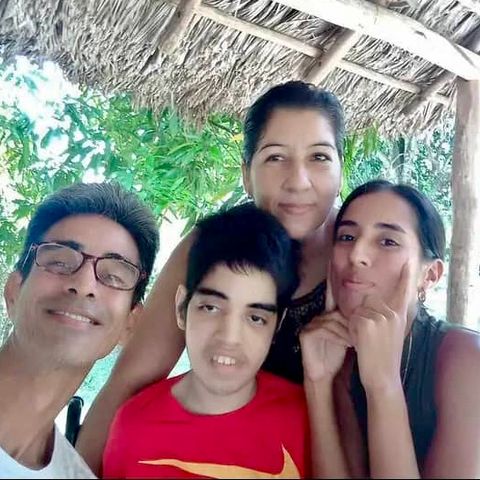
This week’s guest is Leonardo Cespedes of Bayamo, Cuba, a Baptist Preacher and father of two including a son with intellectual and physical disabilities.
Leonardo and his wife, Mairelis, have been married for 26 years and are the proud parents of two; daughter Reveca (23) who is a teacher, and son Marko (20) who has undiagnosed intellectual disabilities, suffers from seizures and is hard of hearing. Marko was one of the recipients of a wheelchair.
During his visit, David spoke with and recorded interviews with two Cubans connected to the disability community in Cuba. Special thanks to Dairy Hernandez, the young Cuban woman that served as one of David’s translators during the week and for her help translating today’s episode in English and Spanish.
That’s all on this episode of the SFN Dad to Dad Podcast.
Show Notes –
WhatsApp – 53 58 01 4667
Email – leobayamo@nauta.cu
Joni & Friends – https://joniandfriends.org/
ACLIFIM (Asociación Cubana de Personas con Discapacidad Físico – Motora – https://www.aclifim.cu/
Transcript:
Tom Couch: [00:00:00] Special thanks to Horizon Therapeutics for sponsoring the Special Fathers Network Dad to Dad Podcast, working tirelessly to research, develop, and bring forward medicines for people living with rare and rheumatic diseases. Discover more about Horizon Therapeutics’ mission at HorizonTherapeutics.com.
Tom Couch: In April 2024, our host David Hirsch traveled to Cuba with Joni & Friends to help distribute 200 wheelchairs. During his visit, David spoke to and recorded interviews with two fathers of children with special needs. Today, we’re going to listen to the first interview with a Pastor from a local Baptist church, Leonardo Cespedes.
Tom Couch: These special fathers speaks Spanish so David enlisted the help of Dairy Hernandez to assist in translation. So now let’s listen to David’s conversation with Cuban special father, Leonardo Cespedes on this Special Fathers Network Dad to Dad Podcast.
David Hirsch: I’m here in Bayamo, Cuba for a week with Joni & Friends, [00:01:00] distributing wheelchairs to more than 200 locals. I’m thrilled to be talking today with Leonardo Cespedes who is a pastor of a local Baptist church and the father of two, including a son with intellectual disabilities. And I also want to offer a special thanks to Dairy Hernandez for helping interpret this conversation.
David Hirsch: Leonardo, thank you for taking the time to do a podcast interview for the Special Fathers Network. You and your wife, Mairelis, have been married for 26 years and are the proud parents of two: daughter Rebecca, 23, who teaches; and son, Marko, 20, who has undiagnosed intellectual disabilities, suffers from seizures, and is hard of hearing. Let’s start with some background. Where did you grow up? Tell me something about your family.
Leonardo Cespedes: I was born at the main hospital from Vallado. I was raised in a municipality. It’s a community or is a sugar cane mill. The whole economy depends [00:02:00] on that sugar milk. I graduated. I studied civil construction as a technician. And later on I met the gentleman, and after I graduated, I began to work as a construction technician at the Centro José Luis Miguel Figueredo, in a maintenance construction brigade. After I graduated I knew the Lord and I work at sugar mill as a construction technician.
David Hirsch: When you were growing up did you have any siblings?
Dairy Hernandez: He has a sister.
David Hirsch: And out of curiosity, what did your father do for a living?
Dairy Hernandez: He lived with his grandparents. His grandfather was like his father. He used to have cows.
David Hirsch: Like a farmer.
Dairy Hernandez: Farmer.
David Hirsch: Did he have any relationship with his dad?
Dairy Hernandez: He saw his father from time to time when he went to give her the money every month.
David Hirsch: So his father figure growing up was his grandfather. His maternal grandfather or his paternal grandfather?
Dairy Hernandez: Maternal.
David Hirsch: So what lessons did you learn from your maternal grandfather?
Leonardo Cespedes: I learned to work hard, to value what we had. He was an illiterate man, but he taught us to be honest people. To where are the things for our hard work. He taught us to [00:03:00] work hard. At home they have horses, cows. I went to school on a horse. It was a countryside lifestyle.
David Hirsch: Did you have to do a lot of chores on the farm to take care of the horses and the cows and the rest of the farm?
Dairy Hernandez: Yeah, it was common for them to be in charge of the farm. To take care of the empty animals, to feed them.
David Hirsch: So I’m wondering if there’s any other father figures, men who played an influential role. So who is Noel and what role has he played in your life?
Leonardo Cespedes: Noel has taught me to see God as the Lord that created the universe for we all. To accept people as the way they are and not the way I want them to be.
David Hirsch: And it’s not lost on me that Noel is blind. And he lost his sight at age 30 and he is 82 years old now. So you mentioned that he taught you to see, even though he’s blind.
David Hirsch: You mentioned that you went to school to become a construction engineer.
Dairy Hernandez: Yeah. Not [00:04:00] engineer, construction technician.
David Hirsch: And that was your first job?
Leonardo Cespedes: Yes.
David Hirsch: And when did you start pastoring?
Leonardo Cespedes: In 1996.
David Hirsch: And that’s been your full-time job since then?
Leonardo Cespedes: Yes.
David Hirsch: And how big is your Baptist church? How many congregants are there?
Dairy Hernandez: Okay, he started this new church the previous month of March.
Leonardo Cespedes: Because I’ve been working as a pastor in several places.
David Hirsch: Maybe we should go back a little bit. Where did you start pastoring and where has that taken you?
Dairy Hernandez: Okay, he started in Rio Couto, the place where he was raised, in a place called[???].
David Hirsch: And where did his pastoring take him from there? Where did you pastor next?
Dairy Hernandez: Okay, later he worked in Puerto Padre, Las Tunas. And then in Manatee, another municipality from Las Tunas Province. Later he worked in Mia, in Guantanamo Province. His boy was born there.
David Hirsch: So you traveled around a lot [00:05:00] pastoring. Are these mostly rural communities?
Leonardo Cespedes: Yes.
David Hirsch: How did you and Maireles meet?
Dairy Hernandez: They met at a retreat where pastors people gathered to have some spiritual time to study the Bible.
David Hirsch: So he took more away from that experience than the other people.
Dairy Hernandez: Okay, they were single, so they met there.
David Hirsch: Let’s talk about special needs or disability. Prior to becoming parents, did you or your wife have any connection to the world of disability or special needs?
Leonardo Cespedes: Yes, in the church we were in, the first one we went to in Guam, there was a girl with an intellectual disability. And a young man with Down syndrome.
David Hirsch: So you had a little exposure, but not a lot of exposure to special needs.
Leonardo Cespedes: Okay. We saw that like the, maybe their parents made a mistake because they were inexperienced. That was a mistake from them. Maybe that was, yeah, it was a mistake.
David Hirsch: So that’s a cultural way of thinking about disability,
Dairy Hernandez: Cultural. Okay. They think that [00:06:00] they were cursed.
David Hirsch: So you understand differently now that that wasn’t a curse.
Dairy Hernandez: Yeah. When they during the pregnancy, they did some tests and everything was fine. But when the child was born, he had some disabilities and they asked for God. God, but why us?
David Hirsch: So what is Marko’s situation and how did it come about?
Dairy Hernandez: According to doctors, he has a syndrome, but they are not sure about what kind of syndrome is. It only happens in boys. Because of that, his wife had to do a surgical procedure in order to have no more children because they could be born with more disabilities.
David Hirsch: So was that a hysterectomy?
Dairy Hernandez: Yeah.
David Hirsch: What were some of the fears that you and your wife had when you learned about Marco’s situation?
Dairy Hernandez: They fear that they might lose the guy, their boy, or that they couldn’t improve her health situation. Because he didn’t know how to take the milk from the mother. Because he was [00:07:00] born with a static injury in the brain.
David Hirsch: Did you get any meaningful advice early on about how to raise a child like Marco?
Leonardo Cespedes: I think the advice is a lot of love. Love and talk to him. Because there are people who sometimes think they can’t understand you, but they do. When we are with him, we talk to him. When we are with him, we talk to him like a normal person. He laughs.
David Hirsch: So he understands.
Leonardo Cespedes: We think he understands, but he cannot speak.
David Hirsch: What are some of the more important decisions you’ve made as it relates to raising a child with these additional needs?
Leonardo Cespedes: The most important decision is to take care of it all the time. We had a painful experience when he was born. The organization for which I was working as a pastor, no, they retired the credentials as a pastor. Because they considered that I wasn’t an example for having a child with this, that I have to look where was the curse [00:08:00] or the sin that my wife and I made. And Noel Fernandez appeared. He said, “That’s not a curse. Your child is a blessing.” The church said they would take us as pastors and we started to work here in Bayamo.
Leonardo Cespedes: The superintendent of the general district hurt us a lot. When we needed the company the most, they fired us, they judged us. They made us feel so, so bad that it was terrible for us, even for our daughter, who was only four years old. She also felt really bad.
Leonardo Cespedes: So Noel and Eduardo support us and they take us as a mission of Ciego de Avila’s church.
David Hirsch: So let me question to clarify. Because of Marko’s condition, you lost your job as a pastor.
Leonardo Cespedes: Yes.
David Hirsch: And it was because of meeting Noel that you realized that Marko wasn’t a curse, but he was a blessing. So when I think about things like this, people [00:09:00] like Noel are the angels in our lives.
Tom Couch: We’ll be back with more of the conversation on the Special Fathers Network Dad to Dad Podcast in just a few moments. But first, this quick message. Please help 21st Century Dads gather research on families raising children with special needs by having them complete the Special Fathers Network Early Intervention Parents Survey. A link to the survey can be found in the show notes. As a token of our appreciation, each person, mom or dad, who completes the survey will receive a Great Dad Coin. Thank you. Now, back to the conversation.
David Hirsch: Not to focus on the negative, but what have been some of the biggest challenges?
Leonardo Cespedes: Okay. The biggest challenge is to raise him under the blessing of the Lord, that he receive love and attention from our family during his whole lifetime.
David Hirsch: And I don’t know this for a fact, but I’m speculating that pastors don’t make a lot of money.
Leonardo Cespedes: No.
David Hirsch: So has that been difficult to support your family with Marko’s challenges or needs?
Dairy Hernandez: Yes, but very difficult. Okay, [00:10:00] because of the situation, the organization of Baptist Church they gave him some money and he could buy a busy taxi. It’s like a bicycle with three wheels. I think you saw that.
David Hirsch: Oh yeah, and it makes it easier to get around.
Dairy Hernandez: Okay. So he had to work in this busy taxi to gather some money to help his family,
David Hirsch: As a side job.
Dairy Hernandez: Yes.
David Hirsch: What impact have these challenges had on your marriage, on your daughter, or on your extended family?
Leonardo Cespedes: Life got more complicated. We have more expenses. We have to wash the clothes every day because he doesn’t know how to say when he has the need to go to the bathroom. He doesn’t eat the same things. He have to drink liquid food. They have to buy; the food that I need for him is more expensive.
David Hirsch: What impact has this had on his older sister?
Leonardo Cespedes: That’s why she decided to make a teacher for children with special needs.
David Hirsch: So she’s actually a special needs teacher, not just a teacher?
Leonardo Cespedes: Yes.
David Hirsch: And how about your extended family? What impact [00:11:00] has that had on brothers, sisters, the aunts, the uncles, the grandparents?
Leonardo Cespedes: My family couldn’t understand that. They said, why if God is in you and if you are in God, why this could happen to you? Where is God? Look at that child.
David Hirsch: I think of that as a crisis of faith. Your family was suffering from a crisis of faith.
Leonardo Cespedes: Yes.
David Hirsch: Do they still think that way?
Leonardo Cespedes: They changed their mind.
David Hirsch: So I’d like to talk about supporting organizations. What organizations have been helpful?
Leonardo Cespedes: The church.
Dairy Hernandez: When Fidel Castro was alive through social workers, they received a television and a refrigerator. They have asked some other help, but since he is a pastor he can receive it.
David Hirsch: Are there any other organizations that have played an important role?
Dairy Hernandez: Joni & Friends and church.
David Hirsch: So what role has Joni & Friends played in your life?
Dairy Hernandez: Very important role. Thanks to Joni & Friends we have a [00:12:00] wheelchair because our boy didn’t have any wheelchair before. They give us our help.
David Hirsch: How long ago was that? When was the first wheelchair?
Leonardo Cespedes: We received the first wheelchair in 2010. I’m not sure, but I think it was in 2010. I was in some events in [???]. I met there Bonnie. For my wife, my baby boy, my daughter, it was a great experience because they taught us to have a better attention to our baby boy.
David Hirsch: So there have been wheelchairs and these family events as well. Has Joni & Friends had any other impact?
Leonardo Cespedes: We learn about Joni’s story. We saw the movie. I know about this organization because of a brother Noel.
David Hirsch: Have you met other families with children with disability as a result of Joni & Friends?
Leonardo Cespedes: Yes.
David Hirsch: Has that played an important role?
Leonardo Cespedes: Important. It has been very important because we think that we have the bigger problem, but when we see other people with biggest challenges we are thankful for what we have.
David Hirsch: So you don’t feel as isolated or alone. So is there a lack of maternal involvement or a lack of father involvement [00:13:00] here in the disability community in Cuba?
Leonardo Cespedes: I felt that. I’ve seen some lack of commitments mainly in fathers. So the rest of the family and the government.
David Hirsch: What role has the government played in supporting you?
Leonardo Cespedes: Promise only, promises. But we haven’t received anything because they promised to change our house because our house is very small to move the chair. But our house has only one bedroom, the living room, the kitchen, and a bathroom. They were there because the church council talked to them to find a way to help us. Eduardo also talked to the government. They wanted to change the, they tell me that they will change the house for a bigger one and give my small house one other person that made the house, but they didn’t do anything. This was one year ago and nothing has happened.
David Hirsch: So who is Eduardo and what role has he played?
Leonardo Cespedes: Eduardo. Eduardo is for us a friend, a father. He is always asking us for our needs as Noel [00:14:00] does.
David Hirsch: I’m thinking about advice now. And what advice would you share with parents specifically Cuban dads?
Leonardo Cespedes: I will encourage them to love their children, despite the economic situations we have now. To give them love. To dedicate time to them. That is more important than money. Despite difficulties and what we are living as a country. Being always next to our children. Giving them love. Hope.
David Hirsch: Is there anything else you’d like to say before we wrap up?
Leonardo Cespedes: I want to thank you for inviting me to this interview. I’m not a very talkative pastor, but I wanted to say thank you.
David Hirsch: Let’s give a special thanks to Joni & Friends, and especially Noel and Eduardo for helping introduce us. So if somebody wants to learn about your work or to contact you, what’s the best way to do that?
Leonardo Cespedes: Okay, my email address is leobayamo@nauta.cu.
David Hirsch: I’ll be sure to include that in the show notes so it’ll make it as easy as possible for somebody to get ahold of you.
Dairy Hernandez: Okay. He [00:15:00] wants to share telephone number. The code is 53 58 01 4667.
David Hirsch: We’ll be sure to include that.
Dairy Hernandez: Okay. Perfect.
David Hirsch: Leonardo, thank you for your time and many insights. As a reminder, Leonardo is just one of the dads who’s part of the Special Fathers Network, a mentoring program for fathers raising a child with special needs. If you’d like to be a mentor father or are seeking advice from a mentor father with a similar situation to your own, please go to 21stCenturyDads.org.
David Hirsch: Thank you for listening to the latest episode of the Special Fathers Network Dad to Dad podcast. I hope you enjoyed the conversation as much as I did. As you probably know, the 21st Century Dads Foundation is a 50 1c3 not for profit organization which means we need your support to make our content free to all concerned. Would you please consider making a tax-deductible contribution? I would really appreciate your [00:16:00] support. Leonardo, thanks again.
Tom Couch: And thank you for listening to the Special Fathers Network Dad to Dad Podcast. The Special Fathers Network is a dad to dad mentoring program for fathers raising children with special needs. Through our personalized matching process, new fathers with special needs children match up with mentor fathers in a similar situation. It’s a great way for dads to support other dads. To find out more, go to 21stCenturyDads.org.
David Hirsch: And if you’re a dad looking for help or would like to offer help, we would be honored to have you join our closed Facebook group. Please go to Facebook.com, groups, and search “dad to dad.” Lastly, we’re always looking to share interesting stories. If you’d like to share your story or know of a compelling story, please send an email to David@ 21stCenturyDads.org.
Tom Couch: The Special Fathers Network Dad to Dad Podcast was produced by me, Tom Couch.
Tom Couch: Thanks again to Horizon Therapeutics, who believe that science and compassion must work together to [00:17:00] transform lives. That’s why they work tirelessly to research, develop, and bring forward medicines for people living with rare and rheumatic diseases. Discover more about Horizon Therapeutics at HorizonTherapeutics.com.