

317 – Noel Fernandez Collott (82) of Ciego de Avila, Cuba A Retired Baptist Pastor & Disability Advocate, Went Blind at 30
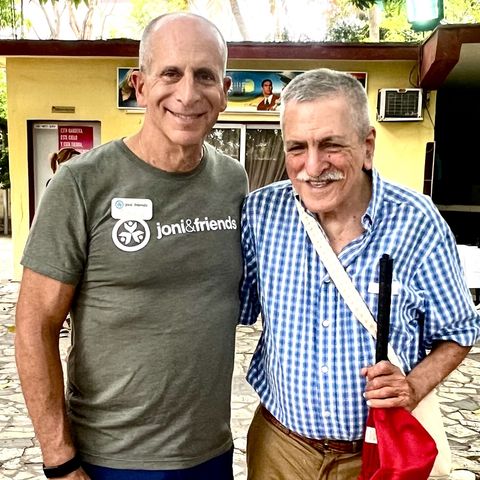
In April 2024, our host David Hirsch traveled to Cuba with Joni & Friends, as one of 12 U.S. volunteers participating in a Wheels For The World Program, to fit and distribute 200+ wheelchairs to youth and adults, who might not otherwise experience mobility. During his visit, he recorded two interviews with individuals connected to the disability community in Cuba. This is the the second of the two interviews.
Toady’s guest is Noel Fernandez Collott of Ciego de Avila, Cuba an 82 year old retired Baptist pastor who led seven churches during his career, who is one of the country’s most well respected disability advocates and himself, went blind at age 30.
Noel and his wife, Ornara, have been married for 58 years. We also learn about how Retinitis Pigmentosa took his dad and grandfather’s sight as well.
Thirty years ago, Noel was the initial point of contact with Joni & Friends, the Agoura Hills, CA global Christian disability ministry. Since then there have been J&F Family Retreats and Wheels for the World programs in all 15 Cuban providences.
Noel is also the author of the book (published in Spanish) entitled: Segun Los Circunstancias, which translated into English is: Living According To Circumstances. The book is currently available in Spanish on Amazon via Kindle and soon to be available in English.
We also learn about ACLIFIM a local NGO that serves the disability community.
It’s an uplifting story about overcoming disability and the power of the Holy Spirit all on this episode of the SFN Dad To Dad Podcast.
Show Notes –
WhatsApp – 53 52 449 967
Email – fernolla2027@gmail.com
Joni & Friends – https://joniandfriends.org/
Living According To Circumstances – https://www.amazon.com/Vivir-seg%C3%BAn-las-circunstancias-Spanish-ebook/dp/B0CQR9XJJ6/ref=sr_1_1?crid=DU5LY58FA1JM&dib=eyJ2IjoiMSJ9.vTCDcNLCV7_U0Z3oenOWXtKah6BZpDjOkT9YlWKfmug.5Bogv-4zgXWbCoiv4J7IQia54bpBaFqcU2XTSbDJfQo&dib_tag=se&keywords=noel+fernandez+collot&qid=1719589939&s=books&sprefix=noel+fernandez+collot%2Cstripbooks%2C98&sr=1-1
ACLIFIM (Asociación Cubana de Personas con Discapacidad Físico – Motora – https://www.aclifim.cu/
Transcript:
Tom Couch: [00:00:00] Special thanks to Horizon Therapeutics for sponsoring the Special Fathers Network Dad to Dad Podcast, working tirelessly to research, develop, and bring forward medicines for people living with rare and rheumatic diseases. Discover more about Horizon Therapeutics’ mission at HorizonTherapeutics.com.
Tom Couch: In April 2024, our host David Hirsch traveled to Cuba with Joni & Friends to help distribute 200 wheelchairs. During his visit, he recorded two interviews for the Special Fathers Network. Today we’re going to listen to the second interview with another local Baptist preacher, Noel Fernandez Collott. Noel is 82 years old, is legally blind, and is pastor at seven local churches. So now let’s listen to David’s conversation with Noel Fernandez Collott on this Special Fathers Network Dad to Dad Podcast.
David Hirsch: I’m here in Bayamo, Cuba for the week with Joni & Friends distributing wheelchairs to more than 200 [00:01:00] locals. I’m thrilled to be talking today with Noel Fernandez Collott of Ciego de Avila, who is an 82 year old pastor of seven different Baptist churches, and because of retina pigmentosis, went completely blind by the age of 30.
David Hirsch: We are very fortunate that Noel is bilingual since I speak very little Spanish. I also want to offer a special thanks to Dairy Hernandez for being here to help interpret if necessary. Noel, thank you for taking the time to do a podcast interview for the Special Fathers Network.
Noel Fernandez Collot: You’re welcome.
David Hirsch: You and your wife, Ornara, have been married for 58 years. You were born in 1942 and have an older brother who is one year older. Let’s start with some background. Where did you grow up?
Noel Fernandez Collot: I grew up in Camagüey, studied in Camagüey and in Methodist schools, because in my city there was not any but a Methodist school. And my parents decided to register me in a Methodist school. I started my elementary school, [00:02:00] my junior high school, and part of my high school.
David Hirsch: And I’d like to do a little deeper dive with your family, starting with your grandfathers, first on your dad’s side. What was his name, and what did he do for a living?
Noel Fernandez Collot: My father studied in the United States, and worked there many years. But in one vacation, or any time that he had, he determined to come away and be in touch with my wife at the Pearl Rapids Shore Baptist Church there. And my mother did not want to go to the United States, and then my father and my mother founded the family in Camagüey where I’m born.
Noel Fernandez Collot: My father worked most of the time in Cuba, in the American enterprise that had to live with their goal. He worked there until he became blind about 50 or 55 years old. He retired. My mother studied to be a teacher. She did not finish her studies, but she worked most of the time in the [00:03:00] educational work of the city.
Noel Fernandez Collot: He enjoyed so much being a teacher. And both of them were Christian. They attended Baptist Church. They were not leaders of the church, but I was. The leader of the church was my grandmother. She has many responsibilities there. But my father only attended service on Sunday evening. But my grandmother guided me. She was a Christian believer.
David Hirsch: So I think what I heard you say is that your dad worked with an American enterprise, right? And he went blind as well. And what age did he go blind?
Noel Fernandez Collot: 55 or 56 years old, I’m not sure, around the fifties.
David Hirsch: Okay.
Noel Fernandez Collot: My father was blind also. In my family, there are many blind persons because of the diagnosis of pigmentosa. Until the present, this is the fifth generation of [00:04:00] blind persons becoming blind in the fold.
David Hirsch: So going back to your dad, who worked for an American enterprise and had the opportunity to travel to the US, how would you describe your relationship with your father?
Noel Fernandez Collot: Very close, very close. Father was a very, very educated person. He did so much, including when he become blind. He did blind very good, very good that he was very well prepared. I could say that he was bilingual because the English that he spoke was very fluent and it is said that it was good English.
David Hirsch: So your dad spoke English?
Noel Fernandez Collot: Very well.
David Hirsch: And is that where you learned your English initially?
Noel Fernandez Collot: No, I refused to learn English. I didn’t want to learn English. My father insisted that I must learn English. I did not want to learn English. My brother studied English. My brother was bilingual. He spoke English, French, and [00:05:00] Italian. But I didn’t want to learn English. I learned English because I need English when I was about 17 years old, more or less.
David Hirsch: So I remember you telling me in a prior conversation during the week that your first trip to the United States was when you were eight years old.
Noel Fernandez Collot: Yes, it’s true.
David Hirsch: So before we move on and talk about Cuba, I’m wondering if there was any other men in addition to your father. And you didn’t know your grandfathers because they passed before you were born. But if there was any other men that played an influential role in your growing up.
Noel Fernandez Collot: Yes. My pastor.
David Hirsch: What was his name?
Noel Fernandez Collot: Rafael Grigorych. Yes. He was a saint.
David Hirsch: A real saint or you called him a saint?
Noel Fernandez Collot: I called him.
David Hirsch: Okay. Okay. [laughing]
Noel Fernandez Collot: We have seven children. And the salary of my father worked three, four days American pesos every week and every month. Every month. And my pastor was 75 Cuban pesos every month. My father has two child. [00:06:00] My pastor has seven children, but my pastor never talk to the congregation, to the person that he visited. They saw the economic situation, doing many things, he and his wife. But he was very pampered.
Noel Fernandez Collot: When I grew up, I used to go with him to visit the more poor people living around the city and also in the countryside. And he talked with them, he ate with them. He has left their houses in the countryside, and I learned to be a pastor, accompanying him when I was a young person. He, I don’t know how to say, el me marco para siempre. He make him, uh…
David Hirsch: A strong impression, an important and strong impression. Gotcha. So it sounds like he was an amazing role model, right? He gave a good example of what to do.
Noel Fernandez Collot: Yes.
David Hirsch: And was he the one that influenced you to become a pastor? Or did [00:07:00] you have that in your heart before that?
Noel Fernandez Collot: I never accepted to be a pastor.
David Hirsch: You never accepted to be a pastor?
Noel Fernandez Collot: He managed opportunities. Persons from churches asked me to go to the seminary to study or be a pastor, but I refused to be a pastor. And I became a pastor just when it was really a necessity to become a pastor. And then I did not have previous study in the seminary. I began to be a pastor without being in the seminary. And I studied later, but the decision was exactly when I became a pastor.
David Hirsch: So you did not go to the seminary, that’s what you said.
Noel Fernandez Collot: Nothing like that.
David Hirsch: Did you go to the university?
Noel Fernandez Collot: No, no.
David Hirsch: And where did your career take you? Where did you start working after your high school education?
Noel Fernandez Collot: I began working in the Baptist Convention. The person in charge of the team eight years in the convention preparing their summer camps, the weekly activities. I print a suggestion for the [00:08:00] activity of the inter group working and my first activity outside the church. And so some person said, this is the pastor. You are, you are becoming the pastor of the convention.
David Hirsch: So that was the beginning.
Noel Fernandez Collot: And let me tell you that my wife worked together with me in that mission, so very strongly.
David Hirsch: So as long as we’re talking about your wife, how did you and Ornara meet?
Noel Fernandez Collot: We met in a summer camp. We were 15 years old. And when she arrived to the camp, I said to another guy that was with me, Oh, the little one is going to be my third in this activity. And a year later, we formed another family. And it began to grow. Talk about [00:09:00] our own nations and you know, it would be a marvelous.
David Hirsch: Well, let’s talk about your situation, going blind. So you mentioned earlier that your dad went blind when he was in his middle age. And you’d mentioned that your grandfather on your dad’s side was also blind. So when did you realize that you were starting to lose your sight, and how did that transpire?
Noel Fernandez Collot: Because the seed that I have said, because the many persons in my family have this, I know about that, and indeed many, for example, about they learn about the treatment. And I said, used to say, I have difficulties during the evening. I could not see very well. I don’t, I could not see the stars.
Noel Fernandez Collot: But any doctor pay attention to the situation that I have. Any doctor. And even, we went to New York. I was 12 years old. I did 12 months. We traveled to New York because my father ran a very famous doctor in New York named [00:10:00] Castro Villan with Chick, my brother, and me, and also my father. And we went there, and I remember that was a very, very good examination, very good research of the doctors there in New York.
Noel Fernandez Collot: At the end of the visit, the doctor said to my father, Okay, your sons doesn’t have, don’t have any difficulties in their sight, but you. You are , your sight, you will have sight normal than a year where you feeding your side. And when I told to my mother, I say, but I don’t see that worry during the evening.
Noel Fernandez Collot: You know what the doctor say that I don’t have any. Okay. And before I met, I decided to go to the doctor office to know what eyes condition I have. And the doctor said, not bad, okay, not okay. After a year, after a year of that, I was involved in a program that Cuba had for Christian persons, for persons that were [00:11:00] disaffected to the system, the Cuban system, same to the David Klein, David Klein, you know.
Noel Fernandez Collot: I couldn’t know a word, very word during the evening, because we came against us on the opposite side, and I said, I was blind, I couldn’t know. I’m becoming blind. And then, was discovered at last that I was with the ADC. It allowed me to finish my time, the record time, thanks to God. Between that also, then God is always have a plan for your life.
Noel Fernandez Collot: Never was saying that I was becoming blind. But when I required to rediscover my disease, was exactly in that precise moment. In the exact, exact moment when I needed to go out one day. The place where I was sent by God.
David Hirsch: So if I can paraphrase what you’ve said, when you were in New York, your dad, your brother and you were tested, examined, [00:12:00] and the doctor said to your father, you’re going to be losing your sight. But to the sons, you and your older brother, your eyes are okay, but you realized that there was something going on at night, right? You were having a hard time seeing. And that within a relatively short period of time afterwards, when you were back in Cuba, it was determined that you also had the same disease that your father and your grandfather had. Out of curiosity, did your brother lose his sight or was his sight just fine?
Noel Fernandez Collot: He only had one sight.
David Hirsch: Okay. When you first started to lose your sight and realized that this was the same disease, what were your concerns or fears at the time?
Noel Fernandez Collot: Again, no fear at all. I said, I learn to be blind. Many persons in my family were blind. All of them continued living and working and doing whatever was possible. I was taught by my aunts, my uncles, my cousins, my friends, to accept the blindness as something natural.
David Hirsch: [00:13:00] So it wasn’t considered a disability or something that would prevent you from doing things.
Noel Fernandez Collot: A different way to live.
David Hirsch: Gotcha.
Noel Fernandez Collot: It’s a different way to live. There is not any problem. You could be blind or have any kind of disability. This is only a new possibility to live in another way, but you have to learn how to live with that.
David Hirsch: To adapt.
Noel Fernandez Collot: Adapt. To accept. All that, adapt, accept.
David Hirsch: Was there any meaningful advice you got?
Noel Fernandez Collot: Oh, yes. The disability is not a problem. Disability is not a question of health. Disability is only a social problem, a cultural problem. You have to accept it liberally, freely. Also, you are denying God’s crimes. And you become blind when you have a mechanical disability. It’s only a way in which God decided that you couldn’t live time also, to show that, to give the possible with God’s hand, whatever the situation you have [00:14:00] to give.
David Hirsch: Not to focus on the negative, what have been some of the biggest challenges that you’ve had?
Noel Fernandez Collot: The purpose is to try to share the hope of Jesus Christ given how you are. You know, my preferent verse in the scripture, if one pulls and pulls, going to the Philippines, being in a gear, waiting for his death, in very, very bad condition, and instead of going to the Philippines, I learned to live with abundance.
Noel Fernandez Collot: I know to live with our abundance. I like to, I know to live according to the circumstances. And this is my goal. You have to live with sight or without any sight. You have to learn to live according to the situation that you are in the moment in which you are living. This is my purpose. And it is valuable for the disability. You have to learn [00:15:00] to live. But put a lot aside or have an inside to live ally to have to learn to live with the condition that you have, that you have to afford.
David Hirsch: Yeah. Well, I think that a way of paraphrasing what you’ve said is you have to do with what you have as opposed to what you hoped to have. That’s the way I would phrase it. Has the situation had any impact on your marriage?
Noel Fernandez Collot: No. No, no, no. My question understand very well the situation. When the doctor announced I have discovered that I have the ailment, the doctor went to my house and said to my wife, the doctor, the specialist said, Noel is becoming blind in just five years, maybe in five years. But I don’t want to talk to Noel and to say that. I don’t want to say it. The doctor said to my wife. And when I got home, my wife said, okay, sit down here. We have to talk. I have something to analyze with you. [00:16:00] Okay, darling, what’s happening? What’s the matter? So the doctor said that you are going to become blind in five years. Yes. Five years. And my wife said, let’s begin to prepare our lives in order to live according to what will happen. Economically, spiritually. Many ways we have to be prepared for that. And then we began to prepare for that, and let me tell you that, you know, five years, after 15 years, we come back. Because we were prepared to live in that condition because my wife prepared me, and prepared myself for that.
David Hirsch: That’s a very powerful statement that your wife accepted this from the very beginning and helped you and herself get ready for the eventuality of you losing your sight. So she’s a very strong woman.
Noel Fernandez Collot: Yes.
Tom Couch: We’ll be back with more of the conversation on the Special Fathers Network Dad to Dad podcast in just a few moments. But first, this quick message. Please help 21st Century [00:17:00] Dads gather research on families raising children with special needs by having them complete the Special Fathers Network Early Intervention Parents Survey. A link to the survey can be found in the show notes. As a token of our appreciation, each person, mom or dad, who completes the survey will receive a Great Dad Coin. Thank you. Now, back to the conversation.
David Hirsch: So I’d like to talk about the organizations, some of them, that you’ve been involved with, and I’m wondering if there’s a local organization here in Cuba that works with people that are sight impaired and blind.
Noel Fernandez Collot: Yes, in 1990, I presented a program to the Cuban Council of Churches of All Disabled People. I make a research and I discovered that there were only 26 blind persons as active members of the Protestant and evangelical churches in Cuba. Only 26 persons were blind. And only 3 deaf persons [00:18:00] were active members of the churches in Cuba. And only 3 of them were pastors in the churches in Cuba.
Noel Fernandez Collot: Maybe the survey was not as big as is required, but what I discover is that church were no involvement in the issue of disability. The churches don’t know how to work with disability. They don’t know anything about disability. Maybe they didn’t know.
Noel Fernandez Collot: Then I began, I presented to the Cuban Council of Churches a program to organize a department that has to deal with disability. A person with disability will be involved in the program with the local churches, and the local churches will learn how to deal with the issue of disability. The program was approved and I was assigned to conduct a program that I did for many, many years. This was the beginning of a [00:19:00] program. Now I can’t say that all the churches recognized in the country have been working for, in any way, in some ways, not always as I would like in the program of disability in Cuba.
David Hirsch: So it started from your own experience losing your own sight and having a better understanding of the importance of the church is embracing people with disabilities. And we were talking initially about people that are blind and deaf.
Noel Fernandez Collot: Beginning with blind.
David Hirsch: Right. And what is this ACLIFIM organization? What’s the acronym stand for and what type of work do they do?
Noel Fernandez Collot: Let’s see. There are four organizations that have to deal with the issue of disability. A non governmental organization. But the states ordain with some programs. Educational programs, cultural programs, sport programs. Okay? But the organizations do whatever they would like to do by themselves. Because our free organization, non governmental organization. One of [00:20:00] them have to deal with the issue of disability. Associación Nacional del Ciego, National Association for the Blind. The deaf has their own organization, Associación Nacional del Ciego, National Association for the Deaf. The person that has any kind of limited mobility.
Noel Fernandez Collot: At the organization association for person who disability and actually our year was founded, the association for person is mentor disability. All of them, the pastoral were. With this person with disability, that is the problem of the Cuban Council of Churches that I conducted for many years, have closed windows this non governmental organization.
Noel Fernandez Collot: For example, talking about blind. We presented to all the public library system a library in braille. Then the Association for the Blind [00:21:00] support that program, inviting the members of the organization to go to the activity in which we open the possibility to have a vibrant life. And with that, of course, we have programs to help them or to do something together.
Noel Fernandez Collot: And I think you could see what we are doing now. Same also wellsharing for persons with disability. Then we, by the agreement to tell us there are persons that require wellsharing because they have their statistics in the whole country. And then we work together in the distribution.
Noel Fernandez Collot: Churches don’t give wellsharing to anybody. I can’t even do that. Because we ask everyone to do that.
David Hirsch: So, if I can paraphrase what you’ve said, ACLIFIM is the organization that assists people with different types of disabilities. The churches play an important role, but they’re not involved with the distribution of wheelchairs, and that’s one of the responsibilities of [00:22:00] ACLIFIM. And you did make reference to Joni & Friends. And my recollection in a prior conversation was that you actually had a chance to meet Joni Eareckson Tada about 30 years ago when she came to Cuba. Do you remember that first meeting that you had?
Noel Fernandez Collot: The story of our relation is a very old story. Many years ago I did a pamphlet at the Cuban Council of Churches. I found a pamphlet there talking about the EUF ministry in the United States. And what they do in the United States, preparing, teaching, personally, to work in the issue of disability. I was interested in that. And then I sent a letter to Joni Eareckson Tada, a woman here in California, telling her we are working with disability in the life of the church, and we are doing that and that and that. I [00:23:00] am very interested in what you are doing in America about that issue. It’s good news for me to know what you are doing there. And someday, may God prosper, that you and me, we will work together, talking and planning what is possible to do together. I dream that, and I ask the Lord that someday, there or here, we will meet. Surely, we will not tire. And I sent the letter.
David Hirsch: So did you go there or did she come here?
Noel Fernandez Collot: We did. Then, after some years, a person for genetic, for DNA thing named Joe Warn, W A R N, Joe Warn came to Cuba. And we met in the garden of the Methodist Church in Havana. And he told me more about Joni & Friends and said to me that Joni & Friends would like to come to Cuba to make outreach in many places, many places. So, that’s good. I would like, a year later, two leaders of Union think, including Joe Warn. I don’t remember the name [00:24:00] of this other person that was there with his family and name was Massa.
David Hirsch: Doug Massa.
Noel Fernandez Collot: Yes, okay.
David Hirsch: I’ve met him.
Noel Fernandez Collot: Ah, yes. They came. Three of them came to Santiago del Porto, and I invited a fellow pastor that knows English more better than me to be in the meeting, where they will explain to me everything of how to prepare our dishes in Cuba together with you and everything. And they talk and say what to do, how to do, when to do.
Noel Fernandez Collot: Okay. After the meeting, I said to my fellow pastor, this is impossible to be done in Cuba. The authority are not going to allow to do that with Americans in that way. I answered to him, oh no, don’t say that. You have to go to the Cuban authority and tell the story. And they will say yes or no. But you are not able to say no.
Noel Fernandez Collot: And I said, I went to the National Office for the Religious [00:25:00] Affairs in the Central Committee of the Communist Party in Havana. I talked with the person in charge of that program. And I said, I received a visit from the United States and they invited me to do that, and that, and that, and that, and that, in that way, and so on, so on, so on.
Noel Fernandez Collot: And she said, Why do you say that it is not possible to eat in Cuba? Why say that? I was surprised. And then she said, listen, no, why not? But I have some suggestion to you. Number one, if you are going to give a Bible to a person, it has to be done freely. If the person don’t accept to receive the Bible, don’t push it.
Noel Fernandez Collot: Then to receive it, The Word of God. This is a personal decision. Okay, it sounds horrible. Number two. Number two. The Americans that are going to come don’t talk with them about politics. Politics. Yes, they will discover what they want to discover and they will have their own opinion. [00:26:00] Don’t tone down their opinion that they have. It’s your opinion and you have to be respectful to their point of view. Oye, you’re so cool.
David Hirsch: [laughing]
Noel Fernandez Collot: Then, some months later, I think, less than a year came the first audition. Thirty years ago. And let me tell you that was not easy to work with you Americans. Yes, but we did. Yeah.
David Hirsch: [laughing] So that was the beginning of the relationship with Joni & Friends.
Noel Fernandez Collot: And you asked me about Joni. Joni came to Cuba in 2014. Yes, 2014.
David Hirsch: So a decade ago.
Noel Fernandez Collot: Yes . It was fantastic. She flew directly to Santiago de Cuba. Of course, I was in the airport waiting for her, and she said to me, You see? At last we are together. At last we are together. I remember your letter. What? Wait a minute. She remembered what I said [00:27:00] years ago about our problems, and that we will be together someday, here or there.
Noel Fernandez Collot: And then we have a service in Santiago de Fuma. She preached there. Later, she went to Havana with you. And then we have a very, very big service in Herbert, shortly there in Havana.
Noel Fernandez Collot: Many other activities. This was a tremendous activity. You know what I said very frequently the journey in frame a lot. I was to her to open windows and doors that were closed to the churches in Cuba. The activity with Joni & Friends in Cuba was a big support to open doors and windows that were closed to the church in Cuba, that the relationship between state and the churches in Cuba was known.
Noel Fernandez Collot: And I’m on all the factors for the activities that we have done with your influence. The friendship that we have was a [00:28:00] sign that it’s possible to build bridges of understanding between the people of the United States and the people of Cuba. Not before there was a number of friendship and the relationship.
Noel Fernandez Collot: As soon as that will happen and it was a lesson to my country maybe that we hope that also for the United States and we hope that as we are working together that our friendship and cooperation will be other factors of our two countries and maybe someday by the wishes that we are building the government of Cuba and the United States we work together hand by hand.
David Hirsch: Yeah, well, that’s lovely. Thank you for sharing. So, we’ve been talking a little bit about the Wheels for the World program, right? Distributing wheelchairs. How many years has that been going on here in Cuba? And in how many different locations around Cuba?
Noel Fernandez Collot: This is the 70th [00:29:00] anniversary of the This is the 7th anniversary this year. We are celebrating 70 years of work together. We have been working in all Cuba, all around Cuba, all the provinces have received your address and your support here. And we have 15 provinces, all of them have been visited and distributed and shared together. The three, five, Joni & Friends, Al Clifton, and Pastor Eduardo, a good person with disability, program of the Council of Churches.
David Hirsch: Do you also do the family retreats? The Joni & Friends family retreats here?
Noel Fernandez Collot: Yes, yes, we also have the family retreat, but it’s more new than the Alvejos. We done the 14th one of them last, last, last. Yes, much in Caliway.
David Hirsch: So let’s switch gears and talk a little bit about your book, which came out recently. What’s the title of your book?
Noel Fernandez Collot: The title of the book is Living According to [00:30:00] Circumstances. The text that I mentioned before in Philippe Belfort, according to the circumstances, how to live according to the circumstances. Yeah, yeah. It’s a text with the experience that I have. That is also the experience, the way of living, of my generation.
Noel Fernandez Collot: But my generation lived in different situations in Cuba. All different situations. The situation that we have at the beginning of the revolution in Cuba. The beginning of the ’60s, it’s not the same that we have in the ’70s or in the ’80s or the ’90s. The situation here changed more frequently, and we have to adapt to that situation.
Noel Fernandez Collot: We have to understand the situation, and we have aligned that to live according to it what happened. But the situation is not to enter the United States. Or, or do not pay attention to what is happening here. The situation is to be involved in the situation and be a [00:31:00] Christian in the situation. Teaching that it’s Jesus with us, nothing is against us.
David Hirsch: I know that at each of the talks that we do each day, I’m not sure if it was you or Eduardo, but he said that we’re translating things for you Americans even though Jesus only understands Spanish. [laughing]
Noel Fernandez Collot: You know, I used to say, I have a little copy from it, but I said, I said that God that burned me said to me that the language that is going to be spoken in heaven is Spanish. [David laughing] This is the reason that you, America, have to learn Spanish.
David Hirsch: I’m going to have to learn.
Noel Fernandez Collot: Hey, I have to go out to work.
David Hirsch: So I’m thinking about advice now, and I’m wondering what advice can you share with parents, specifically dads, who are raising children with special needs?
Noel Fernandez Collot: I wished to have a child. My wife and me wished that we were parents someday. But when the doctor decided that, or announced it’s retinitis [00:32:00] pigmentosa and that he recommended not to have child, we decided not to have.
Noel Fernandez Collot: All those that had the privilege to have a child, have been blessed by God. No important what situation the child had. It is not important. What is lovely is that God gives you the opportunity to have a child. to work for him, for her, to love him, her, to do whatever is possible to make the life for them as pretty, as good as possible. The blessing of the child is something that we never could worry for about.
Noel Fernandez Collot: Do whatever is possible. And if the child don’t do it, he express her love by his faith. The boy or the girl could not say, I love you, pappy, or I love you, mommy. We show he explain his or her love friend. He a privilege to me to be a father, [00:33:00] to be a mother, and we have all eternity to show you are loved.
David Hirsch: Pearls of wisdom. What great advice. Is there anything else you’d like to say before we wrap up?
Noel Fernandez Collot:
Noel Fernandez Collot: The only thing that I want to say to you is that I am rolling because Pastor Leonardo is working alone. And she didn’t find my questions.
David Hirsch: [laughing] Well, I interviewed Leo the other day and he looks up to you and Eduardo as his mentors. So I think the people are in good hands, at least temporarily. But we’ll get you back to the work that you’re here to do. If somebody wants to learn more about your work, about your book, or to contact you, what’s the best way to do that?
Noel Fernandez Collot: I don’t know which way it could do, but I intend it to do whatever we’re doing The whole, that Jesus show us to teach all person that we could dish that the whole Jesus Christ is the only way to refer him to give. And you may share the person, my person, [00:34:00] and the number.
Noel Fernandez Collot: David, I would like to know a little more about the blind man that you mentioned before, at the beginning of the, a person to know. Do you understand what I’m saying? You didn’t know? I mentioned that I would like to know more about the blind man that you mentioned.
David Hirsch: Oh, Jim Stovall.
Noel Fernandez Collot: Jim Stovall.
David Hirsch: Okay.
Noel Fernandez Collot: Yes, because he’s important. And you may show or tell about a blind viewer that is something very fond of what he’s doing, what he’s doing.
David Hirsch: Yeah, well you’re both doing amazing work. And just for our listeners’ benefit, before we recorded this interview, I was mentioning that there’s another person in the network. He’s not a father like yourself. Jim Stovall in Tulsa, Oklahoma, who’s founder of the Narrative Television Network, author of 51 books, eight of which have been made into major motion pictures. And I will definitely put the two of you in contact with one [00:35:00] another, and I’ll start by sending you a link to the episode, the interview that he did, so you can get a little background before you have an opportunity to connect with him.
Noel Fernandez Collot: I will appreciate it. Let me tell you, I forgot to mention it before, a friend of mine in America, applying to translate my book into English. And the editorial that printed the book here in Cuba allowed them to do so. They are allowed to print the book in English in America. I hope that they could do that.
David Hirsch: Well, when that gets done, not if it gets done, but when it gets done, God willing, we will also include the link to that so that it’ll make it as easy as possible for people to get a copy of your book in English or Spanish for that matter.
David Hirsch: Noel, thank you for taking the time and many insights. As a reminder, Noel is just one of the individuals who’s part of the Special Fathers Network, a mentoring program for fathers raising a child with special needs. If you’d like to be a mentor father or are seeking advice from a mentor father with a similar [00:36:00] situation to your own, please go to 21stCenturyDads.org.
David Hirsch: Thank you for listening to the latest episode of the Special Fathers Network Dad to Dad Podcast. I hope you enjoyed the conversation as much as I did. As you probably know, the 21st Century Dads Foundation is a 501c3 not for profit organization, which means we need your help to keep our content free to all concerned. Would you please consider making a tax-deductible contribution? I would really appreciate your support. Noel, thanks again.
Noel Fernandez Collot: You’re welcome.
Tom Couch: And thank you for listening to the Special Fathers Network Dad to Dad Podcast. The Special Fathers Network is a dad to dad mentoring program for fathers raising children with special needs. Through our personalized matching process, new fathers with special needs children match up with mentor fathers in a similar situation. It’s a great way for dads to support other dads. To find out more, go to 21stCenturyDads.org.
David Hirsch: And if you’re a dad looking for help or would like to offer help, we would be honored to have you join our closed [00:37:00] Facebook group. Please go to Facebook.com, groups, and search “dad to dad.” Lastly, we’re always looking to share interesting stories. If you’d like to share your story or know of a compelling story, please send an email to David@ 21stCenturyDads.org.
Tom Couch: The Special Fathers Network Dad to Dad Podcast was produced by me, Tom Couch.
Tom Couch: Thanks again to Horizon Therapeutics, who believe that science and compassion must work together to transform lives. That’s why they work tirelessly to research, develop, and bring forward medicines for people living with rare and rheumatic diseases. Discover more about Horizon Therapeutics at HorizonTherapeutics.com.