

386 – Dr. Paul Collins of Portland, OR A Professor at PSU, Prolific Author & Father Of Two Including An Autistic Son
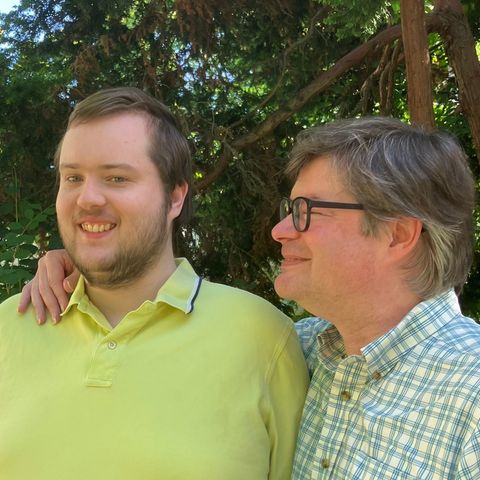
Our guest this week is Dr. Paul Collins, of Portland, OR a professor at Portland State University, a prolific author, and father of two boys including one with Autism.
Paul and his wife, Jennifer Elder, have married for 28 years and are the proud parents of two boys: Bramwell (21) and older brother Morgan (26) who is Autistic.
Paul is a professor of English in the college of Liberal Arts & Science at Portland State University. In addition to teaching English, Paul has been a prolific author including the book: Not Even Wrong: A Father’s Journey Into the Lost History of Autism (Bloomsbury, 2004), which is a brilliant story including a fascinating look back on the history of Autism.
We’ll hear Paul’s story on this episode of the SFN Dad to Dad Podcast.
Show Notes –
Phone – (503) 725-3504
Email – pcollins@pdx.edu
Website – https://www.pdx.edu/profile/paul-collins
Wikipedia – https://en.wikipedia.org/wiki/Paul_Collins_(American_writer)
Books –
- Blood & Ivy (W.W. Norton, 2018)
- Edgar Allan Poe: The Fever Called Living (New Harvest, 2014)
- Duel With the Devil: The True Story of How Alexander Hamilton and Aaron Burr Teamed Up to Take on America’s First Sensational Murder Mystery (Crown, 2013)
- The Murder of The Century: The Gilded Age Crime That Scandalized a City and Sparked the Tabloid Wars (Crown, 2011)
- The Book of William: How Shakespeare’s First Folio Conquered the World (Bloomsbury, 2009)
- The Trouble With Tom: The Strange Afterlife and Times of Thomas Paine (Bloomsbury, 2005)
- Not Even Wrong: A Father’s Journey Into the Lost History of Autism (Bloomsbury, 2004)
- Sixpence House: Lost in a Town of Books (Bloomsbury, 2003)
- Banvard’s Folly: Thirteen Tales of People Who Didn’t Change the World (Picador, 2001)
- Community Writing: Researching Social Issues Through Composition (Erlbaum, 2001)
Transcript:
Paul Collins: He will answer questions on a screen for a game. Like, he’ll get a screen like, do you want to quit? Do you want to play a new game? You’d click the right thing. And so I thought, I think I can communicate to him this way. And so I asked him what he wanted for lunch. And then I made a little list. Bagel, pizza.
David Hirsch: Order form.
Paul Collins: Yeah. And he grabbed my finger and jammed it into the word bagel. And I was like, you want a bagel? And he jammed it into the word again. And that was like the real start of us being able to communicate with him.
Tom Couch: That’s our guest this week, Paul Collins, a professor at Portland State University, a prolific author of such books as the Murder of the Century, a, Gilded Age crime that scandalized a city and sparked the Toughest tabloid Wars, and the Book of How Shakespeare’s First Folio Conquered the World. Paul is the father of two, including Morgan, 26, who is autistic. And we’ll hear his story on this special Father’s Network Dad to Dad Podcast. Now say hello to the founder of the Special Fathers Network and the host of the Dad to Dad Podcast, David Hirsch.
David Hirsch: Hi, I’m David Hirsch, host of the Special Fathers Network Dad to Dad Podcast. One brief message. The Special Fathers Network Mastermind Group experience is the most comprehensive program the 21st Century Dads foundation offers. Dads raising children with special needs, meet virtually on a weekly basis and form meaningful relationships while sharing weekly wins, discussing books, and, sharing heartfelt challenges. One of the highlights of the year is attending the in-person weekend retreat scheduled this year from September 5th through the 7th. As you think about the year ahead, I invite you to join one of the existing or soon to be formed SFN Mastermind groups and join a group of like-minded dads to become the best version of yourself. It might just transform your life as it has done for so many others. For more information, please see the show notes or simply go to 21stCenturyDads.org.
Tom Couch: Now let’s listen into this conversation between Paul Collins and David Hirsch.
David Hirsch: I’m thrilled to be talking today with Paul Collins of Portland, Oregon, a professor at Portland State University, a prolific author and father of two young adult children, one who is autistic. Paul, thank you for taking the time to do a podcast interview for the Special Fathers Network.
Paul Collins: Oh, thank you so much for having me here. I should add it’s finals week coming up, so if you hear anything in the background, it’s students fretting about their final papers.
David Hirsch: I thought it would be like students beating on the door or something. Okay. You and your wife Jennifer have been married for 28 years and are the proud parents of two boys, Bramwell, 21, and older brother Morgan, 26, who’s autistic. Let’s start with some background. Where did you grow up? Tell me something about your family.
Paul Collins: Yeah, so I grew up in, Perkiomenville, Pennsylvania, which is, one of those names that people usually ask me to repeat and then they still don’t quite know what I’m saying. It’s a very small town. It’s grown a bit since then, but it’s a very small town that’s about 30 miles from Philadelphia. Very rural, particularly when I was growing up there. And kind of an odd place to wind up in a way, because I was born there, but everyone else in my family was from England, so it’s an immigrant family. And I was the token American in the family.
David Hirsch: So were you the baby of the Kabustan? Is that what you’re saying?
Paul Collins: Oh, yeah. I have an older brother who’s nine years older than me. And in fact, he’s moved, back to England, so he lives in Britain now.
David Hirsch: Gotcha. I’m sort of curious. What did your, dad do for a living?
Paul Collins: My dad was a mechanical engineer. And he, specialized in the candy industry, basically, and in particular cocoa processing. But he also worked with all kinds of stuff. Hard candies, nougats, et cetera, et cetera, and designed, machinery for that, and, would help companies, design factories and that kind of thing for. For producing candy. So, one of my distinct memories of growing up, he would do these test runs of the equipment. And so we would just wind up with, like, sometimes literally like, pallets of candy in our garage of, like, kind of rough molds of stuff. And so, you know, there would sometimes literally be hundreds of pounds of chocolate just sitting around. I remember at one point in particular, there was a bunch that was basically unmolded for some reason. I guess a run hadn’t gone very well, and it was just these giant chunks of chocolate. And I remember going out with some friends of mine to the garage and, going to the workbench and getting a hammer and a chisel and just like, knocking these giant chunks of chocolate off the pile.
David Hirsch: Yeah, well, your house was probably a very popular
00:05:00
David Hirsch: house to spend some time at just because of that. And the vision I had when you mentioned cocoa processing, manufacturing was like Willy Wonka and the chocolate factory.
Paul Collins: It’s a lot more Ordinary than that, sadly. although the results about the same.
David Hirsch: That’s fascinating. So I’m sort of curious now. How would you describe your relationship with your dad?
Paul Collins: Well, it was an odd one in a way. It was a little distant in that he traveled a lot, he was constantly doing consulting work, he had his own company and. And so he would go off and go to all these distant locations to set up factories and stuff like that. We’d often be on hand there for a while as they got started to keep an eye on things. So he would frequently be gone for like, you know, a month or two at a time. Yeah, it’s strange. I think I got to know him a bit better actually, when he retired. Really? And so my mom was one that really had to kind of hold down the fort a lot when I was growing up and she was already, you know, she was working a full time job too. I mean, in one sense my dad always seemed a little exotic to me because he was always flying off somewhere and when I saw him, there was a certain amount of catching up to do.
David Hirsch: Well, out of curiosity, is there an important takeaway or two that come to mind when you think about your relationship with your dad? Maybe something that’s influenced you as a father?
Paul Collins: Yeah, I mean, I think, you know, probably like a lot of things, it’s a bit of a mixed bag. There are things that I think I try to emulate and things probably that I’ve decided to move in a different direction with. One of them is actually, I mean, it’s a bit of both. He was not around a lot of the time when I was in school. And so, you know, I had to figure out stuff on my own. And my mom was really busy and I have a very distinct memory of not doing very well. at one point in a physics course in high school and he was home and in his office he was drafting some blueprints or something. And I went in and I said, I’m really stuck on this. And he sat there, I mean, in my recollection, for like an hour or two. And it was going over electricity basically, and kind of getting the basic concepts around electricity. And he just went over all of it with me. And so I had it and I went in and I aced the test. And that really left an impression on me because it made me aware of how much of a difference that can make just having that kind of involvement. And partly that was because there was often an absence of it, just sort of necessarily because he wasn’t Helm that had a real influence on me. The other is actually that at one point he was having, some health issues with his heart. This really started in his 40s, 50s, and he actually wound up living to be, I think, 82. But there was a stretch in his 40s and 50s where it felt pretty touch and go. And so for a couple of his trips during that period, he had me come along with him. You know, I was like, I don’t know, 13, when I went on one of them. And another one When I was 14, one was down to Venezuela where he was setting up a factory, another one was the Dominican Republic. And that made a real impression on me because I got to see him at work and it kind of helped me understand him differently. I mean, I would always see him in his home office working on things, but I actually saw him really interacting with people and just, you know, it was the closest thing I ever got to a take your kid to work day in a very extensive fashion for like, you know, a couple weeks at a time. And yeah, that, that made an impression on me too. I’ve always tried, I think, with my kids to actually have them be aware of like how I spend my day and to maybe, you know, demystify that a bit because, that experience had a real impression on me. And I think it was a very positive one, particularly considering that, I mean, in a way it wasn’t entirely positive for him because he was very worried and didn’t want to be alone during that period. but it was ironically, kind of nice to actually have that time with him and to see him at work.
David Hirsch: Yeah, well, thanks for sharing. that’s pretty unique, you know, that somebody would take a, you know, young child or young teenager on an extended trip. Not just like overnight or a weekend or, you know, someplace more local, but, go internationally like that. And you know, that one on one time that you spend. Right. You know, that’s, that’s really special. Yeah, to be able to do that. And maybe the circumstances that led to it were out of a fear or concern that he had for his own health. But the net result is, you know, there’s this bonding experience that takes place when you have these one off type of experiences.
00:10:00
David Hirsch: And I can relate to, I think, what you were saying before that, which is, you know, when we look back on our, experience, how we were raised, the relationship we had with our mom or our dad, you know, there’s certain things that you emulate. Right. You want to try to do the same Thing like that, they were getting it right. And maybe there is things that, you know, you would do differently. So you live vicariously right through other people’s experience. So some, you don’t make some of the same, not mistakes, but, you know, you don’t just follow in somebody’s footsteps.
Paul Collins: Yeah. And I think, I mean, probably like a lot of people seeing my friends, parents and sort of their families and how they worked as well was, was also a real influence. You know, you kind of, you kind of try to take the best things from your own family and your own upbringing and where those things aren’t working, you kind of, you know, if possible, you look at your friends, families and see how they’re doing it and if they seem to be doing it in a really like, you know, positive way. And so, yeah, there were a few of my friends were, you know, when I saw their families and how they were working with certain families, things I thought, ha, that’s how you do it.
David Hirsch: Very insightful. My recollection was that, you took a BA from UC Davis, a, master’s at, College of William and Mary, and you got your PhD at CUNY grad center. And did you always know that you wanted to pursue a career in education or in literature, or were there some twists and turns along the way?
Paul Collins: There were definitely some twists and turns out. The funny thing is, is that I always knew, or certainly, I mean really from junior high school onwards that I wanted to be a writer. And I wrote my first book, and I use that term advisedly, but I wrote my first manuscript, we’ll say, in 11th grade. I, wrote a novel, you know, entirely handwritten in a bunch of notebooks. And I’d written a couple more books by my second year of college. And so at one level I already was very ambitious and very determined to be a writer. But I also had it in my head, frankly from my parents that that was not a profession or field I could go into. You know, they wanted a doctor or a lawyer or an engineer. Actually, when I started college, I started first semester at University of Wisconsin at Madison with the intent of being a pre veterinary student. I decided Wisconsin was too cold very quickly and my brother was living in California and I actually came out to visit him and I was like, oh, this is where it’s at. And so I applied to Davis because they had a huge veterinary program there. And yeah, it was really in that first year that, that I was, you know, I was taking all the, all the weirder classes that they used to knock students out basically like O chem and stuff like that and was just barely slogging through them. and it didn’t feel like it was coming naturally to me at all. I was having to like do so much work just to like eke out a, you know, a C or a B minus or something. But at the same time I was taking lit classes and I was getting A’s in them almost without even trying. And I just remember just one day being in chem lab and having this realization like, oh, I’m in the wrong major. This is not where my talent lies.
David Hirsch: I’m glad you figured it out while you’re still in school.
Paul Collins: Right.
David Hirsch: So I’m sort of curious to know, how did you and Jennifer meet?
Paul Collins: We actually met through a personal zed, the old fashioned type of personal zed in like the weekly newspaper Bay Area Guardian. That happened because I was complaining to a friend of mine. I just moved to San Francisco. I’d moved like a year earlier from New York where I’d been going to grad school. And I was complaining about the people I was meeting to a friend of mine in New York because I’d been doing a little bit of work at like ad agencies and things like that. A number of my old classmates and people like that had gone into advertising. And so I was doing just enough ad work to sort of stay alive and to work on, on my book. Basically. I think I was complaining that, you know, all the people that I met that I might date were ad people and they were not very impressed by a broke would be novelist, which wasn’t a problem in grad school. And so this friend of mine and I, we basically challenged each other to answer
00:15:00
Paul Collins: three personal ads, from the paper so that we would just meet people we totally didn’t know. So I set the dates from three ads and Jennifer was the third one. And the first two had gone poorly enough that I almost chickened out at the last minute on going with Jennifer. And of course I’m now incredibly glad that I did not check it out. The funny thing is, later on I called up this friend of mine and I told her I went out on these three dates and I was like, how did yours go? And she said, oh, you know, I didn’t actually wind up doing it.
David Hirsch: Oh geez.
Paul Collins: So this friend of mine didn’t keep up her end of the bed. But that’s fine. It worked out pretty well for me.
David Hirsch: Yeah. Well, I love the story. Thanks for sharing. Let’s talk about special needs first, on a personal level and then beyond. I’m sort of curious to know. Prior to Morgan’s birth, did you or Jennifer have any connection to the world of disability or special needs?
Paul Collins: I don’t think so. I think that Jennifer has a cousin with a fairly significant disability, but it wasn’t a cousin that lived in the same area as her. So I think that’s the kind of thing where she might have met him a few times at family reunions or that kind of thing. But, you know, probably, like a lot of people, I didn’t know that much about it until it was there, until it was there in my life.
David Hirsch: Out of curiosity, what is Morgan’s diagnosis and, how did it come about?
Paul Collins: Yeah, so, Morgan, has a diagnosis of autism. he got that diagnosis when he was 3. The doctor, during a checkup, said, you know, we should have him come in for some specific testing on this. And it was a surprise to us. You know, in our case, we had actually been moving around a fair amount beforehand. And so, we had tried moving briefly to the Welsh countryside, which is a whole story in and of itself. But we, wound up coming back to the US and then moving up to Oregon. So we’d moved a couple times in as many years. And one of the effects of that was that we hadn’t seen his peers, like other parents and their kids, hitting whatever particular milestones, so we didn’t have much to compare with. And also, it was our first kid, so.
David Hirsch: Don’t know what you don’t know, right?
Paul Collins: Yeah, yeah, exactly. And so. And this, I think, is not an uncommon experience with autism, too. We had, you know, sometimes described as cognitive scatter, where there’s certain abilities that were actually developing very quickly. He started reading, I mean, he started reading when he was, like, one and a half, but he wasn’t. He wasn’t talking, though. And so I. I guess I didn’t really know what to make of that. I just thought, well, I guess he’s just taking his time on talking. But clearly his development is really roaring along because he’s already reading. So it was, I don’t know, it was one of those things where when the doctor suggested it, I think we were taken aback. But then after a day or two of, thinking about it, you know, certain behaviors and things like that started to make sense. You know, it’s a bit of a process of probably initially pushing back a little bit on the diagnosis or like. Well, that’s just, you Know, that’s just him. He’s just, he’s just different than what you’re used to and then realizing, oh, well, I mean, he is different, but he’s also different in a way that’s very similar to other kids. So.
David Hirsch: Yeah, well, there’s that, not denial straight out, but just the lack of understanding.
Paul Collins: Yeah.
David Hirsch: And you have to sort of like start to wrap your mind around it, like, oh, maybe we have something here. You know, you sort of question to clarify and it takes a while just to let it sink in. And you know, it’s better to know what you’re dealing with than sort of wondering. Right. Like not getting the testing done or not making an effort to understand. So you get the diagnosis. He’s about three years old. And I’m wondering if you can remember way back when, because this is better part of two, two plus decades ago. What were some of the fears that you and Jennifer had going through your mind?
Paul Collins: Yeah, that’s a good question. You know, I think probably my primary fear, and this is always maybe, you know, this is maybe the case really for all parents, is that he would be unhappy in some way. And I’m not sure if I went through the process of somehow imagining him as someone other than who he is, that that suddenly changed because, you know, he didn’t change, in that sense. Because, you know, obviously there are some disabilities that come about very suddenly and so then you’re kind of understanding of the person in some ways
00:20:00
Paul Collins: has to suddenly adjust. But in his case, he’s. He’s the same as he’s always been. I just had to understand who he was a little differently all of a sudden.
David Hirsch: Right.
Paul Collins: And so, I mean, some of it was, yeah, just like, you know, are we going to make the right decisions for this? How do we advocate for him? And yeah, how do I. Especially since he was not particularly verbal at that point and still isn’t really. How do I make sure that he’s okay? How do I make sure that he’s happy? So I think that was probably foremost in our minds.
David Hirsch: Yeah. Well, thanks for sharing. You made reference to the fact that he was non verbal or isn’t very verbal. Does he use any devices to better communicate then if he’s not able to communicate in a more traditional way?
Paul Collins: Not really. Although the funny thing is, initially he did, his use of language now, now is I would say fairly directive. It’s usually simple sentences and kind of declarative. So he uses language in a very directive fashion like that but it’s not, you know, there’s not a lot of, like, back and forth conversation particularly. But when he was 3-4 years old, he wasn’t even doing that. He would sort of talk. But it was, scripting, it was repeating things he had heard from, from games or from tv. You know, Sesame street is always a big, is always a big component of that. He’s a big fan.
David Hirsch: And Muppets, I think that was Big Bird. Yeah, big fan of Big Bird, right?
Paul Collins: Yeah, big fan of Big Bird, the Muppets and, you know, Bear, the Big Blue House, Teletubbies, all that stuff. So in that sense, he could certainly talk, but it was just repeating these things that he had heard, and often in a way that we couldn’t really figure out if there was any communicative function of that. But. And I think this comes up in the book, what we realized is that he could read starting at a very early age. And so I, really remember this distinctly. One day we had this, you know, this toy called a Magna Doodle, which is a little bit like an Etch A Sketch, but it’s. It’s with a pen, basically, but it’s the same kind of like magnetic fillings or whatever, in the thing. And so you write on it, and then you can kind of clear it off. And he loved, like, drawing on the magma doodle or, you know, writing kind of random things on it. And so I think I put a question on it, like, what do you want for lunch? And I thought about this because I thought, you know, he. He will answer questions on a screen for a game. Like, he’ll get a screen like, do you want to quit? Do you want to play a new game? You’d click the right thing. And so I thought, I think I can communicate to him this way. And so I asked him what he wanted for lunch. And then I made a little list. Bagel pizza.
David Hirsch: Order form.
Paul Collins: Yeah. And he grabbed my finger and jammed it into the word bagel. And I was like, you want a bagel? And he jammed it into the word again. And that was like the real start of us being able to communicate with them. And then over the course of, I guess, like maybe a year or two, that then started to transition into spoken language. But, yeah, that, I mean, it’s funny because it’s a very humble device in a way, but that device was really was the first way we were able to converse with him.
David Hirsch: Yeah. Well, thanks for sharing. Very insightful. Not to focus on the negative but, what have been some of the bigger challenges as it relates to the challenges that Morgan’s encountered?
Paul Collins: Probably the single biggest is, he also has mood disorder or in shorthand, he has meltdowns, which I think is not an uncommon experience with, you know, kind of more pronounced forms of autism and even kind of further up the spectrum too, but particularly where, you know, you have non verbal autism and things like that. And sometimes it’s from things where we know what the cause is and that he’s frustrated with something. You know, if the Wi-fi goes out, that’s always, a bad sign. But at other times it’s almost like a change in the weather. You know, he will just be in a mood and he’ll just fly off the handle. And that’s, that’s a challenge. And that’s a challenge in part because he’s a big guy. He’s like 6:3, he’s 230, he’s bigger than I am. So, you know, if he’s having a meltdown, it’s, it’s hard.
David Hirsch: Well, if you’re thinking it’s hard, I imagine it would be even more difficult for Jennifer.
Paul Collins: Yeah. Yeah. I mean it is hard for both of us. I mean, that and the fact that he needs constant supervision, you know, it means that practically speaking, there always really has to be
00:25:00
Paul Collins: two people in the house. And if it’s not the two of us, then, you know, then we need a care worker in the house with one of us. Or it means if, if Jennifer and I are going to go out, you know, like we have our anniversary coming up soon. If we’re going to go out to go to dinner, which is, not as frequent as we would like, we have to make sure that there are two care workers in the house to cover. That’s definitely been one of the big challenges. And I think the other big challenge that comes to mind is just advocating for his rights in terms of dealing with insurance, in terms of, at earlier stages with school system. I mean, that’s certainly not always been hard or adversarial or anything like that, but there certainly have been times where it has been. And I have to say I feel very fortunate in that regard because Jennifer and I are a good team. I tend to be the more diplomatic, probably more conciliatory of the two of us.
David Hirsch: Are you talking about a good cop, bad cop, that type of thing?
Paul Collins: Yes. And she is the one that is, not going to take any guff. And it’s good. Sometimes I need to cool things down a bit, but sometimes that’s absolutely not what is needed. Sometimes you really need someone going in there and advocating hard for someone. And Jennifer is very good at that. And so I’m very grateful for that.
David Hirsch: Yeah. Well, thanks for your authenticity and transparency about the challenges. The fact that he’s got this mood disorder, he’s a big guy, 6’3, 230 sounds like he’d be like a football player or something.
Paul Collins: Yeah.
David Hirsch: You know that it’s like a two person job, not just one. And that the importance of advocating right for his rights in the school or beyond. And it’s not one size fits all. Right. There’s not one way of doing things. So. So the fact that you can complement each other to get to the goal line, if you will, to seek the services that he needs. Are there any supporting organizations that come to mind? An organization that Morgan has benefited from directly or maybe your family’s benefited from as it relates to his autism?
Paul Collins: Yeah, I mean there’s Disability Rights Oregon and I think they’re part of a national network of, disability rights organizations and they’ve been very helpful. Not necessarily at the individual level, although we have called them a few times for advice on stuff. But they kind of advocate at the state level for making sure that there are sufficient resources for care workers, for making sure that schools are providing sufficient help for students. That’s been really important. And I think one reason for that, probably like a lot of states, is that Oregon in particular tends to have somewhat chaotic finances at the state level. And so that has a lot of knock on effects. One particular issue that the state runs into is that it doesn’t really maintain a surplus. I’m sure there are positions pro and con around this, but they don’t really maintain any rental. If there’s any money left over in the budget, they literally will send you the check back. And that’s great when you get the check. But it also means that if the state has a bad year, then everyone is running for cover because there’s not enough money for the various services in the state. And so maybe more than most states, Oregon has a certain amount of volatility in its ability to just do the things it’s supposed to be doing. And I think particularly when those situations come up, that disability, rights Oregon has been very vigilant about making sure that that stuff actually does get covered.
David Hirsch: Yeah, well, thanks for the insight. it is a state by state situation, right?
Paul Collins: Yeah.
David Hirsch: The resources that are Allocated through the state departments of Human Services, which is a generic agency. Vary. Right. Some states are a little bit more on top of these things and they’re a little bit more progressive, others are not. And, you know, obviously these are really expensive services.
Paul Collins: Yeah.
David Hirsch: Especially the personnel related, costs. You know, this is like a lot of hands on type of work that needs to be done. So I’m sort of curious to know what impact Morgan’s situation’s had on your marriage, his younger brother, or your extended family for that matter.
Paul Collins: You know, it’s funny, I think, that like a major disability, I don’t know, it can potentially be an accelerant in a way, both in the sense of, I would suspect at least that if there are some really significant challenges in a marriage already, that it might accelerate those. But I mean, fortunately for us, I think the opposite situation kind of happened, which was that we were already pretty close and it
00:30:00
Paul Collins: pushed us together all that much more. I mean, I think if anything, it actually made us closer because there was just that sense that we really have to be on top of things that, you know, we have someone that we, we have to advocate for. So we have to have it, we have to get it together, basically. So, yeah, you know, I think in that regard, I think we were pretty fortunate. And yeah, I think as far as, like, our kind of, our situation around our family, I don’t know. You know, it’s funny, I think in some ways, oddly enough, the biggest effect I noticed was probably with my parents. And, this is going to sound like an odd thing to say, but they had a tendency to be pretty critical of other people, not least of which was me. But there was a fairly general thing. They had a lot of opinions on other people. And, they kind of stopped doing that to me. I think because at some level they felt a little, afraid to pass judgment when I was, you know, suddenly facing something that seemed pretty big and maybe kind of difficult. So it had. It had an odd effect. I think they. They kind of felt like they needed to back off on the criticism a little bit.
David Hirsch: Yeah, well, it’s an insight. It’s a really important insight, Paul. you know, if you’re not impacted by disability directly or even indirectly, you know, it’s. You’re oblivious. Right. You don’t know what you don’t know.
Paul Collins: Right.
David Hirsch: You know, you get a taste of it if it’s family, you know, it’s hard not to be a little bit more sympathetic or understanding. But, you know, there are situations that you don’t have as much influence over as you’d like, that are not typical and, I think broadens, your aperture for what’s going on in the world that you might not have a good perspective on.
Paul Collins: It’s interesting, too, because I think that is one of those things where you asked earlier, had I had any particular experience of disability before Morgan? And I really hadn’t, and I don’t think my parents had either. And of course, theirs was more indirect. They lived across the country from us, but that was, you know, getting to know their grandson was probably also their first real experience of actually learning about a disability and knowing a disabled person. And I would guess that that probably changed their perspective on it a bit, you know, and I think in a more thoughtful direction.
Tom Couch: We’ll be back with more of the conversation on the Special Fathers Network Dad to Dad Podcast in just a few moments. But first, this quick message. Please help 21st Century Dads gather research on families raising children with special needs by having them complete the Special Fathers Network Early Intervention Parents survey. A link to the survey can be found in the show notes. As a token of our appreciation, each person, mom or dad, who completes the survey will receive a great dad coin. Thank you. Now, back to the conversation.
David Hirsch: Let’s switch gears and, talk about, the first of the two books of yours that I read, the title of which is not, even Adventures in Autism. My recollection was the book came out in 2004. So Morgan was quite young at the time. And I’m so grateful that the book, was produced in audible fashion more recently. Thank you for taking the initiative to do that. And I had some, what I’d call takeaways, in no particular order of importance. And then I’ve got some questions I’d like to ask you. So I thought you did a brilliant job, you know, sort of, researching the history of Asperger’s and autism and how it became more well known starting in the 1980s. We might get into that a little bit. I was like, oh, my gosh, you actually interacted with Dr. Simon Baron Cohen. I’m like, oh, geez, you know, you went to one of the sources here. You know, you weren’t just, like, reading, about it. And I was intrigued by your visit to Microsoft, right, who I think of as being a very progressive company for people with differences, and the fact that there’s, you know, people that have autism or Asperger’s, who are very high functioning, right. Who have very high paying Jobs. I mean, they fit like glove in hand at companies like Microsoft and some of the others. My antenna went up when you, made reference to Temple Grandin and, the Thinking in Pictures book and the influence that that had. You know, she’s been a good advocate, a strong advocate for our work and been involved in a. Quite, quite a few of our programs and also did a podcast interview, a number of years ago. And, I have a little bit of a German history in my family. My dad was, born in Germany. The family immigrated here in 19, 38. And I was, curious to
00:35:00
David Hirsch: know a little bit more about the influence of guide dogs and the connection to Germany. So that piqued my interest. And then it wasn’t lost on me, the. That your mom had some reflections on your own childhood behavior. Yeah, so those are not my questions. Those are just some of the highlights of, things that really stood out, you know, when I was, listening to the book. So I’m sort of curious. Where did the title not even Wrong come from? And how did the writing process help you better understand your son, Morgan?
Paul Collins: So the, title is from. I think from Wolfgang Polly is a physicist. And he was actually being dismissive in that case, where he was describing a colleague’s theory about something as not being right and that, in fact, it was not even wrong.
David Hirsch: It’s like a backhanded compliment, right.
Paul Collins: That it was sort of so far, you know, out of the frame that it just didn’t even fit into right and wrong at that point. So I thought of that almost as the notion of. Of how Morgan was sort of approaching interactions and trying to figure them out, which was. It wasn’t so much that. That he was doing them wrong. It’s that he had almost a whole different frame of reference for understanding a lot of interactions, and that it really. It meant that I had to understand these things differently myself. I think, to me, one of the classic examples of that, and it’s one that I stole. The, you know, still comes up with him is pronoun reversal. You know, if he asks for something, he won’t say, he won’t say, I want toast with butter. He’ll say, you want toast with butter. And. And that’s constant. We’ve gone over pronouns over and over again with them, and it’s still, you know, it’s still you. But in a way it makes sense because of course, whenever we’re addressing him, it says you. So it’s just one of those things where, you know, I Think from his perspective, it sort of makes a kind of grammatical sense. So. Yeah, there was a lot of that kind of reframing where I really had to think about how is he seeing the world, how is he understanding it? So that’s kind of where the title came from.
David Hirsch: Well, thanks for sharing. There’s a little bit of irony here. Right. You are like a wordsmith.
Paul Collins: Yeah.
David Hirsch: This is something that, you know, I would put you up against, the best of the best.
Paul Collins: Oh, thank you.
David Hirsch: When it comes to articulating things and, you know, in a very sort of precise way. And here you have a son who, you know, it’s like those synapses didn’t get connected.
Paul Collins: Yeah.
David Hirsch: In a more traditional fashion. You know, it just seems like this juxtaposition. You share all this DNA, but you know enough that there’s something that is missing in a more consequential way. So, just an observation, your book does a terrific job of weaving together history, science in this memoir fashion. How did exploring the history of autism influence your perspective as both a writer and as a father?
Paul Collins: Well, the funny thing, about this was that when he got diagnosed, I was already starting to work on a book about this historical figure from the Georgian period called Peter the Wild Boy. Basically an abandoned child in the woods in Germany. And people were kind of fascinated by him and by his behavior, which they kind of couldn’t quite figure out. And so he was eventually brought to the Royal Court in London and kind of became a favorite of the royals. And he was this kind of enigmatic, essentially non verbal figure that was taken as sort of this, child of nature. Like this is what would happen if a child was in nature like a feral child, right? Yeah, yeah, yeah. And there have been some famous cases since then of that too. So yeah, he was this quite famous figure in that period of time. And one of the really notable aspects with him was that he did try to communicate things to people around him. And he had certainly certain preferences for things too. So he was not, indifferent to the world around him, but he was not really verbal in the usual sense. So, yeah, I’d been working on a book about this figure and then I got this diagnosis for my son and I thought, this seems pretty strange, God speaking to you.
David Hirsch: That’s what it is. I can tell.
Paul Collins: Yeah. I started really thinking about, like, what, what drew me to this story in the first place. And at some level was I grappling with this question of, you know, my kid is not, is not talking to Me. And so that kind of wound up getting woven into the book and that that was sort of the, the starting point for that historical theme. But that then got me thinking about well, what is this sort of deeper history,
00:40:00
of autism and how does it sort of run through our history? Like how did the idea of autism even come about? How does it manifest itself in society? And I have to say one person that actually really influenced me on that, it was sort of the two ends of the historical spectrum, that kind of connected together. I was working on this Peter the Wild Boy story and then at kind of about the same time, the writer Steve Silberman, who later, I think much later the book Neurotribes, he actually wrote an article in Wired magazine. And I want to say it was in the 90s raising the idea, which is, I think people just take for granted now. But it was actually a very new idea at the time that Silicon Valley, that A, there was a whole spectrum of autism, which was also still a fairly new idea to people, and that B, Silicon Valley was becoming like this kind of amazing place for people on the spectrum to work. And in a way it was almost becoming kind of defined by them. And it’s funny because I think those things are kind of commonplaces now. But when Steve first brought it up like you know, a better part of 30 years ago, it was a really new idea and it really made an impression on me. And I think it was really that essay combined with the Peter the Wild Boy piece that there’s suddenly this, you know, 300 year span of how people with autism, or with, I mean it’s hard to know with Peter the Wild Boy, but similar conditions at least kind of manifest in society. And so that’s really how it came about. And Steve passed away I think a year or two ago, but I felt very fortunate to be able to tell him later on how influential that piece was. And then he of course did his book Neurotribes, which is a tremendous piece of research. He put a lot of work into that.
David Hirsch: Yeah. Well, thanks for sharing. Very enlightening. What has Morgan taught you about communication, connection and the value of seeing the world differently?
Paul Collins: That’s a good question. I think one thing that it has probably done is this is maybe more along the lines of seeing the world a bit differently. I try not to jump to conclusions about people as quickly. And that might also, I mean one hopes is a function of becoming slightly older and wiser. Although it’s not always the case. But, I think a lot of it, though, is that when I see people either sort of struggling with stuff, or acting in ways that I don’t understand, I do find myself more often kind of stopping myself and thinking, well, I don’t know what they’re going through. You know, I don’t know what they’re either personally having to contend with or what, you know, what situation they have at home or in their job or whatever. You know, there’s a whole story there that I actually don’t necessarily know. And the fact that I’m seeing how someone is responding to something or is acting in a particular moment, you know, I don’t necessarily know where that’s coming from. And so I think it’s made me try to be a little more open to keeping that in mind. We don’t know where people have come from, and we don’t know what they’re having to deal with in their own lives. And so I think mainly it’s probably made me a bit more patient, and I at least try to get more understanding of other people in that regard.
David Hirsch: Yeah, I love it. Thank you for the insight. And it’s not lost on me that, you’re a professor, you have dozens and dozens of students every semester, and I can’t help but to think that it’s given you, a little bit more of an insight that not everyone comes to the classroom, you know, with the same basic tools or understanding or life’s experience.
Paul Collins: Yeah, yeah, very much so.
David Hirsch: Have you found that, society’s perception of autism has changed since the book was published? And if so, what role do you think storytelling like yours plays in shifting those perceptions?
Paul Collins: I think very much so. And I think in some ways, probably a lot of that shift has actually been around the idea of an autism spectrum, which I think was really beginning in kind of the 90s. But when that book came out in 2004, it was still sort of in the middle of happening, which was, you know, that the idea that there’s a much broader sort of definition or understanding of autism than there previously been. And that seems to have very much gone into the mainstream. you know, now I have any number of students who identify themselves as being on the spectrum. It’s
00:45:00
Paul Collins: a completely normal thing to hear a student bring up in a classroom. And so that has really changed. And that’s actually been kind of a great thing to see. And I even saw that with my younger son as he was going through school. You would hear from his classmates, them talking about physical or mental health issues or intellectual disabilities and things like that. It was not some big secret. I think that’s been actually kind of a big cultural shift and a very positive one. It’s funny, I’m not sure at some level how much has changed on the more sort of pronounced forms of autism in terms of the understanding of it or culture’s sort of sense of it. And I think that might in part be because there can be a certain amount of isolation that comes with that and that. I mean, there certainly can be with, you know, higher functioning forms of autism too. But I think people have become more accustomed to the idea that both in terms of how they interact with other people who are on the spectrum, but also if they’re m. On the spectrum themselves, that it’s. It’s not something that should be keeping them from interacting with people or something that they have to hide or something like that. But yeah, you know, Morgan is certainly on. On the. The more pronounced end of that spectrum. I think some things have probably changed over time, maybe because of things like the Americans with Disabilities act and things like that. So I think there probably have been some big improvements there. I don’t know if the cultural understanding of those more pronounced forms has changed as much, though.
David Hirsch: Yeah, well, at the very least, I think there’s a heightened awareness for what autism is because it’s become such a prevalent diagnosis. One of the insights that I gained from some of the autistics, the adults, Temple Grandin, Eric Enlik, Sam Farmer, are three that come to mind is that apparently 80% of the adults with autism, this is based on research, not mine, prefer to be referred to as autistics. Autistic people, not a person with autism. The person first language that we’ve sort of been encouraged to embrace. You know, it’s not like it’s something you’re trying to get rid of or shake or, you know, take some medicine to make it go away. It’s just part of who you are.
Paul Collins: Right.
David Hirsch: And, you know, they like who they are. They’re enthusiastic about their situation. Maybe not in all aspects of their situation, but who’s enthusiastic about all aspects. Aspects of their life anyway.
Paul Collins: Right.
David Hirsch: So it’s just, again, it’s, I think that there’s at least a heightened awareness, if not a greater level of acceptance, for people and the stigma, while it still exists, and there’s no question about that, is a little bit less than it might have been a generation or more ago.
Paul Collins: So, yeah, I think that’s very much the case. And, and, yeah, and I think it is also one of those things that for many people it’s, it feels so fundamentally part of who they are that it’s not. Yeah. It’s not some overlay on a different person. It’s just part of who they are.
David Hirsch: Yeah. Well, thanks for sharing. I know our time is limited, but I just wanted to scratch the surface on this other book of yours that I listened to, the title of which is the Murder of the Century. The Gilded Age crime that scandalized a, city and sparked the tabloid wars. What was it that motivated you to write this book?
Paul Collins: So that was sort of funny. I was finishing up a book, or I guess I really just finished a book about Thomas Paine called Trouble with Tom. And I was doing a bit of fill in work, I was revising it. And one, of the things that came up as I was working on that book was that someone had made a, plaster death, mask of pain. Ah. After he died, which is pretty common practice back then. And so I was looking in the New York Times database, like the historical database, for stuff relating to plaster death masks and that kind of thing. And this random article from like, you know, 1898 or whatever came up about a rumor of a murder victim’s head being encased in plaster and thrown at the bottom of a pond. And I went, wait, what? And so I looked it up and it was just kind of a weird story story. And they mentioned this victim, William Goldman. So I plugged his name into the Times database and like hundreds of articles came up and each one I read got crazier and crazier. So the ironic thing about this was I just sold like a week earlier the proposal for my next book, which was going to be about Shakespeare’s first folio. And that became a book called the Book of William. And so that was going to be my next big project. And of course, as soon
00:50:00
Paul Collins: as I sold that proposal, now I found this amazing murder case from the turn of the century that seemingly no one had really written about basically in a century. And so I had to kind of, I finished my Shakespeare book, which took like four years. And then finally after I finished that, I was like, great, now I can write about gold and stuff. So I had to wait a few years.
David Hirsch: Yeah, well, it is a crazy story and we don’t have enough time to go into it here, but, your book reveals the fierce rivalry between Joseph Pulitzer, the New York World, and William Randolph Hearst from the New York, Journal. How did their sensational coverage of this murder shape the future of American journalism and give rise to what we think of as the tabloid culture today?
Paul Collins: Yeah, yeah. I think really in some ways, Pulitzer was responsible for this, for the first steps. but then Hearst is the pupil who then took that and ran much.
David Hirsch: Further with it, like leapfrogged. Leapfrogged, right. Yeah.
Paul Collins: And really what they hit upon was the idea of making news basically into entertainment. You know, a lot of newspapers up to that time had tended to be fairly literal minded in their coverage. Not very narrative in the way they were writing stuff. It was just reporting the facts. And, you know, something like a big murder case was always news. I mean, that’s always been big news in newspapers. But it tended to be covered just, over the course of a few stories. Usually, you know, there would be a story after the murder had been discovered. There would be a story or two after that about police trying to figure out who it was. The person gets arrested, there’d be a story. And then there might be a story after the trial, like, you know, four or five stories, sometimes just one. Like, you know, it would just get reported initially and then you would not hear anything about it again. And they hit upon this idea that for a really sensational case, you would just turn it into this sort of narrative monster where it was just every day there was another development. And so you would keep the readers riveted. And that also that readers really craved kind of narrative. Like they wanted to be on the scene, they wanted to see what happened. They wanted the reporter to talk to people, to give conversations, to describe the setting, to really almost turning it. Turn it into something kind of novelistic. And at the heart of a lot of that was running a story every day. So they would just get a hold of these cases and they would not let it go. They would keep it rolling, even if they had to like kind of scratch to find anything relevant that day. And to me, what. What stood out about the golden. So it was a murder of this fellow, William Goldensupp, that really became kind of the first big iteration of that kind of tabloid approach basically, to journalism, that sensationalistic approach. It definitely had precursors, but it, you know, that was really where it was perfected. And it’s a very mixed legacy because in a way, the positive thing that Hearst and Pulitzer did is they took the news and they made it come to life. They made it vivid and entertaining. And the problematic thing that they did is that they made it vivid and entertaining. They turned it into entertainment and that has its own set of problems. Nuanced explanation is not the strong suit in those situations.
David Hirsch: Yeah, well, thanks for sharing. I wish we had a little bit more time to go into it. But for those that are curious, the title of the book, and we’ll put it in the show notes, is the Murder of the Scientists Century, the gilded age crime that scandalized the city and sparked the tabloid wars. And it came out in 2011. I’m thinking about advice now, and I’m wondering what advice you might be able to offer a dad, you know, like a younger dad who’s maybe got a child who’s more recently diagnosed. what advice would you offer him?
Paul Collins: Yeah, it’s a good question. I, I think a couple things come to mind with that. One is that it’s really, really helpful to reach out to other parents. You know, when we first started after Morgan’s diagnosis, we didn’t know anyone else that had a kid on the spectrum, or if they did, we didn’t know it at the time. And we really kind of had to ask around. And part of that was actually when we went to some initial, like, preschool, intervention type of services for Morgan, it was just reaching out literally to the other parents, you know, in the parking lot when we were leaving with our kids. And it made a huge difference. Some of the, some of the other parents that we met in Morgan’s preschool program for children on the spectrum
00:55:00
Paul Collins: are people that, you know, we’re still in touch with, you know, 20 something years later. I think that’s one of the first maybe really important realizations that we had is that we weren’t alone, and that a lot of parents go through the same thing. And, you know, you still have to figure out a lot of that stuff yourself, but you don’t have to reinvent every wheel. Other parents are just a tremendous resource for learning about things and understanding things. Sometimes it’s just the simplest stuff. You know, when we ran into issues with how to find a dentist that could work with, a non verbal autistic kid, we found out from another parent that, oh, well, there’s this one dentist over at OHSU that, specializes in that. And we’ve been taking our kid there. So, yeah, find that grapevine. And especially if you’re like me and a little bit shy, it’s worth getting over the shyness to, reach out to the other parents. It’s a, it’s a big deal.
David Hirsch: Yeah, well, I think you’ve hit the nail on the head. The whole reason that we created the Special Fathers Network is to have these more seasoned dads that would be like yourself come along. These dads that are close to the beginning of their journey.
Paul Collins: Yeah.
David Hirsch: So that, you know, they don’t have to try to figure out things themselves. They don’t have to be isolated. because in most cases, people don’t know anybody in their family, their friend group, their work colleagues, their neighbors who are going to. Through a similar situation. And the natural inclination is to sort of circle the wagons. Right. There’s, you know, some humility, there might be some embarrassment. There are a whole range of emotions. Right. That parents go through, moms and dads, and, reaching out to others and connecting, you know, seems to be like a lifeline of sorts.
Paul Collins: Yeah, yeah, it. It really is.
David Hirsch: Why have you agreed to be a mentor father as part of the Special Fathers Network?
Paul Collins: I think if you have a kid with a disability, you then become the person that your friends and family send someone to. If a disability then comes up in that person’s family. There’s an aspect of that that I think particularly, once you’ve been dealing with that for a while, it’s valuable for people at the start of that journey.
David Hirsch: Yeah. Well, thank you for sharing. We’re, thrilled to have you be part of the network. Is there anything else you’d like to say before we wrap up?
Paul Collins: No, just that I really appreciate getting to talk about this and especially about that book. I’ve done a number of books over the years, but probably for obvious reasons, not, even Wrong is the one closest to my Heart, because, it’s the subject that I. I still think about and care about every day.
David Hirsch: Yeah. Well, I suspect there might be a sequel. You never know.
Paul Collins: Yes.
David Hirsch: If somebody wants to learn more about your book, not even wrong other work of yours or to contact you, what’s the best way to do so?
Paul Collins: Probably the easiest way to do that is to look me up at Portland State University. There’s a faculty page there that has a bunch of information about me and has my contact information as well. So I’m in the, English department at Portland State.
David Hirsch: I’ll be sure to include that information in the show notes. It’ll make it as easy as possible for somebody to follow up.
Paul Collins: Great.
David Hirsch: Paul, thank you for taking the time and many insights. As a reminder, Paul is just one of the dads who’s part of the Special Fathers Network mentoring program for fathers raising a child with special needs. If you’d like to be a mentor father or are seeking advice from a mentor father with a similar situation to your own, please go to 21stCenturyDads.org. Thank you for listening to the latest episode of the Special Fathers Network Data dad Podcast. I hope you enjoyed the conversation as much as I did. As you probably know, the 21st Century Dads foundation is a 501c3 not for profit organization, which means we need your help to keep our content free to all concerned. Would you please consider making a tax actable donation? I would really appreciate your support, Paul. Thanks again.
Paul Collins: Oh, thank you for having me here.
Tom Couch: And thank you for listening to the Special Fathers Network Dad to Dad Podcast. The Special Fathers Network is a dad to dad mentoring program for fathers raising children with special needs. Through our personalized matching process, new fathers with special needs children match up with mentor fathers in a similar situation. It’s a great way for dads to support other dads. To find out more, go to 21stCenturydads.org.
David Hirsch: And if you’re a dad looking for help or would like to offer help, we would be honored to have you join our closed Facebook group. Please go to facebook.com groups and search dad to dad. Lastly, we’re always looking to share interesting stories. If you’d like to share your story or know of a compelling story, please send an email to david@21stCenturyDads.org.
Tom Couch: The Special Fathers Network Dad to Dad Podcast was produced by me, Tom Couch. Tune in again next week for another intriguing conversation on the Special Fathers Network Dad to Dad Podcast.
01:00:00