

388 – Randy Pierce of Concord, NH An Author, Avid Outdoorsman, Mountain Climber, CEO and Who Is Blind – Part Two
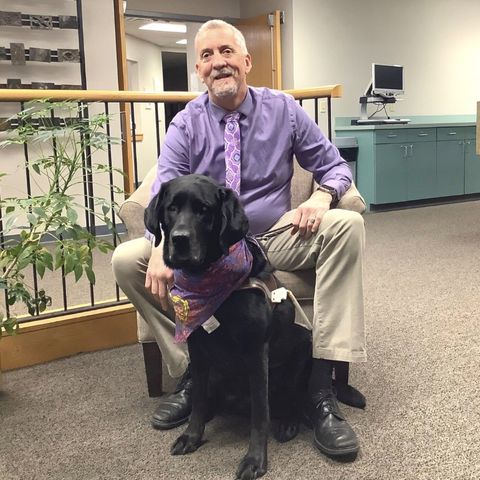
Our guest this week is Randy Pierce of Concord, NH who is an author, avid outdoorsman, mountain climber, keynote speaker, president & CEO of Future In Sight New Hampshire, and who himself if blind.
Randy and his wife, Tracy, have been married for 15 years.
When Randy was in his early 20s he suddenly went blind in one eye and then over a number of years would lose sight in the other eye. If that wasn’t challenging enough, Randy also lost the ability to walk for the better part of two years. After a series of medical procedures and through old fashion grit and determination, Randy regained his ability to walk and has become an avid outdoorsman and mountain climber.
Professionally Randy is president & CEO of Future In Sight New Hampshire, a non-profit providing essential services and support for over 100 years to children, adults and elderly living in New Hampshire who are blind and visually impaired.
Randy is also author of the book: See You At The Summit: My Blind Journey From The Depths Of Loss To The Heights Of Achievement, a brilliant and inspirational read.
There was so much to cover we decided to break his interview into two parts. This is Part #2 of Randy’s SFN Dad To Dad Podcast interview.
Show Notes –
Phone – (603) 546-8542
Email – rpierce@futureinsight.org
LinkedIn – https://www.linkedin.com/in/randy-pierce-2020/
Website – https://futureinsight.org/
Heroes of Summer YouTube – https://www.youtube.com/watch?v=DmUKmbNLvag
Book – See You At The Summit: My Blind Journey From The Depths Of Loss To The Heights Of Achievement – https://tinyurl.com/y6kwpvjh
Transcript:
Randy Pierce: But we’re all each distinctive and that unique aspect is where we get our strengths. You know, you’re going to have a strength that I may not and boy, I’d love if we can share that so we can both benefit and vice versa.
Tom Couch: That’s our guest this week, Randy Pierce, an author, avid outdoorsman, mountain climber, keynote speaker and president and CEO of Future In Sight New Hampshire, working to help children and adults who are visually impaired and Randy himself, who is blind. This is the second of two parts of David Hirsch’s conversation with Randy Pierce, who has an amazing story to tell. Now say hello to the founder of the Special Fathers Network and host of the Dad to Dad Podcast, David Hirsch.
David Hirsch: Hi, I’m David Hirsch, host of the Special Fathers Network Dad to Dad Podcast. One brief message. The Special Fathers Network Mastermind Group experience is the most comprehensive program the 21st Century Dads foundation offers. Dads raising children with special needs, meet virtually on a weekly basis and form meaningful relationships while sharing weekly wins, discussing books and sharing, heartfelt challenges. One of the highlights of the year is attending the in-person weekend retreat scheduled this year from September 5th through the 7th. As you think about the year ahead, I invite you to join one of the existing or soon to be formed SFN Mastermind groups and join a group of like-minded dads to become the best version of yourself. It might just transform your life as it has done for so many others. For more information please see the show notes or simply go to 21stCenturyDads.org.
Tom Couch: Now let’s listen to part two of this conversation between Randy Pierce and David Hirsch.
David Hirsch: I’m thrilled to be talking today with Randy Pierce of Concord, New Hampshire, who’s an author, avid outdoorsman, mountain climber, keynote speaker and president and CEO of Future In Sight New Hampshire, a nonprofit providing essential services and support for over 100 years to children, adults and elderly living in New Hampshire who are blind and visually impaired and Randy, who is himself blind. Randy, thank you for taking the time to do a podcast interview for the Special Fathers Network.
Randy Pierce: Well, thank you for the opportunity and for all the work you do. Uplifting fathers and people and you know, 386 weeks or so now.
David Hirsch: So how do you define success when the traditional metrics like site are no longer available?
Randy Pierce: Huh? How does site set a metric? Maybe I’m so far removed of it I don’t even think of it that way. But what do you mean by that?
David Hirsch: Well, I think it has to do with defining achievement, redefining achievement.
Randy Pierce: Yeah. So Achievements to me are you define those when you’re trying to reach them. Right. I mean, sometimes we have achievements we didn’t expect, and that’s great. That’s the magic on the path that I’ll certainly celebrate. But usually we’re defining the goal and I don’t know how my sight influences that. And like I said, I’ve been totally blind long enough now that maybe that’s just not it. I think of the thermometer that when you were trying to do a fundraising goal, right. They’d raise the temperature till you hit the dollar amount. I can think visually like that. But my goals are what is it I’m trying to achieve? And they’re, they’re rarely site based. they’re usually connection based. How do we as people find better ways to understand each other, to accept our differences as people? We have so much more in common than different. That’s great. That’s where you use that commonality to build your trust, to build your communication. But we’re all each distinctive and that unique aspect is where we get our strengths. You’re going to have a strength that I may not. And boy, I would love if we can share that so we can both benefit and vice versa. So my success is usually defined very clearly, usually has a strong team theme to it, but it’s what do we want to do, what do we need to do and how do we get there? and for me, that has no visual component. The only thing sight aspect has given me is a determination that I know it’s possible. I just have to figure out how. And maybe it’s given me a little patience because candidly, things take a little longer for me. Right. I can’t just glance and assess a room. I may be able to do it with a phone and artificial intelligence, but it’s going to take time. Or I may be able to do it tactilely. Right. There’s a whole host of ways, but it takes longer. And so I’ve learned patience. And, you know, I think the most meaningful things probably are worth the investment in time to be patient and get there. Yeah.
David Hirsch: Thanks for the insights.
Randy Pierce: No pun intended.
David Hirsch: Well, the whole conversation is about the insights. No pun intended. In, what way can those of us without the physical disabilities learn from your story to overcome our own invisible barriers?
Randy Pierce: Yeah, I think each person, we have an accountability for what we take away from any situation. So I can’t affect what somebody is going to learn. They get to do that. It’s keep your goals and what you can control. But I want to present a meaningful,
00:05:00
Randy Pierce: hopefully, you know, impassioned story that highlights some of the possibilities. And what resonates is what people take away. But I will say that accountability, you know, we often view it in such a punitive way, right. If you don’t do this, here’s the negative consequence you can expect, right? That’s the kind of mindset we think of in accountability. And like I told you earlier in this conversation, avoid the negative. Absolutely agree with that. But I think it’s even more powerful to promote the positive. Accountability is if I do this thing, here’s some of the positives I can expect as a result. So people have to say, hey, I’m engaged, I’m connected. I’m listening to see what resonates for me. And I think the most powerful thing I can say is that our first barrier is usually inside our mind. And I read this book, Buddha’s Brain, right? We all have this voice in our head that tells us we can’t, we shouldn’t, we’re not good enough. It usually happens at the time that we’re trying something daunting, something new. And when that voice is talking, here’s what Buddha’s Brain gave to me. In that moment, we’re not the voice. Of course, it’s us. It’s in our head. It’s our voice. But in that moment, we’re the one listening. And listening is passive. And I am a big believer of action, right? And if you choose to take an active role, even inside your head, of course I can do this. Don’t let that voice just say that unresponded, right? Be the voice of saying, look at all the things I’ve accomplished. Remind yourself of those that demonstrate why I’m going to be able to overcome this challenge, right? So it’s that mindset first. It’s called, you know, often imposter syndrome when we’re doing that. But the solution is the same. Just to remind yourself that you’ve built that foundation, Right? It’s the Henry Ford believe and achieve mindset. But I think, you know, if I were to say one more thing in that front is that resilience is something we develop. It’s a skill. It’s not you have it or you don’t. I hear that so many times. You’re so lucky you have so much resilience. Well, m. There’s some luck there, sure. But it’s also a skill I’ve developed. And I developed it not just with hard adversity, going blind, getting put in A wheelchair, though, those help. But with this mindset of, I’m going to choose positive adversity because practice makes progress, I will get better and better at handling all the kinds of adversity because I know we’re all going to face it again in various ways, and I’m going to embrace it, saying, okay, here’s another opportunity for me to take that reason mindset, right. To find the answers.
David Hirsch: I love it.
Randy Pierce: And I throw one more out there if you want it, too.
David Hirsch: Sure.
Randy Pierce: You know, people, often tell me, they look at all the things I’ve got to do and they say, you know, you’re so lucky. And I do feel fortunate. And I think about, you know, John Lennon made famous this quote. He said, life is what happens while we’re busy making other plans. And I get it. I didn’t plan to go blind. And my response to that is what’s most important. Right. And I certainly think that, you know, choose the right response, because how you respond is going to have a bigger influence than the challenge. But here’s where I’m going to turn it around and say, I think John Lennon got it wrong. A lot of it. Because life to me is more often exactly about what I plan. That’s that active mindset I suggest. And somebody says to me, hey, we should get together sometime. I don’t say, yeah, and then wander off, and we never do. I say, let’s pull out our calendars. Let’s put something down. Let’s find the first opening. And, you know, what if something happens and we need to change it? Okay, if you’re not sure, let’s put it down and we’ll reschedule. We won’t cancel. But that’s choosing that action every step of the way. It’s, you know, I talk to students. I sometimes say, the GPA mindset. It’s not your grade point average, though. That’s good, too. It’s the set your goals. P plan. Make a plan to figure out how you’re going to do it. What’s the easiest way we can succeed without it, but we’ll have more success with a good plan and fewer setbacks. And A is the action. Right? Because a goal, a plan, a wish, a dream is just that until you put it to action. And then it’s your life. And that’s where the magic happens.
David Hirsch: Yeah. Very powerful. you didn’t use the word intentionality, but that’s the idea, that comes to mind. You know, a lot of people have thoughts, but if you don’t Write them down. You don’t put a plan in place and you don’t follow through on those. No, you’re not going to have as much to show for the time and the effort. So thank you again.
Randy Pierce: Yeah, you’re welcome.
David Hirsch: If you could send one message to your younger self before vision loss, what would it be? And, why would that message change today?
Randy Pierce: You know, I think vision loss did the message for me. I would have said, boy, that the lesson in humility. I think I might try to reassure myself, hey, it is going to be okay. You’re going to have to do some work, but it’s going to be okay. And you’re going to be amazed by what’s ahead. But I wouldn’t want to alter it by giving too much. But you come out of school and we talked about top of the world. That’s confidence. Right. And there’s also overconfidence, which is less good. And there’s arrogance, which I’d like to say is downright bad. And let’s just say I’m pretty sure when I came out of
00:10:00
Randy Pierce: college, I might have been on the spectrum. Right. Somewhere in that group and not entirely healthy. And I think it was a good dose of humility for me to learn that. I think humility is good. that doesn’t mean I don’t celebrate myself, doesn’t mean I can’t have confidence. It just means I should keep it to confidence and be aware. That’s a good end point or a travel point.
David Hirsch: Thank you so much. Sadly, your brother Dan passed away at a very relatively young age. What impact has his life had on you.
Randy Pierce: Such a complicated relationship? You know, I have some joyous memories of my brother. For sure, they’re limited because he was 10 years older than me, but I saw him for the most part and with some understandable reasons. Right. I know his journey is hard and was harder than many in lots of ways. Some of that there was accountability. But he also rejected the hands of help in lots of ways. And, I get it. I’m stubborn, independent, strong minded, and want to sometimes not accept help. And I think he did it so much that he left himself without options and had built that pattern. And, you know, for me, his story is tragic. You know, there’s no secret. I, wish I could understand where are my opportunities to help guide him? What are the things I could do differently to potentially influence that? And then I remind myself I’m on that same journey and I try to remember not to reject the support that’s around me, especially when I need it, and to ask only when I need it, not just because I’m going to take advantage of a situation. To me, when I help someone, I feel great. When I give somebody an appropriate opportunity to help me, I’m giving them the opportunity to feel great. And as long as that’s not an exploitive situation, there’s some really great power. My brother never got that. And I think I can understand how he felt rejected by the greater community of the world. Some of that was his role and ways to change how he approached it. And I think about that all the time. For me, you know, I, I got on a bus one time using a cane at the time as a city bus, and I, right behind the driver’s the first seat, I said, is anybody sitting there? And nobody responded. And I turned around and put 6 foot 4, 200 plus pounds onto this poor woman’s lap. And I, I jumped up and I said, I’m so sorry. And I was frustrated internally right about, you know, I just asked if anybody’s sitting there. But I tried to quell that a little bit. I do have some techniques on that. But I ultimately said, you know, did you hear me ask if anyone was sitting here? And she said, yes. But I had never spoken to a blind person. And again, in my head, fortunately only in my head, I was like, the way you speak to a blind person is by speaking. But I realized that I had done the same thing as I told you. And I also realized something else, that she was being vulnerable and sharing that. So we had a really good conversation. But if I repeat that a hundred times, I might sit on 98 laps because I’m going to have the same problem, people not knowing. And you know, I always joke, right, someday one of those, one of those old ladies is going to be knitting and my world’s going to be a lot worse. But the reality is goals and what you can control. I changed my approach. So now when I get in that similar situation, I would say, excuse me, I’m totally blind. So I’m going to need you to answer me out loud. Tell you clearly what I need is anyone sitting there. Now, if I still don’t hear anything, then I either know they want me to sit on their lap or there’s nobody there, right? And, you know, either way, that’s a message from my brother, is that what can I change about what I do to help my world around me better work for me and the folks around me?
David Hirsch: I love It. So, you’ve had some, extraordinary accomplishments, physical accomplishments, and two of them that come to mind. Climbing Kilimanjaro and then that Tough Mudder experience. I remember seeing the video, a YouTube video of your Tough Mudder experience. I’m like, oh, my God, this is like breaking down all the paradigms I’ve had with people that are sight impaired. what would you say that the big or simple takeaway is from each of those experiences for you?
Randy Pierce: You know, I had those experiences because I chose. And, you know, there was a lot of work. Right. I mentioned the planning, right? John, Wooten modified a quote by Ben Franklin. In a way, I like John Wooten, right? Winningest basketball coach in college history. Said, we don’t plan to fail. We fail to plan. You want to do something, dig in. How can you do this? You know, you don’t just say, hey, let’s go climb Kilimanjaro and go, out tomorrow and do it. You’re going to train on other mountains. You’re going to learn what are the obstacles you’re going to encounter, how you’re going to do them. Same thing from the Tough Mudder. It’s the same mindset, right? Learn what every obstacle is going to require and then find ways you could approach it. Not every one of them is going to work. But you know what? No plan survives the enemy, right? You adapt. And
00:15:00
Randy Pierce: the trick is, none of it happens if you don’t set that goal. and I can’t even tell you all of the details that led to those goals, but it was the confidence that says, I’m going to look around my world and be open to what are possibilities. And that’s the gift of confidence I said earlier, competence. Getting your good skills leads you to be confident. But what I didn’t say is what confidence leads to. We do risk management all the time. I like to say I’m a problem solver, not a risk taker. And risk management just says, hey, you know what, what is the risk here and what can I do to mitigate it? And we usually say it in the, if I take this risk, here’s the terrible things that can happen. What we forget to do all too often as people is say, if I don’t take this risk, what might happen? Because there’s an answer there, too. It could be stagnation, could be emptiness, right? There could be reasons that make you say, don’t just avoid the negative, promote the positive. This is a risk. This is an opportunity. I want to take so let me figure out how to do it the right way and that, you know, Kilimanjaro, the Tough Mudder, both were examples of that. Yeah.
David Hirsch: Well, thank you for sharing.
Randy Pierce: Very powerful.
Tom Couch: We’ll be back with more of the conversation on the Special Fathers Network Dad to Dad Podcast in just a few moments. But first, this quick message. Please help 21st Century Dads gather research on families raising children with special needs by having them complete the Special Fathers Network Early Intervention Parents survey. A link to the survey can be found in the show notes. As a token of our appreciation, each person, mom or dad, who completes the survey will receive a great dad coin. Thank you. Now back to the conversation.
David Hirsch: So you’re a super Patriots fan, and I’m wondering if you can share or highlight experience, if I can call it the highlight experience of being a Patriots fan.
Randy Pierce: Maybe different than most people would expect. I built a relationship with a guy named Teddy Bruschi, right? We share a birthday. We built a good friendship. Teddy Bruschi had a stroke. And, when he had his stroke, I was totally blind and in a wheelchair at the time, and I was still going to every game, and we were still conversing regularly. He has this stroke, and he can’t see out of the right quadrant of both eyes, and he’s struggling to walk. And there was a lot of discussion between us about, like, how do you handle it? Because right in the moment, it’s hard. You know, if I asked all your viewers right now, you know, I want you to imagine being blind, and what I’m going to ask you to do, to do that, I’m going to ask you to close your eyes and see how that feels. That’s not what being blind feels like. That’s what being instantly totally blind feels like. That’s not where I’m at, nor was it where Teddy was, at. Right? It’s the moment of anything is the hardest. It has to be if every step after that you work towards resolving it. We had these conversations, but here’s where I want to take you. Teddy went back and played a little more football. it did shorten his career, I have no doubt. But he became a stroke advocate, and my dad had a stroke, and my dad quit. And that was really hard for me. And, you know, with all the things I do and all the things I’ve overcome, and I couldn’t encourage my dad to go because the people closest to you are the hardest ones to do. But Teddy wrote a book, Never Give up. And it came out while my dad Was struggling with his stroke. So you bet. I made a trip down to the book sign and told Teddy I was bringing my dad down. Asked him if he’d give him a few moments. And so we get there. As soon as we get there, there’s a line, they haven’t started yet. Teddy sees us and he pulls us into the back room and he says, you know, he calls me Zip for a variety of reasons, but he’s like, zip, you mind if I just have a conversation with your dad? I’m like, no. And I step out and my friends and I were in a different room and they’re giving me a play by play and he’s down, crouched, he’s holding my dad’s hand and he’s talking to him earnestly. And my dad’s speech was very affected. You had to work hard to hear him during that. But here’s the thing. When we left there, my dad was totally motivated. Next day he’s working OT. They’re like, this is a different guy. Because when you’re ready to try, your body is going to grow, your brain is going to grow. And how much you know, we never know that. But what you almost can guarantee is if you’re not willing to try, you don’t get there. So what’s one of my greatest Patriots moments? Nothing to do with football has to do with connections of people, has to do with watching a quality human who happened to be a New England Patriot player deliver one on one speech to help somebody. And all he did is relate. He took the time to get at my dad’s level, to fully connect with him, to empathize and to share and encourage. And boy, you know, I told you, teams are what I’m about. And when you have people like that on your team, that’s the biggest win you can hope for.
David Hirsch: Yeah, well, very powerful story. Thank you for sharing that about Teddy Bruschi and, impact that he had on your dad specifically. That’s just an anecdotal story. I’m sure he’s had an impact on thousands, tens of thousands of other people
00:20:00
David Hirsch: as well. What I was thinking you were going to tell me about was going to the Super Bowl.
Randy Pierce: Yeah, I am very fortunate. You know, I. Candidly, I don’t think I could afford to go to a Super Bowl. There’s so much cost associated with it. But I’ve got to go to 2 at no cost. And, the deal was building community. I built a website to practice learning how to code a computer without sight, to use A screen reader, jaws to do it. And the first page I built to practice was a Patriots page. And it was a year that the Patriots, went to the Super Bowl. 1996. It was their second Super Bowl. But it got a lot of attention because websites were still pretty new. Hey, here’s this guy. He’s got this fun website. He’s got a doghouse for players who don’t play well. He writes previews and reviews. So built up a good community. And I got into a couple of papers. The Globe and the Herald featured me. And that community of people who follow my website really didn’t matter that I was blind. But it carried on. And a, few years later, when the Patriots went to their first super bowl, they had started a fan of the year award. And all of the community that have been part of it said, hey, let’s get Randy into the Pro Football hall of Fame. And that’s what they did. They wrote in date. The Patriots said they’d never had more candidates right in for one person. So they called me up, gave me the award because he was going to the Super Bowl. The NFL heard about the story. They named me the ultimate fan. Put a plaque in me and my guy Doug in the Pro Football hall of Fame. And they sent me to that first Super Bowl m front row balcony seats in New Orleans for the, for the win over the Rams. But, you know, really fun moment that I think is worth sharing, like, everything about the game. How could you not love it? And I was still on a journey to get past my blindness and believe it. It was a long journey. I was making good progress. But moments of that make you pinch yourself, right? And I was in radio row doing a radio interview with Emmett Smith. And I’m just thinking, you know, here I am with this amazing player, and we’re talking about my team has no chance to win. And he’s like, you know, hey, it’s great that your team got here, but the Rams are the greatest show on turf. And, you know, I think you’ve got to celebrate that your team was good enough to get here. This isn’t one they can win. And I said, Emmett how many times did you go to a game with a team that was maybe better than you on paper? Did you just quit or did you say, here’s what we need to do if we want to win? And you maybe can’t control all of those things, Control what you can, but, you know, you set out to do that, and if your plan was good and you gave it execution you probably took some of those games. He’s like, of course, yes. But this one, this is different. And I’m like, well, how is it different? And he says, it’s different because I am an NFL star. And you know what? I like you. you’re knowledgeable, but you’re just a fan. And I had just been told that the NFL was putting my plaque in the hall of Fame, and he wasn’t there yet. And I was like, Emmett, I gotta tell you, I just got announced, I’m going into the hall of fame. You gotta wait five more years, so maybe I have a little more credibility. And he laughed himself off his chair onto the floor. It was, it was a great moment, right? But it’s also a powerful moment about, hey, are you going to accept fate or are you going to say, you know, I get to influence this a little.
David Hirsch: I love it. Thank you for sharing. Very powerful. I know that, you were, in a fraternity when you were at UNH. I think it was, if I remember, Phi Kappa Theta. And I’m wondering what role the fraternity has played in your life.
Randy Pierce: Well, first off, and I love this to this day, I am connected with a lot of the folks that were in that fraternity. And I look at them and I think, what good people. And there’s a little bit of luck there because far and wide, we never know the influences we choose. We hope we make healthy choices. And I look at these people and I think, boy, I was making a lot of dumb choices. But these are good people. And they’re demonstrating it consistently today. That makes me proud. you know, there’s. There’s the quote. Was it Mark Twain said, I don’t know that I would join any organization that would have me. And I wonder about my 19 year old, Randy. But I think we all had to grow together and we did. And they gave me experiences. You know, I got to be the housing chairman that learned how to build our first house. And I learned so much about the business world from that. Or I got to be, the person who went out and recruited people. And, I got to learn how do you connect with people when. How do you find that common ground that makes connection easier? You know, I just, I think it gave me an opportunity to learn a lot, to practice. Sort of like growing up in a small town, right? You can do all those things. You play every sport, band, chorus, drama club. Because they need bodies. Well, similarly, a fraternity gives a microcosm that gives you a lot of opportunity to find yourself. Right? And I Think it had a huge role, but the biggest role by far to this day, the people, those connections matter. You know, I’ve got a bunch of my fraternity brothers who volunteer to help, my organization today. I’ve got some who have served on boards with me. When I founded an organization, it just people, the right people in
00:25:00
Randy Pierce: your life will lift you up to higher summits. Right. And I want people who won’t waste any energy in pushing people down, because that’s lost energy for you and for them. Every bit of it should be, how do we help each other climb higher? And that is to see you at the summit mentality that, you know, I fortunately surrounded myself even back then.
David Hirsch: I love it. Well, we both had very, very positive fraternity experiences. And, you look back, you know, when you were. I think I was 17 when I joined. I joined as a senior in high school, right. They allowed individuals to go through formal fraternity rush. If you were admitted to the university, like that spring before you actually started in the fall.
Randy Pierce: Wow.
David Hirsch: You know, you don’t know anything about anything, right? As a senior in high school, you think you do, but, you obviously don’t know anything. And, it’s been an extraordinary experience. Maybe for another conversation or a beer.
Randy Pierce: Yeah. I love it.
David Hirsch: I’m thinking about advice now, and I’m wondering what advice you can share with parents, specifically dads who have a child, whether it’s a young child or young adult child for that matter, who’s struggling with a disability of some sort. It could be a, physical disability, an intellectual disability.
Randy Pierce: It’s funny the way you frame that. I’d share that I generally find the father’s struggle, because that was the word you used with the disability more than the person who experiences it. That doesn’t mean that they don’t necessarily struggle with it. That’s not my point. It’s that the fathers often struggle more because they can’t carry that load and they don’t know how to do it. Kind of like my dad didn’t know how to handle it. I tend to shy away from advice and share opinions and let people extract what resonates for them. Because every situation can be so vastly different. And here is some observations I had. One of the more powerful moments I’m doing this presentation to. I think they were 10, 10, years old. And I asked the students often how I start a lot of my presentations at the school level, what do you think a blind person might not be able to do? And they give me all sorts of suggestions. Well, you can’t read. And we talk about Louis Braille developing braille when he was 14 years old, which. Right. He was a student when he solved the problem. So any age to solve it or, you know, sometimes they’ll call out athletics. I love when they call it swimming. You won’t be able to swim. And I’ll say, well, if you know what to do, do it. And I shout Marco. And they all shout Polo. And I’m like, well, you’ve all swum blind. And it’s powerful for them to realize they’ve done it without knowing it. But I asked this question. You know, I go through all of them, drive everything, but this one young lad in a very disparaging voice says, you can’t play sports. And, I make a mental note. I’m like, there’s something behind this story. Because he said that, not accusingly, he said it with frustration, right? And so I said, well, you know, what sport? And he’s like, hockey. I was like, well, I don’t play hockey. Although, ironically, there’s a team in Hartford, Connecticut, that calls themselves the Hartford Braillers. They’re all blind. And they were mocking the Hartford Whalers as a, NHL team. But there are blind hockey teams. I haven’t ever played it, but I understand what’s necessary. You need to have a way of communicating with each other because you’re going to. Going to run into each other. Otherwise you need a puck that makes noise and you need a net that makes noise so you know how to aim it. And we talked kind of through that process and how I do that with soccer or basketball, because I’ve done those things. I just hadn’t done hockey. But I like that free form. And it’s not about what I can do. It’s right about what anybody who wants to will do. But when it was done, finished the presentation and teachers bring me up, somebody wants to talk to me. It’s that young boy who’s losing his sight. And why he was frustrated is he has all older brothers who were all athletes, but his parents had decided that it was too dangerous for him to play sports. Get it concerned. Don’t want your child to get hurt, right? That’s all fair. And boy, he’s going to be at such higher risk. But what they had done is artificially limited him, didn’t engage him, didn’t necessarily do all of the work to say, hey, is this really not possible? Or can we say what can we do to reduce the risks? I mean, driving is a terrible idea. If you’re drunk driving is a terrible idea if you’re texting and looking at your phone, right? All the distracted driving, Right. Similarly, playing a sport without sight has some risk. What can you do? Right. How can you make it less risky? Because I can tell you there was a bigger risk of how he was responding by being given the message, you can’t. You don’t get to. And so I would just encourage, be connected and be real about it. Right? Hey, how would we do that? That’s my favorite question. That’s what the folks, on our team, when we’re going out to somebody who’s new to sight impairment, we say, what are you not doing now that you used to do, and how might we do that? And so I would say to those fathers, right, Encourage the ability to dream. And I want to be careful because if, you know, if
00:30:00
I had a, blind child and he says, I want to be a neurosurgeon, I want to own the real challenges there. The truth is, neurosurgery is going to be mostly done by robotics and programming in the future, but somebody’s going to be doing that. So maybe he could be right. I don’t know. What I do know is I’d say, you know, right now, that’s pretty sight dependent, but we’re getting to that level that maybe there’s. I would say, what are the challenges? How are we going to do that? And what do you have to do to set yourself up for success? Well, for starters, you better get your braille underway in that instance, right? So it’s encouraging them to do the things that will help, not coddling them, but then giving them the space to do it. And that’s tough love sometimes because you got to watch. There might be some bumps and bruises along the way. You just try to choose to. How you limit them.
David Hirsch: Yeah, well, I think the message is a common one, which is you don’t want to put any limits or caps on what somebody is capable of doing, especially your children. And by preventing them from trying or engaging, we’re further handicapping our kids. And these are typical kids as well as atypical kids, for that matter.
Randy Pierce: You bet.
David Hirsch: Is there anything else you’d like to say before we wrap up?
Randy Pierce: You know, thank you first off for the opportunity. Right. Gratitude is so powerful. I am not positive every day. Right. I want to own that journeys are hard. We often try to compare our backstage past to somebody else’s highlight film. And right now we’re talking about all the good stuff. But it’s okay that things can be hard, and I want people to understand that. The trick is, how long do you want to leave it at the hard? How long before you say, I’m ready to start moving it towards the better? You know, there’s a quote by Nelson Mandela, don’t judge me by how many times I fall down, but by how many times I get back up. I like the quote. I don’t love it. Because first off, I don’t want to judge people. And second off, I want to know how he gets back up. And my answer, and this is why I went into it with gratitude first, is I look for something positive that I can focus on, forward focus that I can move towards, because positive. Once you get positive momentum, moving in a good direction, it gets easier and easier. Zig Ziglar used to say about inspiration, it’s like bathing. We should do it every day. And you’re a part of that, so thank you for that choice. But we should find inspiration in ourselves and all the world around us as often as possible, because that gets us there. And to that last end, I start every morning that I can, and I fail often, and I usually pay for it, but I take a moment of gratitude. I call it my cup of gratitude. And I think about three very specific things from yesterday that I’m grateful for. And practice makes progress. It used to be hard, I’d be like, ah, what else can I find? Now I usually find that I’ve got to select down because there’s so many, because there’s gifts. It’s not that they’ve changed. I’m just more attentive to them. And the mindset I get into by being grateful sets me up for the second part of it, which is then I say, what are three things I’m going to focus on today already with my mindset shifted focused to a positive. And I’ll tell you that gratitude, that benefit of inspiration, makes a difference in our everyday lives. So thank you for being part of that for lots of people’s journey. I hope you and I were a part of that for some people’s journey. and I’m sure going to be looking forward every day going forward.
David Hirsch: Yeah. Well, thank you for the, inspiring insights and the conversation. Let’s give a special shout out to Harrison Hoyes, one of my UBS Financial Services service work colleagues and host of the Careers for the Blind podcast for helping connect us.
Randy Pierce: You bet. Harrison’s such a great guy and what a great story in his own right. I know you know that his podcast is marvelous, but really what’s marvelous is his approach. And, you know, candidly, he’ll tell you he’s still in some of the struggle times, but you don’t let the struggle stop you from the doing.
David Hirsch: Absolutely. So if somebody wants to get a, copy of your book, meet you at the summit, to hire you as a speaker or to learn more about the work that you do at In Sight New Hampshire, what’s the best way to do that?
Randy Pierce: Sure. And thank you for that opportunity. So I’m the president and CEO at Future In Sight in Concord, New Hampshire, and we have a website, futureinsight.org. There’s, right off the first page, you can land on my speaker page. Right. Just look for learn more about Randy and, similarly, catch a couple of video clips. Book is available for people who are sight impaired. It’s on the, talking book program, so they could get it there. But it’s also on Amazon in audible. It’s paperback. It’s an eBook. Right. So it’s not hard to find. really appreciative. You know, there’s probably about 20,000 people who’ve taken the time to tour through my book. Not all of them have written reviews, but seems like people enjoy the journey. It’s raw, it’s candid, but I think it’s ultimately uplifting.
David Hirsch: I’ll be sure to include all that information in the show notes and make it as easy as possible for somebody to follow up with you. Randy,
00:35:00
David Hirsch: thank you for your time and many insights. As a reminder, Randy is just one of the individuals who’s part of the Special Fathers Network, a mentoring program for fathers raising a child with special needs. If you’d like to be a mentor father or are seeking advice from a mentor father with a similar situation to your own, please go to 21stCenturyDads.org. Thank you for listening to the latest episode of the Special Fathers Network Data dad Podcast. I hope you enjoyed the conversation as much as I did. As you probably know, the 21st Century Dads foundation is a 501c3 not for profit organization, which means we need your help to keep our content free to all concerned. Would you please consider making a tax actable contribution? I would really appreciate your support, Randy, thanks again.
Randy Pierce: David, thank you.
Tom Couch: And thank you for listening to the Special Fathers Network Dad to Dad Podcast. The Special Fathers Network is a dad to dad mentoring program for fathers raising children with special needs. Through our personalized matching process, new fathers with special needs children match up with mentor fathers in a similar situation. It’s a great way for dads to support other dads. To find out more, go to 21stCenturyDads.org.
David Hirsch: And if you’re a dad looking for help or would like to offer help, we would be honored to have you join our closed Facebook group. Please go to facebook.com groups and search dad to dad. Lastly, we’re always looking to share interesting stories. If you’d like to share your story or know of a compelling story, please send an email to david@21stCenturyDads.org.
Tom Couch: The Special Fathers Network Dad to Dad Podcast was produced by me, Tom Couch. Tune in again next week for another intriguing conversation on the Special Fathers Network Dad to Dad Podcast.
00:36:46