

407 – Jeff Wallis of Valparaiso, IN A Veterinarian & Father Of A Son Who Had HADDTS Before Passing Away At 18
Description
Our guest this week is Jeff Wallis, of Valparaiso, IN who is a veterinarian and father of who had a son with Hypotonia, Ataxia, Developmental Delay, and Tooth-Enamel Defects Syndrome (HADDTS) an extremely rare but serious genetic condition caused by a mutation in the CTBP1 gene.
Jeff and his wife, Mindy, have married for 22 years and are the proud parents of Charles 18, who very sadly past away in May, who had Hypotonia, Ataxia, Developmental Delay, and Tooth-Enamel Defects Syndrome (HADDTS) an extremely rare but serious genetic condition caused by a mutation in the CTBP1 gene.
We learn about a host of organizations that played a key role in the Wallis family and on behalf of Charles including; the HADDTS Foundation, University of Chicago Genetics, Kids Work and Jacob’s Ladder.
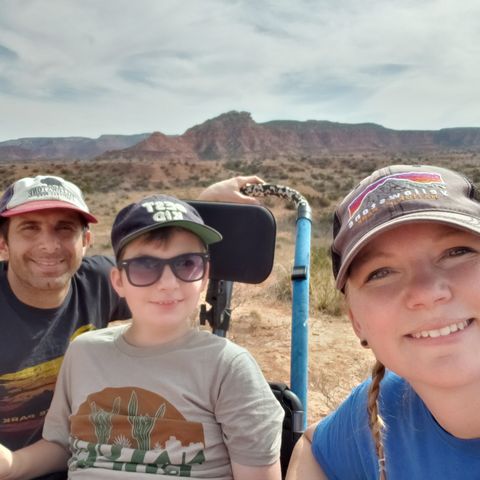
We also learn about an epic cross country RV trip the family took with Charles during COVID to provide him with some extraordinary memories.
While Charles lived a relatively short life, the Wallis family story one is about making the most of the situation and celbrating life.
Show Notes –
Phone – (219) 771-6129
Email – wallisje1@yahoo.com
HADDTS Foundation – https://www.haddtsfoundation.org/
Jacob’s Ladder – https://www.jacobskids.org/
Transcript:
Jeff Wallace is a veterinarian and father to Charlie who passed away recently
Jeff Wallace: We, believe that at this point in our lives, Charlie is in a better place and healthy because when he left us, he was not in good health at all. Please don’t be, afraid to go places, show them the world, and just get out and meet people and show the world how, special your child is.
David Hirsch: That’s our guest this week, Jeff Wallace, a veterinarian and a father to Charlie, who sadly passed away just a few short ago. Charlie was 18 and had an extremely rare condition called Hat’s disease. We’ll hear all about Charlie and Jeff and their family on this Special Fathers Network Dad to Dad Podcast.
David Hirsch: Dad to the dad, you’re not on your own. We walk this road together, hard and home.
Tom Couch: Now say hello to the founder of the Special Fathers Network and host of the Dad to Dad Podcast, David Hirsch.
The Special Fathers Network Mastermind Group is free for the first 30 days
David Hirsch: Hi, I’m David Hirsch, host of the Special Fathers Network Dad to Dad Podcast. The Special Fathers Network Mastermind Group experience is the most comprehensive program the 21st Century Dads foundation offers. Dads raising children with special needs, meet virtually on a weekly basis and form meaningful relationships while sharing weekly wins, discussing books, and sharing heartfelt challenges. The Mastermind Group is free for the first 30 days. Stop trying to figure out things on your own. I invite you to join one of the existing Special Fathers Network Mastermind groups. You’ll meet some extraordinary dads, exchange a lot of best practices, and recharge your fatherhood battery for the journey ahead. It might just transform your life like it’s done for so many others. For more information, please see the show notes or Simply go to 21st centurydads.org.
David Hirsch: Through every season, in every stride, great dads are present. 247365.
David Hirsch: Now, let’s listen in to this conversation between Jeff Wallace and David Hirsch.
Jeff Wallace is a veterinarian and father of a son with rare genetic condition
David Hirsch: I’m thrilled to be talking today with Jeff Wallace of Valparaiso, Indiana, who’s a veterinarian and father of a son who had hypotonia ataxia, developmental delay, and tooth enamel defect syndrome. That’s a mouthful. Haddts, an extremely rare but serious, genetic condition caused by a mutation in the CTBP1 gene. Jeff, thank you for taking the time to do a podcast interview for the Special Fathers Network.
Jeff Wallace: I appreciate the, opportunity to tell my story and to, continue Charlie’s legacy. Thank you very much.
David Hirsch: You and your wife Mindy have been married for 22 years and are the proud parents of Charles, 18, who very sadly passed away in May, who had hypotonia ataxia, developmental delay, and tooth enamel defects syndrome. Hadts an Extremely rare but serious genetic condition caused by a mutation in the CTBP1 gene.
Your parents divorced when you were very young due to infidelity
Let’s start with some background. Where did you grow up? Something, something about your family?
Jeff Wallace: My family, is interesting. It’s probably a family that a lot of people can relate to. My, My mom and my dad, got divorced when I was very young. My mom has been married, she’s on her third marriage now, my dad is on his fourth. They were divorced, when I was about, in kindergarten due to some infidelity. And then after that, my mom, who was an amazing human, we were a team. And she put herself through college becoming a nurse and working in the ICU for as long as I can remember. We did this in kind of the Detroit area, throughout our life. We did move to Florida when I was in about 8th grade and then back to Michigan in 9th and 10th grade and back to Florida and 11th grade. So we moved around a lot. But the biggest part of that is my mom’s family. My mom’s side of the family have an amazing, caring, loving side that between them and my mom, they were huge influences. As I grew up on my dad’s side, unfortunately, there were. There was a lot of tension and difficulty. My stepmom, my dad’s second marriage, unfortunately, when I was very young, about 10 years old, and my brother and sister one and three, she, took her own life and grew up knowing that happened and really added some tension within the family as we kind of grew and grew and grew. But I was very lucky to have the other side of the family to raise me and kind of, look more towards that side for role models, I should say.
David Hirsch: Yeah. Well, sorry to hear about the dysfunctionality that took place early on in your life as it relates to the parenting situation like, yourself. I was very close to my mom after my parents divorced as well. You know, you said something that really, struck a chord with me, which is,
00:05:00
David Hirsch: you know, learning from the different examples, right? Emulating perhaps the family members that were getting it right, the ones you wanted to be more like, and then maybe living vicariously so that you don’t repeat some of the same mistakes that you witnessed or you experienced, you know, when you’re growing up and while you weren’t that close, what it sounds like to your dad, I’m wondering, what, what did he do as a career?
Jeff Wallace: he was a Michigan, state police officer early on and then, did insurance fraud investigation for Blue Cross and Blue Shield later on in life.
David Hirsch: Okay. And is he still alive?
Jeff Wallace: Yes.
David Hirsch: Okay. And, how would you characterize your relationship with him?
Jeff Wallace: We talk about, once a month. You know, I wouldn’t call it a deep relationship. I would call it a loving, more superficial relationship. I think, we both have changed as time goes on. And I would say that I wish, he would have been closer to Charlie. I think, he would have grown more and, seen the wonderful side of Charlie. But I also know from what I know as I grow and go to therapy and all these things that you can only expect from people, what they can give. And I don’t know if, he can, give more.
David Hirsch: Yeah. Well, thanks for sharing. It’s really hard to understand or appreciate why people do what they do. And, I think a lot of challenges in life have to do with expectations, you know, not being met. Like you had said, sometimes people can’t give what they didn’t receive themselves. So there might be some things about your dad’s past that, have been challenges and put some limits or, barriers up. And, you know, the sooner that we can let go of what people think, say or do. Right. And not let it, you know, sort of, internalize, you know, I think it provides a certain level of freedom, and allows you to focus on what you do, have control over. And then you realize there’s very little we have control over. Yeah. So, anyway, thank you for sharing. My heart reaches out to you.
Any important takeaways from your relationship with your dad or stepdad
Having said all that, any important takeaways, lessons learned directly, indirectly, as a result of the relationship with your dad?
Jeff Wallace: I believe that it gave me more patience with life, especially with, life of a special needs child with a progressive disorder. It allowed me to also be patient with the people around me in regards to family. One other person to put out there as well as my father is, my stepdad, Ron. We have had our ups and downs, but what I do know is we love each other very much and would always be there for each other. And as far as lessons from all these people, including my father, I think patience, honesty is really big. Kindness is a huge part of my son’s legacy as well as me moving forward.
David Hirsch: Yeah. Well, it’s interesting that you mentioned, the words honesty and patience. You may or may not be familiar with the, great dad coin, but you will become more familiar with it in a very short period of time because, when we came up with this idea a decade or more ago, we identified four attributes that, all great dads possess. And, two of them are patience, and Honesty. And then the other is commitment.
Jeff Wallace: Ah.
David Hirsch: And love. And I suspect that those were some of the attributes that you were referring to when you were referring to your stepdad Ron.
Any other individuals that uh, played an influential role in your life
Any other individuals that played an influential role in your life, father figures or grandfathers for that matter?
Jeff Wallace: Yeah, on my mom’s side, my grandpa, her dad had eight children and four uncles, four aunts and all of them growing up. My male influences, my Uncle Sam, my Chuck, my Uncle Tony, my Uncle Jim were all influences. My grandpa Charles, Charlie’s namesake and then not as a young child, but as the father, my father in law, Bob Woods, Mindy’s dad, he has been very much an influence on how much he loves and cares for his family, how much he’s cared for Charlie throughout his life. That those people are a, big influence on the type of dad I wanted to be as we went through Charlie’s life over the last 18 years.
David Hirsch: Yeah, well, thank God for the Charles, Milan and Robert woods of the world. Right. just because. Right. You look back now with some perspective writing, you can see the influence that they’ve had on your life. You don’t take things for granted. Right. When you’ve got individuals like that in your life.
Jeff Wallace: Absolutely.
David Hirsch: So thanks for sharing.
David Noah says he knew from a young age he wanted to be a veterinarian
So my recollection was you took a bachelor’s degree in zoology and aquarium science from Michigan
00:10:00
State University. So you’re Spartan. Go Spartans. And you did your doctorate at Ross University, clinical work at ah, University of Illinois Urbana Champaign, Golini, that’s one of my alma maters. And you started your career in veterinary medicine, doing emergency and critical care. And now you have more recently a practice, of your own. And I’m wondering, did you know from a very young age that you wanted to go into vet medicine or what was it that drove you to that?
David Hirsch: I did.
Jeff Wallace: I mean ever since I was a little kid I remember wanting to be a veterinarian from the time I had a hamster as a young man and. As a young boy and took care of him and had dogs as a, as a child. But my whole life all I can remember is wanting to be a veterinarian. And as I went through high school and undergrad, there really was no other option. This is what I was going to do with my life.
David Hirsch: I love it. My mom was one of those moms that let us have almost anything that we wanted as pets. You know, you realize how much patience that must have taken. They didn’t all live very long. Right. With two really young kids taking care of them. but, I do share, a passion for animals, as well. So, but that wasn’t my career calling. I’m sort of curious, Noah. How did you and Mindy meet?
Jeff Wallace: We, we actually met at, Michigan State University. You know, it’s interesting how things work out. Well, I’ll just be honest. I didn’t study as hard as I should have when I was at Michigan State, so I had to stay a fifth year to finish up all my, all my, credits to, to get into vet school. And if I wouldn’t have stayed that fifth year, I wouldn’t have met Mindy. So, if I would have been a more astute four year student, I would have never met my wife. So it’s kind of interesting how things work out that way.
David Hirsch: Yeah, well, it is a fascinating insight. Maybe it’s ordained it was fate that, you would take longer than anticipated. I’m sure that gave you some anxiety, maybe your mom’s anxiety, having to pay for a fifth year of school. But you can look backwards and say, hey, if it wasn’t for this, where would we be today? That’s a beautiful thing.
Jeff Wallace: David, before we move on, can I just quickly say something, in regards to my history, and work history? I started, my veterinary career in general practice. Then I went to er, and then now I’m in general practice again, but I, I’m an associate veterinarian, so I don’t own the practice. But there’s eight veterinarians there, with two owners. And so I just wanted to specify that.
David Hirsch: Okay, well, thanks for the clarity.
Charlie hads disease, a mutation in the CDBP1 gene
Let’s talk about special needs first on a personal level and then perhaps beyond. And I’m sort of curious now. Prior to having children, did you or Mindy have any connection to the world of disability or special needs?
Jeff Wallace: no, we did not. We kind of were like any young parents, came out of college and hit careers hard and, then worked on having a family and expected plan A, and we got plan B, which actually worked out, in my opinion, as a blessing.
David Hirsch: Plan B. Yeah. Well, thanks for sharing. What was Charlie’s diagnosis and how did it come about?
Jeff Wallace: Charlie, you know, as you had said, hads disease, H, A, D, D, T, S. It’s, a mutation in the CDBP1 gene. When Charlie was diagnosed with it, well, we started seeing, you know, delays and things when he was under a year old, but he. We didn’t actually know what it was until a couple years later when we Mapped his genome. And truthfully, science didn’t know what it was. We knew there was a mutation, but, even our geneticists said, we don’t really know what this means. There really aren’t that many people in the world that have been diagnosed with this at that point. I want to say there were more than five people within at least the company that maps the genome to know that this mutation was there. That’s how it kind of came about. And we, honestly, between us and our geneticists and our doctors, it was kind of flying by the seat of our pants because we didn’t know what to expect.
David Hirsch: So once you got the diagnosis, did that change anything? Or it’s like, oh, okay, now we know what it is. But the therapies or the treatments or the way that you’re going to help provide for your son, did that make a difference or not?
Jeff Wallace: It really did not, because we were just really reacting to what happened. You know, his, appetite started waning. And so we did all the things from appetite stimulants to, you know, oral OT and all this stuff. Then at three years of age, we decided to get a feeding tube. You know, when he was born, he started crawling, and then
00:15:00
Jeff Wallace: he walked. And then, you know, after a very short period of time, he needed a walker. And then at about five years old, he got his first wheelchair. From what we knew, we didn’t know how fast this was going to progress. We didn’t know how it was going to progress. So it was more trying to maintain what he had throughout basically his entire 18 years, reacting to, you know, one day he could. He could, you know, walk fine with his walker, and then the next day, he couldn’t bear his weight, and then trying to build that back up. So really, the diagnosis, I think, was nice to have, but it really didn’t change our approach in any way. It was just involving as many people as possible to get him the best care or the best, we’ll say, equipment that he needed to have the best life?
David Hirsch: Yeah, well, thanks for making that point.
Jeff and his wife decided to have Charlie undergo surgery to correct scoliosis
Was, there any advice that you got early on that helped put this thing in perspective, knowing that perhaps it was going to be, progressive?
Jeff Wallace: You know, I think, my wife and I both have a science background from being, you know, veterinarian. My wife is a veterinary technician. And, I think the best advice we got, actually, I don’t know if it was advice more than our geneticist saying this is abnormal and we need to look into this, because prior to that, for a good, you Know, year, almost two years, everyone was like, well, maybe we just need to wait longer. Well, maybe this. You know, maybe we just need to see what happens. and no one was willing to kind of put their, exact, you know, this is abnormal. We need to look into it. And as soon as we met him, he’s like, this is absolutely abnormal. And then once we got the diagnosis and his lead, I think his honesty of this is progressive. And unfortunately, at some point, he will most likely pass away from it from most likely respiratory complications and things like that. And so my wife and I, once we heard that was more. We just need to make his life the best we possibly can for the time we have.
David Hirsch: That’s pretty heavy, Jeff. That’s really heavy. So, knowing what you just said, what were some of the important decisions that you made to create the best life possible?
Jeff Wallace: I think, you know, we talk about, you know, the grieving that my wife and I are going through now. But truthfully, for most of Charlie’s life, we would grieve the loss of function of some kind and from going from walker to wheelchair. And I think the, the biggest points is, I think, like a lot of people, we were very hesitant to get a walker, hesitant to get a wheelchair, because it’s almost like we failed. But it actually gave him so much freedom with his decrease in abilities that once you. He got it, you were like, oh, my gosh, we should have done this much sooner. So, number one, use the equipment. Two, he, as time went on, developed scoliosis very severely. And we had a wonderful surgeon at, Lurie’s, and it was progressing so fast at some point that we’re like, okay, we need to wait through this season and get it to surgery. And between all three of us, we decided we needed to go sooner than later. And we were very lucky we went when we did, because how fast it was progressing actually would have prevented him from having that, surgery. And he was in a lot of pain. So I think that surgery and the timing was pretty perfect to extend his life out.
David Hirsch: Thanks for sharing.
Charlie and Mindy renovated their camper to be handicap accessible
my recollection, maybe it was from a prior conversation, is that, you and Mindy decided that, hey, this is going to be a shorter situation than we anticipated. You’re living through Covid, and you decided to do something. Well, I’ll just say it’s way off the beaten path. What was that?
Jeff Wallace: Yes. Covid hit and. And again. Just like you said, we knew things were, going to be shorter than we want. We wanted Charlie to See as much of the United States possible. So we purchased a bus, like you would, you know, see driving around a city or a nursing home bus, you know, kind of a transit bus. We, renovated it to be a fully handicap accessible camper wheel, wheelchair lift in it, and Charlie and I actually built the kitchen cabinets together, the storage unit together, and every storage place had room for his equipment, whether it’s his pneumatic vest or his BiPAP for his bathroom wheelchair versus his motorized wheelchair versus his hiking wheelchair. We had a spot for everything. And it allowed us to travel from the east coast to go to Acadia, to the west coast to go to Big
00:20:00
Jeff Wallace: sir and Joshua Tree, up, to Yellowstone and Yosemite, Colorado, Texas. It allowed us to take them all over the country and camp. And it was pretty amazing.
Please help Fathers Network gather research on families raising children with special needs
David Hirsch: So how many months, how long were you on the road?
Jeff Wallace: Well, the interesting part is when I changed jobs to the er, it allowed me to take two weeks off at a time. So we would take these two week trips. And then just about six, eight months prior to him really getting sick, they allowed me to take two months off to travel in the Southwest because his doctors had always recommended getting out of flu season and going somewhere better, so warmer. So that’s where we went. We went, to Arizona, California, and kind of traveled in the Southwest and up the California coast for about two months and then circled back. that was our longest trip.
David Hirsch: That is, it sounds like it would, have been a journey. And ah, no doubt some people, maybe family members, thought you’re crazy, right? Just because. And, did the bus have a name? Did you name it the SS Beagle?
Jeff Wallace: Yeah, the SS Beagle. Because one of our favorite breeds are our beagles. And Charlie had a beagle when he was younger. And then we have a beagle currently. So yeah, the SS Beagle was a, huge part of our life.
David Hirsch: We’ll be back with more of the conversation on the Special Fathers Network Dad to Dad Podcast in just a few moments. But first, this quick message. Please help 21st Century Dads gather research on families raising children with special needs by having them complete the Special Fathers Network Early Intervention Parents Survey. A link to the survey can be found in the show notes. As a token of our appreciation, each person, mom or dad, who completes the survey will receive a great dad coin. Thank you.
What was it that Charlie benefited from or your family benefited from?
Now, back to the conversation.
David Hirsch: I’m thinking about supporting organizations and I’m wondering, what comes to mind? What was it that Charlie benefited from or your family benefited from? When you look back on it,
Jeff Wallace: Definitely, University of Chicago genetics. Dr. Wagner and his assistant Sarah, they were a huge part of our lives, for his whole life, you know, Lurie, most of a lot of his doctors were there. Larry Children’s Hospital. And then, throughout Charlie’s life with all of his equipment and PT and all of his stuff. Jacob’s ladder was a big part of it. More towards the end, there is his PT in school. Diane was. I mean, gosh, he was with, him for most of his life. He really thrived when, when she was his pt. And then lastly, I would say the Valparaiso High School, whole special education unit. Tina Morales and Megan Lawrence were astounding at, really making Charlie feel at home with all the students there and, and really, giving him a high school experience that I don’t think he would have gotten anywhere else.
David Hirsch: Yeah, well, special shout out to the individuals that you mentioned, particularly Diane, physical, therapist that you made reference to. you know, these are the angels in the world, right? Because how could you do anything, you know, without some of these people stepping up or leaning in?
Jeff Wallace: Right. We, believe that at this point in our lives, Charlie is in a better place and healthy because when he left us, he was not in good health at all. And I think the biggest unit of all of this is the community we have, where we live, as well as our family. I think those were our biggest supporters.
David Hirsch: Thanks for sharing.
You volunteered to be a mentor father for the Special Fathers Network
So I’m thinking about advice now, and I’m wondering, what advice would you give to a parent, dad in particular, who finds himself in a similar situation, you know, with one of these super rare diagnoses? Looking back on it, I think,
Jeff Wallace: Two pieces of advice. I think, the first one is with a rare progressive disorder, you’re not alone in the grieving as you go. You know, all those anger and blame, that is such important steps to go through. Me, personally, I. I had to go through some anger management therapy to become the father I wanted to be because I wasn’t coming to terms with my son’s illness. Please know you’re not alone going through all of that. the second one is, you know, everyone’s situation is different, but I would say my wife and I really didn’t want to be limited to a hospital and didn’t want my son to be in a hospital all the time, even if that meant, you know, renovating a bus and
00:25:00
Jeff Wallace: doing that. Please don’t be, afraid to go places, show them the world, and just get out and meet people and show the world how Special your child is.
David Hirsch: Yeah, well, two really rock solid pieces, of advice. you’re not alone. And, you know, give one another the grace to go through the grieving process. And everyone’s situation’s a little bit different. And thanks for being so open and authentic about the, need to go to therapy in your own situation and then, you know, because everybody’s situation’s different, you know, try not to put any further limits on what you can or can’t do and think, outside the box. That’s what I sort of heard you saying. M. why is it that you’ve agreed to be a mentor father as part of the Special Fathers Network?
Jeff Wallace: I think, with 18 years of raising Charlie, I think I could be a very good listening ear to someone who. Is just starting out or has been doing it, a while and just needs someone to talk to and someone to relate to. And I think, honestly, I think Charlie would want me to help other people in this way.
David Hirsch: Yeah. Well, we’re thrilled to have you. Thank you so much for volunteering. given all that you and Mindy have been through, certainly in the last six months, just, you know, reflecting on it all and then, you know, the prior 18 years during Charlie’s life. Is there anything else you’d like to say before we wrap up?
Special Fathers Network is a mentoring program for fathers raising children with special needs
Jeff Wallace: I guess the only last thing I’d like to say is, when I was listening to the other podcasts, I think, when you enter the special needs community, what comes to mind in a lot of ways is the blessing that these special children bring to each family. And my son, as much as you talk to family members and everyone wished for a blessing so that he would be with us longer. Truthfully, he was the blessing. Even the disease was a blessing because of what it taught us. Charlie was always happy, kind, loving.
David Hirsch: All those.
Jeff Wallace: All those words on that coin that you told me that’s what he was. And I would say that I’m going to try to live out the rest of my life exemplifying the things that he taught me.
David Hirsch: Yeah, that’s really beautiful. Thank you for sharing. If somebody wants to contact you, what’s the best way to do so?
Jeff Wallace: well, they can contact, me by phone. 219-771-6129 would probably be the best way to do it.
David Hirsch: Well, I’ll be sure to include that and perhaps your email and the, show notes. It’ll make it as easy as possible for somebody to reach out to you. Jeff, thank you for your time and many insights. As a reminder, Jeff is just one of the dads who’s part of the Special Fathers Network, a mentoring program for fathers raising a child with special needs. If you’d like to be a mentor father or are seeking advice from a mentor father with a similar situation to your own, Please go to 21st centurydads.org thank you for listening to the latest episode of the Special Fathers Network Data Dad Podcast. I hope you enjoyed the conversation as much as I did. As you probably know, the 21st Century Dads foundation is a 501c3 not for profit organization, which means we need your help to keep our content free to all concern. Would you please consider making a text contribution? I would really appreciate your support, Jeff. Thanks again.
Jeff Wallace: Thank you.
David Hirsch: Dad to the dead. You’re not on your own. We walk this road together, hard and home.
David Hirsch: And thank you for listening to the Special Father’s Network Dad to Dad Podcast Podcast the Special Fathers Network is a dad to dad mentoring program for fathers raising children with special needs. Through our personalized matching process, new fathers with special needs children match up with mentor fathers in a similar situation. It’s a great way for dads to support other, dads. To find out more, go to 21st.
David Hirsch: Centurydads.Org and if you’re a dad looking for help or would like to open offer help, we would be honored to have you join our closed Facebook group. Please go to facebook.com groups and search dad to dad.
David Hirsch: Lastly, we’re always looking to share interesting stories.
David Hirsch: If you’d like to share your story or know of a compelling story, please send an email to david@21st Century Dads.
David Hirsch: Uh.Org the Dad to Dad Podcast theme was written and performed by Shane Madden. The show was produced by me, Tom Couch. Tune in again next week for another intriguing conversation on the Special Fathers Network.
Jeff Wallace: Dad to Dad Podcast.
David Hirsch: Through every season, in every stride, great dads are present. 247-365-247365.
00:29:47