

418 – Mike Griffiths of San Francisco, CA Exec. VP at CBRE & Father Of Two Including A Son With KCNB1 A Rare Genetic Disorder
Description
Order your copy of the new 21CD book: Dads Raising Chidlren With Special Needs & Disabilities: A Guide For 21st Century Dads on Amazon: https://amzn.to/4tdvjcv
Our guest this week is Mike Griffiths of San Francisco, CA an Executive Vice-President at CBRE, a real estate management firm and father of two children including one with KCNB1, a very rare genetic disorder.
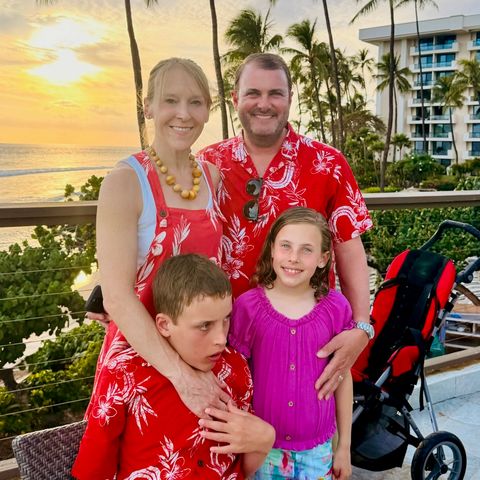
Mike and his wife, Julia, have been married for 17 years and are the proud parents of two children, daughter Rowe (9) and son, Hall (14) who has KCNB1, a very rare genetic disorder associated with severe developmental delays, intellectual disability, and various types of seizures.
Hall and the family have benefited from a number of organizations including; the KCNB1 Foundation, Support for Families with Disabilities, and Best Buddies to name a few. Mike has also participated in some endurance cycling events to raise funds for charity.
Mike is very authentic about parenting a child with a wide range of physical, intellectual and emotional challenges.
We’ll hear about that and more on this episode of the SFN Dad To Dad Podcast.
Show Notes –
Phone – (415) 407-7782
Email – michael.w.griffiths@gmail.com
LinkedIn – https://www.linkedin.com/in/michael-griffiths-63a87/
KCNB1 Foundation – http://www.kcnb1.org/
Best Buddies – https://www.bestbuddies.org/
Transcript:
Mike Griffiths has a son with a rare genetic disorder
Mike Griffiths: If you don’t live it every day and you’re not affected by this or have this exposure, it can be daunting and overwhelming and it’s a lot to process by yourself. But knowing people who have been through it, I’ve been at this for 14 years. Every day is a different day and a learning experience. And I’m going to know things when our son’s 18 that I didn’t expect or foresee. So that would be the advice I would have, is get involved with these kinds of communities and meet people who’ve been through this.
David Hirsch: That’s our guest this week, Mike Griffiths, an executive director at CBRE, an investment management firm based in San Francisco. Mike is married to Julie and they have two children, including Hall, a 14 year old boy who has KCNB1, a very rare genetic disorder. We’ll hear all about that and more on this Special Fathers Network Dad to Dad Podcast. Dad to the dad, you’re not on your own. We walk this road together, heart and whole. Now say hello to the founder of the Special Fathers Network and host of the Dad to Dad Podcast, David Hirsch.
The Special Fathers Network US tour will take place from May 21 to June 21
David Hirsch: Hi, I’m David Hirsch, host of the Special Fathers Network Dad to Dad Podcast. Two brief messages. First, I’m thrilled to announce our new book, Dads Raising Children with Special Needs and Disabilities. A Guide for 21st Century Dads is now available for pre order on Amazon, Barnes and Noble and other sites. See the show notes for additional information and how to pre order. Second, the Special Fathers Network US tour will be taking place from May 21 to June 21, Father’s Day. The tour will start in Maui, then Anchorage and then to Milwaukee and all around the US by RV to all 50 states. The purpose of the tour is to strengthen and grow the Special Fathers Network and to promote the new book. We’re still looking at confirmed venues for the tour and we can use your help for more information and see how you can help. Please see the show notes or Simply go to 21stCenturyDads.org through every
David Hirsch: season, in every stride, great dads are present. 247365 now let’s listen into this conversation between Mike Griffiths and David Hirsch.
Mike Griffiths is executive vice president at CBRE and father of two
David Hirsch: I’m thrilled to be talking today with Mike Griffiths of San Francisco, California, who’s the executive vice president at CBRE and father of two, including one with KCNB1, rare, very rare genetic disorder. Mike, thank you for taking the time to do an interview for the Special Fathers Network Dad to Dad Podcast.
Mike Griffiths: Thank you for the opportunity, David. I really appreciate it.
David Hirsch: You and your Wife Julie, have been married for 17 years and the proud parents of two children, daughter Ro, 9, and son Hall, 14, who has KCNB 1, a, very rare genetic disorder associated with severe developmental delays, intellectual disability and various seizures. Types of epilepsy. Let’s start with some background. where did you grow up? Tell me something about your family.
Mike Griffiths: I grew up in a town called Clark Summit, Pennsylvania, which is in northeastern Pennsylvania, just outside of Scranton, where, I was born. My parents, Wayne and Kathy, just celebrated their 50th wedding anniversary.
David Hirsch: Congratulations to Wayne and Kathy.
Mike Griffiths: Yeah.
David Hirsch: That’s exciting.
Mike Griffiths: Yes. So I’m the oldest of two. I have a younger brother, Tom, who lives in Denver, Colorado.
David Hirsch: Yeah, well, thanks for the quick flyby. That’s a pretty good milestone, 50 years.
Mike Griffiths: Yes, it is.
David Hirsch: Some people don’t even live long enough to get to their 50 anniversary.
Mike Griffiths: Right.
David Hirsch: Let alone celebrate it.
Mike Griffiths: Exactly, exactly.
David Hirsch: I’m sort of curious to know, what does your dad do for a living?
Mike Griffiths: My dad is, I’ll say quasi retired, but still keeping himself busy. He was, Both of my parents were bankers, retail bankers. So they worked in bank branches and managed bank branches in northeastern Pennsylvania for a number of different bank. My dad right now is. He’s 82, so just celebrated. He’ll be 83 in February, but he actually works every day, just part time. A couple hours in the morning, usually 8 to noon for a longtime friend of his who runs a car dealership in my hometown that I actually worked at when I was, in high school, so learned to drive from my dad when I was probably 14, and then used to wash cars and detail cars there. So he does the books for his friend Joe at, at the car dealership.
David Hirsch: I love that story. Your dad’s my role model. How would you describe your relationship with your dad?
Mike Griffiths: I would say it is close and has changed over the years. My dad grew up in my hometown, so he was the youngest of two. He has an older brother, Dave, who is still living and is retired in Arizona. He’s a very authentic. Wears his heart on his sleeve type of person, very emotional guy, which is where I get my, my waterworks. Crying. Gene from definitely comes from him, and his came from his father. My grandfather. David, was the same way.
00:05:00
Mike Griffiths: You know, his family is his. His sole priority. Always has been, I think was a good provider to my mom and my brother and I, and I think. But for him and my mother’s sacrifices in sending us to college and, you know, taking on that financial burden, my brother and I would not be where we are so incredibly grateful for their love and guidance and coaching along the way.
David Hirsch: Great, testimony. Thank you for sharing.
Your dad instilled in you the value of treating others with respect
So I’m thinking about takeaways. any important takeaways, lessons learned that you think about when you think about your dad.
Mike Griffiths: great question. I mean, I think my dad has probably instilled in me just the value of treating everyone with respect, no matter who they are. Whether it’s the, kind of. This is my own words, not my dad. But it’s like if the person is the janitor or the CEO, they put their pants on the same way, and they deserve the same level of respect and courtesy. That’s kind of the golden rule. Treat others how you want to be treated. I think my dad is, you know, has lived his life that way, treats people with respect and instilled that in me, for sure.
David Hirsch: Yeah. Very powerful. Thank you.
My recollection was that you went to Penn state, took a B.S. in logistics
My recollection was that you went to Penn state, took a B.S. in logistics, and then, UC Berkeley, where you got your MBA in real estate and finance. And I’m wondering, where did your career start and how did you get to be where you are today?
Mike Griffiths: Yes. So my first job out of Penn state was with PwC. I was a management consultant. So I started in 1999 out of school and worked in, Northern Virginia, just outside of Washington, D.C. those firms recruit large numbers of people. And I was, you know, start class of a certain week. There was 100 people in the room. I, would say probably 10 of those people are still some of my best friends to this day. It was a great experience. Didn’t know really what I wanted to do coming out of college. I had a basic logistics supply chain degree, got a minor in business law because I really thought I wanted to go to law school. That experience with PwC and then another consulting firm, Booz Allen Hamilton, that I worked at for about five years before I moved to California, just gave me a lot of exposure to a lot of different industries, a lot of different clients, and most importantly, what. What I took away from it was how to work with all different kinds of people. It was a great way to get exposure, and I really took away from it. something I continue to use is just like, how to connect with all different kinds of people because it forces you to do that. But I think it’s a great job coming out of college to just really help you figure out what it is you like to do, what you’re good at, and how to work with these different people. And I ended up liking what I Did very much, but I was not passionate about it. I was in a relationship in D.C. for about four years, and that person and I had talked about moving to the West Coast. I had some friends in San Francisco, and a roommate of mine actually moved to Northern California, and I came out to visit him. I had never been to Northern California before, and I just fell in love with the place. When I came to Northern California, it was just the city of San Francisco, the wine country, the mountains, Lake Tahoe, all the things that this area, it is a spectacular, very special place to live. And I was like, I got to figure out a way to get out there. Right. My relationship ended in Washington and realized at that point I wanted to go to business school, not law school. And I applied to UC Berkeley. That was the only school I applied to. And. And I was fortunate enough to get in and I packed up my stuff and drove out here with, a Penske truck and all my stuff in July of 2005 and was newly single, new city, whole new environment. And I was expecting that to be the path. And then I met my now wife at orientation at, UC Berkeley’s Haas School of Business. So she’s from Walnut Creek in the Bay Area here. And I think it was 13 days I was in the state, met her, we went on three dates. And by the third date, I knew I was going to marry her. So I got an MBA and a wife out of the deal. So that was, I think, a good investment and a good ROI in that decision.
David Hirsch: That’s awesome.
Mike Griffiths: Yeah.
Hall has a condition called KCNB1 which causes severe delays and disability
David Hirsch: So let’s switch gears and talk about special needs. What is Hales diagnosis and how did it m come about?
Mike Griffiths: Our son hall has a condition called KCNB1, which is a you referenced in the opening comments. It is a neurologic genetic condition that is caused by a mutation on what they call the KCNB1 gene. And it disrupts the, basically the potassium and calcium flow within certain genes within the brain that regulate developmental growth, intellectual growth, and it basically causes severe delays, disability. He does have epilepsy. That is a side effect of this condition. It’s very severe. When he was diagnosed,
00:10:00
Mike Griffiths: we went through, I guess about two and a half years of kind of throwing the book at him, trying to figure out what was going on. And finally it took a full human genomic sequence map that was, completed by a Stanford geneticist out here. And we got the results of the test and it showed this condition. There was like 25 bullets of this is how people with this condition present. And it was just it was hall. It was just every single thing. It’s like, that’s him, this is it. Right? And we finally knew what it was because we spent two and a half years between, you know, ENT doctors and, you know, vision and hearing and all kinds of different things, metabolic tests and everything that you could think of that his doctors or other neurologists or his pediatrician would refer us to and they would talk to them, we explain the situation, say, okay, we think this is what the test is going to find. And we would get the test results and we come back, it’s normal. It’s normal. It’s normal for two and a half years. And then this happened and we finally knew what it was. But we had no idea in the beginning. His, all of his, you know, pre birth examinations, there was no indication his apgar score was 9 out of 10. Everything was quote, normal. And neither of us had spent that much time around infants in our families or anything like both of us. My wife has one sibling, I have one sibling, and they’re both within two years of us. So it’s just not. We weren’t around a lot of infant children. So to us he was perfect. We had no idea there was anything wrong or any cause for concern. But he started missing milestones with his pediatrician. Basic things such as he wasn’t sitting up on his own, he wasn’t rolling over, he wasn’t doing tummy time the right way. So they were, I think, had their spidey senses up of, we’re watching this, something’s wrong. And I was not frustrated, but just like, he’s fine, he’ll catch up was my mentality. And over time, you know, the, you think of like a linear curve, the curve between a normally developing child and him. He was progressing, but the gap just kept getting wider as time went on. And that’s when we knew something was wrong.
David Hirsch: Yeah. Well, thanks for sharing. This circuitous route that you were taking for not just a couple weeks, a couple months, but, a full two plus years. And I guess there’s some relief at, some level knowing what it is. Right?
Mike Griffiths: Yes.
David Hirsch: But maybe there’s this shock of coming to grips with the, oh, okay, that’s what we’re up against. Right. Because now that you know what it is, you have a sense for what some of the challenges are going to be and the treatments or the therapies.
Mike Griffiths: Yes.
David Hirsch: And, can you remember back, it wasn’t so long ago, what were some of the concerns or fears that you had when you Got the diagnosis.
Mike Griffiths: I remember vividly the geneticist, once he understood what it was, you know, we had to give blood samples, and they, you know, basically map the genes between my wife, myself, and our son. And, you know, all of us have genetic mutations. It’s what makes us have blue eyes or dark hair or all these different things. Right. It just so happens that this mutation on this particular gene or set of genes causes this issue. Right. And I remember, when the doctor told us this is what this is and you should be prepared that your son will never speak to you ever. M. And I just remember, you know, trying to. Excuse me. Trying to process that. It’s very hard.
David Hirsch: Was that the case? He’s not spoken.
Mike Griffiths: He’s not spoken. He’s 14.
David Hirsch: Okay.
Mike Griffiths: He makes a lot of noise. He makes a lot of. He’s very loud. but it’s all unintelligible. So just to. Just to hear that and kind of, you know, process that. You’re never going to know or have him be able to articulate how he’s feeling, what his thoughts are, what he’s thinking about, what he’s hopeful for. You just never know. So you have to just understand. He communicates in his own way, and he does. He’s very deliberate about things that he wants. And he’ll. You know, he’s hungry, he’s going to stand at the refrigerator and stare at you. But he doesn’t know how to vocalize what he. What he needs or what he wants. So that. I think that was a very heavy thing to hear. And honestly, like, surprised that 12 years later I still get emotional about.
Was there some meaningful advice you got early on that helped put the severity of the diagnosis in perspective
David Hirsch: Was there some meaningful advice you got early on that helped put the severity of the diagnosis in perspective and helps you move on or.
Mike Griffiths: That’s a great question, I think. I guess the short answer is no. I think it’s something that. And you’ve been through it, and all of the folks that are in this. This network, it makes you feel very lonely because there is not a. Oh, well, this is what this is. And here’s the path, and here’s the playbook, and here’s how this works and what’s. What’s going to happen. It’s just like this kind of nuclear bomb is dropped on your life of what you. When you set out to have children and build a family, this is not on the bingo card, right? And you draw this hand, and it’s like winning the lottery, statistically. Right? It’s like, how could this be? But it just is. And you have to just take One day at a time and put your head down. And some days are really, really hard, other days are not as hard. And actually very rewarding where he has a big smile on his face for something or you can tell that he’s happy. He can’t vocalize that or verbalize that to you, that he had a great day, but you can tell that he’s comfortable, he’s happy, he’s healthy. And those are the moments you have to savor. Right. Because he is safe, he’s comfortable, he’s happy. And clearly you can see that with the expression on his face. Right. But in terms of advice or guidance, we got connected to a group called Support for Families, here in the Bay Area for children with disabilities. And it’s an organization that provides resources and they have events and peers. Similar to David, your organization, where my wife ended up getting very involved in that. That, organization was on the board for a number of years and it was groups like that that we just were reaching out to, to try to get connected to others who had similar journeys.
How do you deal with this and what have you thought about or
Right. Everybody’s got their own unique journey with the specific disability that their child has, but just a health process. And how do you deal with this and what have you thought about or. I think the hardest thing for us, in coming to terms with it, at least for me and my wife and I process this very differently. I think she, she understood much earlier on that this was a path that was going to be forever. I was of, probably of the mindset for, maybe till he was five years old. It’s just like, he’s going to be okay. He’ll catch up. That’s because that’s what I wanted to believe and that’s not true. Right. And obviously he’s 14 and he hasn’t caught up. He’s developed. Right. That curve continues. Now he’s 14, but the gap between his condition and a neurotypical 14 year old is vast at this point. He needs help with the most basic tasks of, you know, feeding himself, dressing himself, bathing himself. Can’t do any of that on his own, so. And he’s heavy now. I mean, he’s bigger than my wife. He’s 120 pounds and five foot four. Right. So he’s a, he’s a big kid. We can’t just pick him up and move him around anymore. So it’s definitely, definitely a challenge.
David Hirsch: Yeah. Well, thanks for being so open and authentic about that. It is difficult. Parents, don’t process things at the same rate or during the same time frame. And, you know, you want to maintain that, hope or that optimism. And maybe it’s a form of denial. but it’s good that Julia sort of saw the situation for what it is and just sort of lean in, right?
Mike Griffiths: Yes.
David Hirsch: You just have to do whatever you can do to meet his needs. and whether that’s, occupational therapy, physical therapy, speech therapy, just do whatever can be done, especially earlier on than later, so that those early developmental years are as productive as they can be.
Mike Griffiths: Right.
David Hirsch: We’ll be back with more of the conversation on the Special Fathers Network Dad to Dad Podcast in just a few minutes. But first, this quick message. Please help 21st Century Dads gather research on families raising children with special needs by having them complete the Special Fathers Network Early Intervention Parents survey. A link to the survey can be found in the show notes. As a token of our appreciation, each person, mom or dad, who completes the survey will receive a great dad coin. Thank you.
What impact have special needs challenges had on your marriage or on your daughter
Now back to the conversation.
David Hirsch: I’m sort of curious to know what impact have these challenges had on your marriage or on, his younger sister, for that matter?
Mike Griffiths: That is a very deep question. It’s had a profound impact. Who we are as people, our relationship with each other, and our relationship with our daughter, for sure, because it is very different, I think, you know, if you look at separation rates, divorce rates for people with
00:20:00
Mike Griffiths: special needs children, it’s above 90%. And I think it makes sense because there’s no solution to it. But I think it’s human nature to look for the reason why. And there’s. There is no reason why. It just is. Right. It’s like we said, you just, you won the lottery, but in a really challenging way. It’s natural where you’re, you’re looking for the root cause or how did this happen? Why did this happen? Is there, you know, some blame on the other person’s part? What caused this? Right. And throughout our journey, there was periods of time where you start to resent the situation, like, why us? Why did this happen to us? Right. But you can’t think that way. Right? It’s just. It just is. And as you said, you need to just take one day at a time and give him the best opportunity to succeed and keep him safe and comfortable and get him the resources. And we’re very fortunate to be in a position to be able to do that for him. You know, we live in an amazing place with great health care, and between Berkeley and UCSF and Stanford and all of these people here, geographically, the density of San Francisco. The services exist here, but it’s hard. It definitely has caused a fair amount of tension in our marriage because we each process it in a different way. It can be, you know, really challenging to deal with him. There’s a lot of sleep deprivation. And my wife is. She takes on an enormous burden of, you know, every night he gets up in the middle of the night, if he’s having some issue, she’s out of the bed before I even hear it, you know, five minutes later. Because it’s just like this motherly instinct, right? So she, she takes on, we both do our part, but there’s no question she takes on, you know, the vast majority of tending to his needs, changing his sheets in the middle of the night. If he’s had an accident that needs to be cleaned up, it’s 2 o’ clock in the morning, right? And she’s pulling his bed apart and changing his clothes and putting him in the bathtub and. And that’s not an infrequent occurrence. It happens regularly. So she’s sleep deprived, right? I’m sleep deprived, but not nearly as much as she is. And that just. It’s not healthy for her, not healthy for me or for all of us. And it just wears on you after a while and you’re just like, exhausted. Right. On the flip side, our daughter, but for her, I don’t know where we would be.
I’m thinking about supporting organizations you mentioned one support for families with disability
David Hirsch: I’m thinking about supporting organizations you mentioned one support for families with disability that Julia’s gotten really involved in. I’m wondering what other organizations have helped either haul directly or have been of value to your family.
Mike Griffiths: There’s one in particular that I have been involved with, I’m not involved with right now, but I would like to be more involved with. And it’s called Best Buddies. It was started by Anthony Kennedy Shriver. And I got connected to it through a friend of mine who had a special needs sister who, has since passed away. He’s a little bit older than me. She was in her 50s. But best, Buddies has bike rides, charity bike rides all over the United States. They do one in California, Texas, Martha’s Vineyard, New York, Miami. And I participated in that ride with him, which was a ride from Monterey, California down Route 1 on the coast to Hearst Castle, and it ended at Hearst Castle. Absolutely spectacular bike ride. You know, there’s different levels. So I think we rode the, the 66, the metric century, so 66 miles along Route 1.
David Hirsch: So I’m thinking about advice now. and I’m wondering what Advice you can share with parents, or more specifically, dads who find themselves in that situation that you and Julia did. You know, when you first got the diagnosis. What advice could you offer a young dad?
Mike Griffiths: I would just say surround yourself with as many people as you can who have had this experience, organizations like yours. I’m incredibly grateful to a colleague of mine, Brad Surratt, who introduced me to you. Brad is in our Chicago office and has a child with special needs, and I has recorded a podcast with you as well. Brad and I have commiserated over what this is like with each other, but if you don’t live it every day and you’re not affected by this or have this exposure, it can be daunting and overwhelming, and it’s a lot to process by yourself. But knowing people who have been through it, I’ve been at this for 14 years. Every day is a different day and a learning experience. And I’m going to know things when our son’s 18 that I didn’t expect or foresee. So that would be the advice I would have, is get involved with these kinds of communities and meet people who’ve been through this. everybody’s story is a little bit different, but I think the feelings are the same. The fear, the resentment, the confusion, the uncertainty. Or, you know, I think one of the hardest things for me has been not trying to fast forward of what’s his future gonna be like? What’s it gonna be like when he’s 16? Is he ever gonna drive?
00:25:00
Mike Griffiths: Is he ever gonna be in a relationship or play sports or go to college or all these different things? It’s just like, focus on the moment and the day. Right. And not try to project forward. What, what if, what if, what if that day will come. But I think it’s just trying to live in the moment with him and enjoy him for who he is at that moment in time. Right.
David Hirsch: Yeah. Great advice about, not worrying about the past. You can’t change the past, or dwelling in the past, I should say. And then don’t get too far out or spend too much time in the future because, you know, there’s a lot of variables.
Mike Griffiths: Right.
David Hirsch: And whatever time we spend contemplating, worrying, etc, about what might or not happen, you’re robbing yourself of the present moment. You know, the more we can discipline ourselves to be in the, in the moment or being present is critically important, easy to talk about. Right?
Mike Griffiths: Yes.
David Hirsch: It’s like a muscle almost. You know, if you keep exercising and it gets stronger and stronger and you get better and better at just being available.
Mike Griffiths: Couldn’t agree more.
Special Fathers Network is a mentoring program for fathers raising children with special needs
David Hirsch: Is there anything else you’d like to say before we wrap up?
Mike Griffiths: Last thing I’d like to say would just be thank you David, for I know you are a busy guy with a full time job and a lot of other responsibilities, but having met you, I’m grateful to have met you, because of Brad. And thank you for the opportunity to share my story as part of this community and really appreciate your time and hope, to keep in touch with you over the years. I’ve learned a lot from the interactions we’ve had so far and the people that you’ve asked me to listen to the other recordings and hope to learn more over time.
David Hirsch: Yeah, well, the feelings are mutual. If somebody wants to contact you, what’s the best way to do so?
Mike Griffiths: best way to do so. My email is michael.w.griffithmail.com that’s probably the best way.
David Hirsch: I’ll be sure to include your Gmail address in the, show notes. It’ll make it as easy as possible for somebody to follow up. Thank you Mike. Thank you for the time and many insights. As a reminder, Mike is just one of the dads who’s part of the Special Fathers Network, a mentoring program for fathers raising a child with special needs. If you’d like to be a mentor father or are seeking advice from a mentor father with a similar situation to your own, Please go to 21st centurydads.org thank you for listening to the latest episode of this video Special Fathers Network Data Dad Podcast. I hope you enjoy the conversation as much as I did. As you probably know, the 21st century dad’s foundation is a 501c3 not for profit organization, which means we need your help to keep our content free to all concerned. Would you please consider making a tax collectible contribution? I would really appreciate your support, Mike. Thanks again.
Mike Griffiths: Thank you, David.
David Hirsch: Dad to the dead. You’re not on your own. We walk this road together, heart and home. And thank you for listening to the Special Fathers Network Dad to Dad Podcast. The Special Fathers Network is a dad to dad mentoring program for fathers raising children with special needs. Through our personalized matching process, new fathers with special needs children match up with mentor fathers in a similar situation. It’s a great way for dads to support other dads. To find out more, go to 21st centurydads.org and if you’re a dad,
David Hirsch: looking for help or would like to offer help, we would be honored to have you join our closed Facebook group. Please go to facebook.com groups and search dad to dad. Lastly, we’re always looking to share interesting stories. If you’d like to share your story or know of a compelling story, please send an email to David 1st century dad.
David Hirsch: The Dad to Dad Podcast theme was written and performed by Shane Madden. The show was produced by me, Tom Couch. Tune in again next week for another intriguing conversation on the Special Fathers Network Dad to Dad Podcast. Through every season, in every stride, great dads are present. 247-365-24-7365.
00:28:56