

424 – Pat Wire of Crystal Lake, IL High School Teacher, Varsity Baseball Coach & Father of 4, Including One With Autism
Description
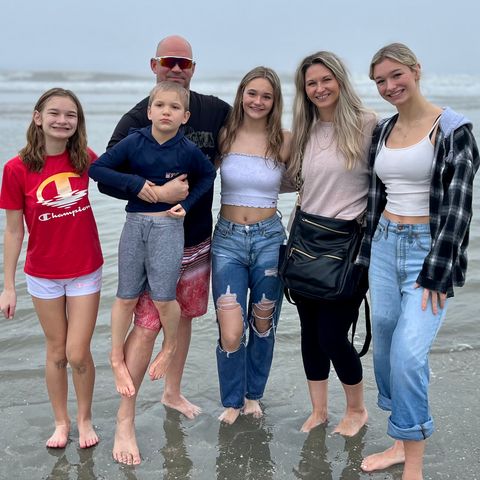
Our guest this week is Pat Wire, of Crystal Lake, IL a social studies teacher at Barrington High School, long-time head coach of the Barrington Broncos High School varsity baseball team and father of four, including a son with autism.
Pat and his wife, Leane, are the proud parents of four children: Gabrielle (19), Bobbi (17), Shaelyn (12) and Preston (11) who is autistic and non-verbal.
Pat has been coaching for nearly three decades and at the high school level for more than two decades.
Pat reflects on how much Preston has taught him about; parenting, patience, himself and what’s important in life. The big take away? Parents of a child with special abilities need to use the child’s yardstick to measure the child’s progress vs. the one they might have used for themselves.
We’ll hear all about Pat, his open and transparent views on parenting and life, all on this episode of the SFN Dad to Dad Podcast.
Show Notes –
Phone – (847) 754-0138
Email – PWire@barrington220.org
Order your copy of the new 21CD book: Dads Raising Chidlren With Special Needs & Disabilities: A Guide For 21st Century Dads on Amazon: https://amzn.to/4tdvjcv
Join 21CD on the SFN U.S. Tour, a 30 day, 50 state, 60+ stop tour taking place from May 21 to June 21, 2026: to strengthen and grow the Special Fathers Network as well as give away copies of our new book.
Transcript:
David Hirsch: Don’t worry about fixing problems; be there to support
Pat Wire: And my wife said it wonderfully. She said, I’m not going to set expectations and benchmarks. I’m going to do the best that I can to provide him with more support than having what I think many men struggle with, which is this fixer mentality where we try to fix these issues. I think don’t worry about trying to fix problems, but be there to support. I think that’s been the best piece of advice that I’ve received, and I think that really came from my wife.
David Hirsch: That’s our guest this week, Pat Wire, a social studies teacher at Barrington High School in Barrington, Illinois, and longtime head coach of the Barrington Broncos varsity baseball team. Pat’s also a father of four, including a son with autism. We’ll hear all about Pat and his life on this special Father’s Network Dad to Dad Podcast.
Pat Wire: Dad to the dad, you’re not on your own. We walk this road together, hard and home.
David Hirsch: Now say hello to the founder of the Special Fathers Network and host of the Dad to Dad Podcast, David Hirsch.
The Special Fathers Network US tour will take place from May 21 to June 21
David Hirsch: Hi, I’m David Hirsch, host of the Special Fathers Network Data podcast. Two brief messages First, I’m thrilled to announce our new book, Dads Raising Children with Special Needs and Disabilities. A Guide for 21st Century Dads is now available for pre order on Amazon, Barnes and Noble and other sites. See the show notes for additional information and how to pre order. Second, the Special Fathers Network US tour will be taking place from May 21 to June 21, Father’s Day. The tour will start in Maui, then Anchorage and then to Milwaukee and all around the US by RV to all 50 states. The purpose of the tour is to strengthen and grow the, Special Fathers Network and to promote the new book. We’re still looking at confirmed venues for the tour and we can use your help. For more information and see how you can help, please see the show notes or simply go to 21st centurydads.org through
Pat Wire: every season, in every stride, great dads are present. 2, 4, 7.
David Hirsch: Now, let’s listen into this conversation between coach Pat Weir and David Hirsch.
Pat Weyer is a social studies teacher at Barrington High School
David Hirsch: I’m, thrilled to be talking today with Pat Weyer of Crystal Lake, a social studies teacher at Barrington High School, longtime head coach of the Barrington Bronco High School varsity baseball team, and father of four, including a son with autism. Pat, thank you for doing an interview for the Special Fathers Network Dad to Dad Podcast.
Pat Wire: Thank you for having me.
David Hirsch: You and your wife, Leanne have been married for 21 years and the proud parents of four children, Gabrielle, 19, Bobby, 17, Shaylin, 12, and Preston, 11, who’s autistic and non verbal. Let’s start with some background. Where did you grow up? Tell me something about your family.
Pat Wire: So I grew up originally, in Michigan. We ended up moving to Hoffman Estates, Illinois. Had a great childhood, growing up with an older brother. He and I, of course, just like most sibling relationships, you know, at times were good and at times were on edge. we, we grew up probably more or less polar opposites, but always found still with the values that were instilled by both my mom and dad. Always to see eye to eye in that regard. I moved more towards a path of sports. I had thought about wanting to potentially be a teacher. like anyone who’s probably playing sports, you hang on to that dream for as long as you can. I went to school to play, you know, in multiple places eventually and, you know, you find yourself coming back to that original passion. And that’s where, you know, that ultimately happened there. And then we moved to Cary in my sixth grade years and had to kind of redo everything, you know, relive life. And so it was great to be able to move because I was more or less leaning on my relationship with my brother and my family. So I’m very powerfully family oriented as a whole. And then inevitably going to Carry Grove High School where I get a chance to meet my future, bride.
David Hirsch: Well, thanks for the quick flyby. out of curiosity, what did your dad do for a living?
Pat Wire: So my dad worked, for Sears and his dad before him worked for Sears. They both were, in upper management scenarios with Sears, Roebucks.
David Hirsch: When you think about your dad who’s still alive, how would you describe your relationship with him?
Pat Wire: fantastic. Quite frankly, I think the best part when trying to really find a role model, I think dads play that role. My dad has always been one of the brightest people I’ve ever met. He went to Notre Dame, he went there on a Fulbright Wilson Scholar. There’s only two in the history. He’s extraordinarily brilliant, but really now I see just a different side of him because I’m going through that same chapter in my own life as dad. But when my mom passed away, I watched him really embrace the line from Shawshank Redemption, which is get busy living or get busy dying. I watched my dad basically
00:05:00
Pat Wire: turn into Benjamin Buttons and it reversed course. He got younger and younger. And it has been a powerful motivator, for myself just in terms of like, when the road gets tough, you keep going. And he is the epitome of that.
David Hirsch: Love it.
You’ve been coaching baseball and football for well over 25 years
So you mentioned that your dad’s, dad was also at Sears. Did you have a relationship with him or not?
Pat Wire: I did. A giant of a man. I wish that we all got his height. I think he was about 6, 2, 6 3. Not college educated, but extraordinarily brilliant, for a time in which you didn’t really have to go to college, per se. But he was very well read. A larger than life figure, both figuratively and metaphorically.
David Hirsch: Got it. And, how about your mom’s dad, Your maternal grandfather?
Pat Wire: I never met him, but I know everything about him. He is essentially the. The star of the two in the sense of he played football at Notre Dame. He’s in the actual movie. Newt Rockne All American. He’s a national champion there for football. Eventually signs a professional contract where he’ll play with the Lions and the Jersey Giants at the time. Died at a young age, and I, I never got a chance to actually meet him.
David Hirsch: Yeah, well, it sounds like there’s some good lineage there on both sides. So, my recollection was you went to Beloit College, Wisconsin, Whitewater. You have a BA in social science and secondary education and a minor in history, and then Concordia University. Is that where you got your master’s in school? And, where did your career take you once your formal education was done?
Pat Wire: So I did my student teaching here at Barrington High School. Another father figure for me happens, to be the guy in which the field is named after in Barrington, named Kirby Smith. So I was recruited to play, American Legion baseball when I was a junior in high school and my senior year as well. So I went to Cary, but I was brought into the Barrington area, basically through the channel of baseball. And once that had all finished, I reached back out to Kirby and asked him if there’s any way that he could set up a chance for me to get into the high school. I did my student teaching here, and then, I coached here while student teaching. And then once there was an opening to get into the high school, I taught for, four years at the middle school level, but I coached at the high school and Tim Dunn ended up bringing me back knowing that I wanted to be a, head coach here at some point and a varsity coach, which I get a chance to do both, which was a dream. It was great.
David Hirsch: Always baseball or football and baseball.
Pat Wire: so I coach both forever. well over 25 years. it’s kind of crazy because I’m 48, so I literally had coached for over half of my life here at the school.
David Hirsch: Yeah, well, thanks. You’ve done a great job and there’s a lot of men who’ve benefited, from your leadership over the years.
Pat Wire: Thank you.
Preston was diagnosed with autism at age 2
David Hirsch: So let’s switch gears and talk about, special needs first on a personal level. And I’m sort of curious to know, prior to having children, did you or Leanne have any connection to the world of disability or special needs?
Pat Wire: We did only basically through our own family. We both have, special needs individuals. But then all of a sudden you join that fraternity and sorority when it’s your child and you see it through a different type of len.
David Hirsch: Yeah. Well, thanks for sharing. What is Preston’s diagnosis and, how did it come about?
Pat Wire: So he was 2 when we found out? My wife’s intuition, which I would give advice to all of these dads that are out there. Trust your wife on it because she’s usually right. there was a sensory motor delay in which she just was very perceptive on, since this was child number four for us. So she just has that inclination as to when, you know, that time slot should be there. I think, to be fair, I was kind of hoping that it was just, that a developmental delay, maybe he would eventually kind of grow out of it, et cetera. we found out at age 2 that he had been diagnosed, which is just incredible that my wife had that intuition. He is diagnosed with autism across the board. He is a non verbal. He also has what’s called apraxia. So we have a lot of different challenges that he has grown through for the last 11 years. But in its early stage, you know, it’s not unique in the sense that you’re waiting for your child to kind of get those first words out or to walk and things along those lines. And that part, it didn’t seem that, you know, difficult, but as the challenges get a little bit larger once they get a little bit older.
David Hirsch: Yeah. Well, what is the apraxia? What impact has that had, really?
Pat Wire: I think it’s the language barrier, because on top of it, it’s like if we’re trying to have a way to communicate with them, we don’t know because we can’t communicate
00:10:00
Pat Wire: with what is being taken in on his end. So the question of does he truly understand what we’re saying or is there, a disconnect with what that is? That’s one of the great mysteries that we still, you know, struggle with. I feel as though he has gotten older. I think he understands us, which is great. Through a lot of different types of therapies that he’s been going through, but I don’t know about that in its early stage, which I can’t imagine, you know, from his perspective, what that would be like. You know, whether it’s all gargled or if it’s. It comes in one year and it comes out the process or another, it’s one of the great challenges.
David Hirsch: Yeah. Well, you’d mentioned he’s non verbal. I’m sure he has a way to communicate with you and Leanne and his sisters for that matter. does he use a device, does any use anything to bridge that verbal communication gap that exists today?
Pat Wire: So, yes, he has a device. He predominantly uses that both in school and then during his therapy sessions. We try to give him a little bit more of a break when he’s at home because we just feel like he’s pushed the limits when he’s there. Like any parents, I think, you know, we try to do whatever we possibly can to give your son and, and, or daughters what have you, anything that they possibly can to get that leg up. And for us, like, especially in the summer, he’s going to therapy like six days a week. And during a regular school, week, he’s going to school two of those days and then therapy for three. So we, we try to have the balance there of not p. Pushing too much. I almost feel like at times he’s being asked more than, say, my daughters because of the amount of work that’s, you know, being pushed upon him.
David Hirsch: Yeah, well, good observation. And you just have to trust your instincts as a parent. Right. You know, you want your kid to be, whole, but you also want them to be happy. Right. And, you know, if it’s too much work and no play, or I guess it could be vice versa, too much play and no work, you know, you might not be helping somebody reach their full potential.
With Preston’s autism diagnosis nine years ago, what were your fears
So with the autism, diagnosis starting at about age two, nine years ago now, if you could roll the clock back to your younger self, what were some of the fears that you and Leanne had at that time?
Pat Wire: I think the first part is just the unknown. You don’t know what you don’t know. I don’t think that that changes with any of your children. But I think in this case we weren’t sure if, or when he was going to be able to speak or be able to listen or understand, et cetera. I think my wife really woke me up to a very powerful theme, and that was she stopped having And I think this is important because even with my sports background, and same with her athletic background, we’re goal driven. We would try to set goals, we want to meet those goals. And I, that that’s important to try to get away from. And my wife said it wonderfully. She said, I’m not going to set expectations and benchmarks. I’m going to do the best that I can to provide him with more support than having what I think many men struggle with, which is this fixer mentality where we try to fix these issues. And so I look at it the same way now that she brought it up. And it really, it really clicked for me. It was very helpful for me. And I think it was also therapeutic for. Because all of a sudden you sit there and you think, well, goal not met. We didn’t succeed. It’s not really that it’s a long journey. I’ve seen strides. It may not have been at the timeline or the benchmarks that we’re at, but as I look back then to now, and then we look to the future, it’s sort of the same thing. I try not to worry about where he’ll be at 18 because I don’t know where he’ll be at 18. And I think it takes a tremendous load off of our chest and, or our shoulders for both of us as parents. but particularly I think being a male, being the dad, it’s, I think don’t worry about trying to fix problems, but be there to support. I think that’s been the best piece of advice that I’ve received and I think that really came from my wife.
David Hirsch: Yeah, well, well stated. there’s a, fellow that I met, Rabbi Common Samuels in Jerusalem. And he and his wife have seven kids and their second son Yossi, ah, very sadly was, impacted, dramatically impacted with a bad batch of vaccines. like at age 1, literally went deaf and blind 24 hours. That’s a whole other story. But because he experienced, Yossi experienced these devastating, challenges about not being able to hear, not being able to see. And Rabbi Samuels, you know, was one of these, like you were saying, very, focused, goal oriented, move forward type of guys. It wasn’t his wife, but it was his older sister who said, hey, kid brother. I’m
00:15:00
David Hirsch: paraphrasing this. Hey, kid brother. You have to measure Yosi by Yosi’s yardstick, not your own yardstick, which is pretty much what I heard you saying, Pat.
Pat Wire: Yeah.
David Hirsch: You know, you’re not measuring Preston’s abilities based on what you were doing at that age or what you hoped he would be doing. But, you know, you need to figure out what Preston’s yardstick is and then measure against that.
Pat Wire: Yeah, I. I believe in that wholeheartedly.
David Hirsch: we’ll be back with more of the conversation on the Special Fathers Network Dad to Dad Podcast in just a few moments. But first, this quick message. Please help 21st Century Dads gather research on families raising children with special needs by having them complete the Special Fathers Network Early Intervention Parents survey. A link to the survey can be found in the show notes. As a token of our appreciation, each person, mom or dad, who completes the survey will receive a great dad coin. Thank you.
Leanne has an autistic son and two daughters. So I’m curious what advice you’ve received
Now back to the conversation.
David Hirsch: So I’m sort of curious to know if you’ve gotten some meaningful advice that’s beyond what you were just saying about Leanne, indicating about being there to support him. If there’s any other meaningful advice that comes to mind that you’ve received over the years.
Pat Wire: I. I think it’s tricky in the sense that when I feel like, especially in my profession and being a coach and doing those things, there’s always people that will complain about what I think are very. They’re minuscule. on the playing field, I look at it with a different lens in that I take the struggles that we have and I find ways to then channel that energy to get better at, what we do. In particular, I pride myself on being a good communicator, someone who has to lecture so many times a day. And I have the ability to, I hope, still connect with both players, coaches, etc. And I take my experiences with my son and I share this with my students that, it has made me understand in the struggle or the challenge in trying to communicate with him on how to be a better communicator or to be better at being perceptive to other people’s needs. And so the advice I would really ultimately provide is to take the unique experience in which we are going through and use that as a strength and recharge the way that you look at things to be better at the average routine that we are used to. there is no doubt that my son. And you’ll hear, I’m sure plenty of people say that their autistic member of their family is like the glue. And through those struggles, we appreciate things that I think people then take for granted. And then in the moments that we get to celebrate, they’re even bigger and better than what they would be for, you know, the average. You Know, individual who lives with, say, out, that situation. I love when people complain because it makes me complain less. I mean, I know the things I’ve had to go through, you know, and I’m sure anyone that has had an autistic son or daughter, you know, I’ve seen it all. I mean, I’ve had the plumber at my house several times in which he was trying to flush things down there. Thankfully, my plumber also has an autistic son, so he gets it and doesn’t charge me full price. I’ve had it where we’ve wiped, poop all over the walls. It’s just little things like that that you don’t think twice about. But like, when I hear people complain, it makes me so much more receptive to. I don’t care how tired I am. I don’t care about being frustrated with something. We go through stuff that’s just different and it’s made our family a lot more, resolved and, and stronger. And with two daughters that are in college volleyball, well, one right now and the other one that will be. There’s no doubt that that’s part of the same thing for them too.
What impact these challenging situations fed on your marriage, Preston’s siblings
David Hirsch: Yeah, well, that was sort of where I wanted to go next, which is what impact these challenging situations fed on your marriage, Preston’s three older sisters, and your extended family for that matter.
Pat Wire: Well, we, we had been told on numerous occasions from many of the therapists, like, they’re like, you guys are a great couple. And we’re like, yeah, well, we feel like we’re pretty good, but like, no, no, no, you guys really are. And I, I guess this was a conversation I had with you earlier about like the divorce rates or the complications that it puts in strains on marriage. We just are great teammates. We find ways to balance it. If there’s a moment in which I know she’s stepping up to the plate, I try to step up, you know, in a different area for her or vice versa. And I think that that part, and even having your family, excuse me, being able to do that, I think that’s very, very, very important. Tied in with the fact that my kids are asked to do things that probably other people aren’t. In some ways,
00:20:00
Pat Wire: I would say that my second born Bobby is sort of an autistic whisperer. Like there’s ways in which she communic and there will be mimicking behaviors that are very rare. And she somehow gets that. She’s been able to get him to say different types of sounds and such. And it’s really, really remarkable. I would just never underestimate the power of siblings, particularly with their siblings that are on the spectrum. They have a huge, ah, role in the significance.
David Hirsch: And how about your extended family?
Pat Wire: I think at times there’s a lack of understanding. Like, in particular, if we happen to go one of our other family members like houses, it’s a struggle because my son, you know, he has an elopement issue. So if we’re not having our heads on a swivel, he could be gone in a blink of an eye. So at my house, we have latches, on every single door that keep him in, so that way we can be rest assured that he’s fine. But that’s not the case and say, some of these other houses. So in particular, when it comes to hosting, we always want to host Thanksgiving, we always want to host Christmas, etc. Because it is so less stressful for us. And we have had a moment in which my son did get out and he happened to climb a fence and then was in another particular neighbor’s swing set. But we, of course, are terrified and happened like this. And thankfully, some of my neighbors who know the situation, we were like, all hands on deck and we were able to locate him. But I’m sure a lot of people have these particular issues because they’re significant. And my son at age 2 was a crazy climber. Like, Guinness Book of World Record stuff. It’s insane. I show it in my classroom with videos, because we’re just talking about the idea of allowing kids to have, like, autonomy and such. Well, he took it to a whole different level.
David Hirsch: Yeah. Well, thanks for your transparency. and, some of these kids are runners, right? You know, you take your eye off of them and boom, they’re gone. Right. And that, has got to take weeks, or months or maybe years off your life. Right.
Pat Wire: Or hair. I mean, whatever you want to look at.
So I’m thinking about supporting organizations that have directly benefited Preston
David Hirsch: So I’m thinking about supporting organizations, and I’m wondering, what comes to mind as far as organizations, that have directly benefited Preston, or maybe benefited your family for that matter.
Pat Wire: You know, I don’t. I don’t know if, you know, there something specific comes, but I will tell you, like, for me, using the vehicle of baseball, I had invited all of the special needs, individuals to come out and be Barrington super fans. So in that they had a chance to come out to the field and throw first pitches all together to baseball players, things along those lines in which it kind of create the merging bond. Barrington does a really good job with this in general, but me being in the position that I was, you know, as being the head baseball coach, I did that every single year, because I felt that that was important. Having my son be around the field in those same capacities was also there. But like we talked about, he’s an elopement risk. So it put more pressure, I think, more on my wife making sure that he wasn’t running down to the local, playground or creek, you know, so that’s one of those things where I think it can benefit because there’s more awareness to it. I wish there would be even more awareness when it comes to, say, like, stores, like, when all of a sudden, you know, like, my son can’t speak, but he’ll. He’ll be yelling at, like, a screeching type of voice or whatever. And then you get parents that might look over and that, you know, we create so much more of an awareness to that to say, like, this isn’t just an unruly child, for example, who didn’t get, like, the candy in the aisle. You know, this is. It’s a different story. And I feel like we’re getting better at it. But things like your podcast, I think, is how it gets better. My wife is arguably the greatest human being I have ever met in my life. I know that she’s the type of person who I think can handle it. I hope that I’m able to help compliment her in any way that I possibly can. And I think that there are family members of the people that we have met that come up and embrace him in the same capacity. And so I feel like that’s a blessing that we can create that bond. And that’s what I look at it. It’s. It’s a success story in itself just because of the connections that are made. With all that being said, it’s still the challenge. Like we talked about, like, us being able to go on vacation becomes a challenge. Like, right now. Preston loves theme parks, albeit when we went, he ended up, of course, an elopement issue where you’re nervous. But if you’re ever going to lose a kid, lose them at Disney, because they are better than any form of surveillance unit at being able to find people. He loves going on roller coasters and things like that where he’s confined. But if I bring my son to the mall, it’s a nightmare because he loves to go and look at all the different things. It’s very add overload for him,
00:25:00
Pat Wire: and all of a sudden he’ll have a meltdown if we’re trying to grab something because we’re afraid that he might break it or whatever. So there’s different kind of parameters and rules that are set, but I feel like we were meant to be his parents.
David Hirsch: I love it. Thank you.
I just think that the most important part is don’t be in denial
I’m thinking about advice, and I’m wondering, what advice you can share with parents, specifically dads who find themselves, like you mentioned, as a new member of the fraternity, one that you might not have anticipated, joining.
Pat Wire: I just think that the most important part is don’t be in denial, like, accept what it is. I think there’s that part to overcome, and it’s okay. I think there’s a concern in which you have to, quote, unquote, like I mentioned, fix your. Your son. You don’t, in this case, I. I don’t look at it that way either. When you really start to look at it, it’s actually the same as any of your other kids. I’m not trying to fix my daughters. I’m there as a support system to try to help, provide guidance, or we’re there to provide a bridge to get to where they want to go.
David Hirsch: Yeah. Well spoken. Thank you.
Pat Wirerington is part of the Special Fathers Network helping fathers with special needs
So why is it you’ve agreed to be a mentor father as part of the Special Fathers Network?
Pat Wire: Well, I think the cool part about you being able to reach out to me through a close friend was an awesome thing. I’ve obviously had an experience even being able to help your, you know, sons as well, in particular your oldest, who now has his own kids. So for me, I think it’s important to be able to talk about the same exact mission that you have. I’m doing it through the channel here of the classroom, and you’re doing it through the channel of the podcast. I figured, let’s morph both these worlds together.
David Hirsch: I love it. Thanks. We’re so glad that you could be part of the network. Is there anything else you’d like to say before we wrap up?
Pat Wire: I’m grateful. thank you for reaching out, Dave. I think it’s great. I know our history goes back easily, 25 or so years, getting a chance to be able to coach and teach kids, let alone now in a world of being a parent, and trying to provide some filter to that, and if it’s helpful and if it helps at least one person, then this was worth it. I think the most important part of the whole thing is don’t look at any of it as a negative. Try to spin it into a positive. I think that’s probably the best part in which I feel like I’ve had a great takeaway from and so if anyone is listening and they feel as though that made a difference, then it’s worth it to me.
David Hirsch: Yeah, well spoken. Let’s give a special shout out to John Chakota, a long time friend, the big Barrington baseball guy, for helping, reconnect us.
Pat Wire: Yeah, John’s the one that was able to connect us and it was great.
David Hirsch: So if somebody wants to, contact you, what’s the best way to do
Pat Wire: so I would say email. My email address is pwirerington220.org you have it. That’s the best and easiest way. for me. I’m not on any social media. If I had any of that, I don’t think I’d ever survive. just too much. But yeah, anyone could email me if they were interested in anything.
David Hirsch: I’ll be sure to include that in the show notes so it’ll make it as easy as possible for somebody to follow up. Pat, thank you for your time and many insights. As a reminder, Pat is just one of the dads who’s part of the Special Fathers Network, a mentoring program for fathers raising a child with special needs. If you’d like to be a mentor father or are, seeking advice from a mentor father with a similar situation to your own, Please go to 21st centurydads.org thank you for listening to the latest episode of the Special Fathers Network Data dad Podcast. I hope you enjoyed the conversation as much as I did. As you probably know, the 21st Century Dads foundation is a 501c3 not for profit organization, which means we need your help M to keep our content free to all concern, would you please consider making a tax effectable contribution? I would really appreciate your support, Pat. Thanks again.
Pat Wire: Thank you. I appreciate it. Dad to dad, you’re not on your own. We walk this road together, hard and whole.
David Hirsch: Thank you for listening to the Special Fathers Network Dad to Dad Podcast. The Special Fathers Network is a dad to dad mentoring program for fathers raising children with special needs. Through our personalized matching process, new fathers with special needs children match up with mentor fathers in a similar situation. It’s a great way for dads to support other dads. To find out more, go to 21st
David Hirsch: centurydads.org and if you’re a dad looking for help or would like to offer help, we would be honored to have you join our closed Facebook group. Please go to facebook.com groups and search dad to dad. Lastly, we’re always looking to share interesting stories. If you’d like to share your story or know of a compelling story, please send an email to david01stcenturydads.org the dad
David Hirsch: to dad Podcast theme was written and performed by Shane Madden. The show was produced by me, Tom Couch. Tune in again next week for another intriguing conversation on the Special Fathers Network Dad to Dad Podcast.
Pat Wire: Through every season, in every stride, great
David Hirsch: dads are present too. For 736-524-7365.
00:30:00