

429 – Mike Schugt of Orlando, FL A Former Hospitality Exec, Founder of INNclusivity and Father of Two Daughters
Description
Our guest this week is Mike Schugt of Orlando, FL, a former hotel and hospitality executive, founder of INNclusivity and fahter of two daughters.
Mike and his x-wife are the proud parents of two young adult daughters.
After a successful career in the hospitality industry including senior roles at: Hyatt Regency, Hilton Hotels and Teneo Group, Mike has founded INNclusivity, a non-profit whose mission is: empowering adults with intellectual and developmental disabilities (IDD) to build meaningful careers in the hospitality industry by creating pathways to independence, purpose, and professional success.
It’s an inspring story about being a social entrepreneur, taking for-profit principles and bringing them to bear for the benfit of the community all on this episode of the SFN Dad to Dad Podcast.
Show Notes –
Phone – (407) 973-5253
Email – mike@innclusivity.org
Website – https://innclusivity.org/
Order your copy of the new 21CD book: Dads Raising Chidlren With Special Needs & Disabilities: A Guide For 21st Century Dads on Amazon: https://amzn.to/4tdvjcv
Join 21CD on the SFN U.S. Tour, a 30 day, 50 state, 60+ stop tour taking place from May 21 to June 21, 2026: to strengthen and grow the Special Fathers Network as well as give away 2,000 copies of our new book.
Transcript:
Mike Schugt founded Inclusivity to train hospitality workers with special needs
Mike Schugt: I’m able to team up with Hilton, Marriott and Hyatt and have them support inclusive employment. The greatest part of everything that I am doing is just looking at the face of the individual that has a job. And for them, it’s their super bowl, it’s their number one most important thing. And I can’t think of anything more satisfying than that.
David Hirsch: That’s our guest this week, Mike Schugt, a former hotel and hospitality executive who has formed Inclusivity, a, not for profit that hospitality training for those with special needs. He’s a fascinating figure with a fascinating story, and we’ll hear it on this special Father’s Network Dad to Dad Podcast.
Mike Schugt: Dad to the dad. You’re not on your own. We walk this road together, heart and home.
David Hirsch: Now say hello to the founder of the Special Fathers Network and host of the Dad to Dad Podcast, David Hirsch.
The Special Fathers Network US tour will take place from May 21 to June 21
David Hirsch: Hi, I’m David Hirsch, host of the Special Fathers Network Dad to Dad Podcast. Two brief messages. First, I’m thrilled to announce our new book, Dads Raising Children with Special Needs and Disabilities. A Guide for 21st Century Dads is now available on Amazon, Barnes and Noble and other sites. See the show notes for additional information. Second, the Special Fathers Network US tour will be taking place from May 21 to June 21, Father’s Day. The tour will start in Maui, then Anchorage, and then to Milwaukee and all around the US by RV to all 50 states. The purpose of the tour is to strengthen and grow the Special Fathers Network and to promote the new book. We’re still looking at confirmed venues for the tour and we can use your help for more information and see how you can help. Please see the show notes or simply go to 21sturydads.org through every season, in
Mike Schugt: every stride, great dads are present. 247365.
David Hirsch: Now let’s listen in to this conversation between Mike Schugt and David Hirsch.
Mike Schugt is a former hotel and hospitality executive and father of two daughters
David Hirsch: I’m thrilled to be talking today with Mike Schugt of Orlando, Florida, who is a former hotel and hospitality executive, now founder and president of Inclusivity, a not for profit that empowers lives through hospitality and perhaps most importantly, father of two daughters. Mike, thank you for taking the time to do an interview for the Special Fathers Network Dad to Dad Podcast.
Mike Schugt: It’s my pleasure. I’m really happy to be here
David Hirsch: and thankful you’re the proud parents of two girls, Sophia, 24, and Mia, 21. Let’s start with some background. Where did you grow up? Tell me something about your family.
Mike Schugt: Yeah, so, I’m originally from Pittsburgh, Pennsylvania. I grew up. I have, a twin brother who I am 5 minutes older and 5 minutes better looking than I might say. And I have an older brother who’s five years older. His name’s Dave, and I have two parents. You know, growing up in Pittsburgh, is very competitive when you have a twin brother because someone that is built your size and really into sports. So it’s kind of like you’re battling yourself every day. And, I think that really brought out the competitive nature in both of us. You know, when you grow up in Pittsburgh, it really is, a lot about sports and your friends and doing those sports. They played a lot of ice hockey and Sandalot football and organized football, baseball, basketball, you name it. You know, there’s four seasons and we always took great advantage of it. Really awesome childhood in Pittsburgh, Pennsylvania.
David Hirsch: Thanks for mentioning that. And by guess, by definition, if you’re the older of the two twins, that would make you the middle child, the
Mike Schugt: Jan Brady of the Schuck family. Yes.
David Hirsch: There you go. So, curiosity, what did your dad do for a living?
Mike Schugt: My dad is a third generation German industrial engineer. he came here to basically help start this company that was in Germany, for many years and they created a US branch outside of Pittsburgh. And he started here right around in the early 60s and came to be part of that organization and its growth. And he, you know, spent his whole career in that role and became vice president of the company of, their manufacturing arm and, you know, did really well for himself.
David Hirsch: How would you describe your relationship with your dad?
Mike Schugt: It was great. You, know, I would say that he is a tough cookie. I think he was the ultimate provider. He really made sure that, you know, his family was very well taken care of. And he was quite a character. He had a really great sense of humor. He passed, in 2008, but he had a really great sense of humor. Kind of life of the party type of person. Very smart. And, you know, I learned a lot from him. Maybe not in everything that he said, but perhaps in more of what he did.
David Hirsch: Awesome. So any important takeaways, lessons learned
00:05:00
David Hirsch: that come to mind when you reflect on your dad and your relationship with him?
Mike Schugt: Hard work, hard work. Be there for your family. I think extremely tough minded, but at the same time a great sense of humor. An incredibly generous man financially, to other people, you know, doing the right thing is something I really learned from him. So, you know, it’s really hard to answer that question because it becomes all encompassing and there’s just so Much. But those, those are the things that stick out. And you know, that’s, this is, you know, I don’t know that anyone’s ever asked me that question. I’ve kind of answered it for the first time, especially in my own head here. So I appreciate that.
You have decades of experience in the hospitality and hotel industry
David Hirsch: So my understanding is you went to Penn State, took a bachelor’s degree in hospitality management, you worked at Hyatt, Hilton Tenio, had decades of experience in the hospitality and hotel industry. How would you summarize your career, your professional career?
Mike Schugt: Blessed, you know, lucky, fortunate, you know, you’re doing things for 36, 37 years. It really takes a lot. It takes, it takes a tremendous amount, as we all know who are listening in on this. You know, it takes, takes a lot of support from our families. You know, it takes people that believe in you as you’re growing up, throughout the ranks. It takes mentorship, it takes resources. You know, one of the greatest examples I have is, you know, at a pretty young age I had the opportunity to be the vice president of sales and marketing for Hilton in Southeast and Latin America. And, you know, Hilton sponsored one on one Spanish lessons for me that took two years at Berlitz class. I, went three days a week, two hours a day. You know, Spanish is an extremely difficult language to learn. I speak German fluently. But what makes Spanish difficult? People think it’s easy. The first hundred or 200 words are simple to conjugate each verb 16 ways, and there’s a gender behind every noun and it’s extremely difficult to really bring it to a business environment. So, you know, it’s things like that, that, that level of support, I think, and just given the opportunity and then allowing me to grow into that is really a blessing for me.
David Hirsch: Yeah, well, thanks for sharing. Sounds like it was a great ride.
Before creating inclusivity, what connection or disconnection did you have with disability community
You know that, most of our listeners are parents that have a child with, special needs. And prior to creating inclusivity, what connection or disconnection did you have with the disability community?
Mike Schugt: You know, I didn’t have much of a connection with the disability community per se. I would say first, you know, when I was at Penn State, I had two young, you know, young boys. Actually, as a big brother in the Big Brothers program, I started doing that again three years ago here. Now, as I’m an empty nester for a teenager now for the last three years and, you know, trying to give back, so I didn’t really have much, much of a connection to that community. I will say that I think my life kind of changed when I walked into a coffee shop at the University of Georgia in Athens, Georgia, in May of 2023, when my daughter was graduating. There was a Biddy and Bose coffee shop there, and the young people that were working there were all young adults with intellectual disabilities. And it just. Something struck me down and I called my daughter up and I said, sophia, have you seen this place? I said, this is remarkable. And she says, dad, do you see? A lot of those people are part of our club where we teach them how to play tennis for the last year. So I said, hey, do you guys know Sophia Shook? And they all said, yes. So it was just a moment where I said. I said to myself, well, if I’m not going to help these people or people with intellectual dis, who is? Who’s going to stand up, and help them? What company, what individuals? Because there’s millions of individuals with intellectual disabilities, and they’re going through their daily lives, and we know that what happens when they turn 22, that a lot of the services kind of fall off for them. And I just walked out of there saying, look, I’m no hero or anything, but something’s got to happen to help these individuals. So that really motivated me, inspired me.
David Hirsch: So it sounds like those were the seeds that germinated relatively quickly to create inclusivity.
Mike Schugt: Yes.
David Hirsch: So my understanding, the mission is empowering adults with intellectual developmental disabilities to build meaningful careers in hospitality
00:10:00
David Hirsch: by, creating pathways to independence, purpose, and professional success, which I love. I think it’s a great mission.
Inclusivity uses hospitality as a vehicle for empowering individuals with disabilities
So how does inclusivity use hospitality as a vehicle for empowering individuals?
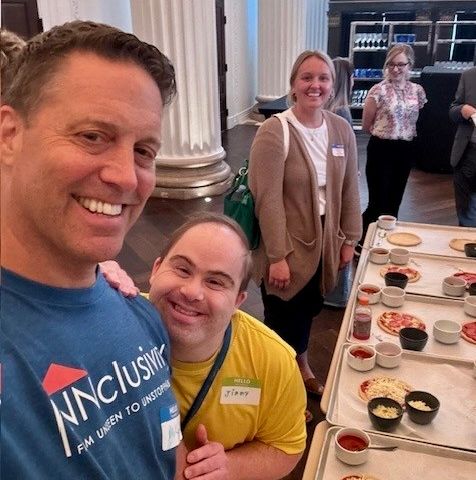
Mike Schugt: Well, what I do is. So based in Orlando, we are now in 10 cities across the United States. I’ve been doing this a year and, three months now. So, you know, each month we’re trying to open up a new city. And I do a few things. I first go to, a city, and I go there to a vocational school for adults with intellectual disabilities. And I do a workshop that takes about an hour, an hour and a half on leadership and hospitality, that you don’t need to be the boss to be a leader, that you just need to lead yourself. And that there’s so many opportunities in the hospitality industry for anyone with unique abilities that it’s a really good match. And so that’s step, one. The next day, I take 10 or 15 individuals from that same vocational school to a hotel, and we do a half day, what we call an immersion. They get to tour the hotel, they get behind the scenes look, they get the laundry room and the kitchens and all the cool places where no one else gets to go. And then they try to, we do some hands on training. So we might set up a banquet room or make pizzas with the chef or create our own meals and then have them later. And so we wrap it up with, with a discussion and lunch and then we see if, if there’s any of those individuals that might want to work in the hospitality industry. And at the same time it gives the hotel leadership an opportunity to see folks in action doing certain things. And you know, we create the match and we start to then put the two together and we hire individuals, in hotels. And while I’m not the entity that hires, I’m the one that puts it together. And the good news is we’ve had some really good success in doing so.
David Hirsch: I love it. What I like, it’s so hands on. Going to those vocational schools with the workshops and then, going behind the scenes, right, and rolling up your sleeves. And whether like you said, it’s in the kitchen or it’s in the laundry room or in whatever other capacity, it’s giving them an opportunity to look down the road. Right. And it’s a two way street. Like you said, it’s giving the individuals with the intellectual disabilities an opportunity to learn and it’s giving the organization, the hotel, an opportunity to observe, you know, what aptitude do they have. Right. You know, would this be a good fit? So it’s a win, win situation.
There is a labor shortage in the hospitality industry
In the, year, just a little bit more than a year that you’ve been doing this. You said you have, programs in 10 cities. Any sense for the metrics, as far as how many people have actually been hired in this very short period of time?
Mike Schugt: Well, you know, hiring is a very challenging process because there’s, you know, it could take a couple months to get people hired. There’s also the idea that there is some convincing for hotels. Okay, this is not something that a lot of hotels are doing right now. But the really interesting thing I think is that first of all, there is a labor shortage in the hospitality industry. And there has been post Covid and even more so now with immigration. And one of the things that happens is hotels in particular, they have a certain percentage of their staff that is least labor, you know, maybe not permanent labor. And so if they can get great employees and reduce the amount of that leased labor, that more, you know, labor that might not stay with them for a long period of time, then, you know, that’s to their benefit. So here we Are a year later, we’ve put 500 people through the workshops. And in some, we’ve done multiple immersions and multiple workshops. Let’s say, for example, in Orlando and San Francisco, Pittsburgh and New Orleans, we’ve put over 250 people through the immersions. We’re just about set to hire our 15th person. We have 10 people in our pipeline and it’s probably going to take the next 60 days to hire them. But, you know, my goal is to see if we can hire 100 people by the end of the year. And right now, just in the last, literally two weeks, we have commitments of, hotels to hire another five individuals. So it’s one of those things where the dam is now starting to break and things are happening.
David Hirsch: Yeah, very exciting. I see this sort of funnel. Right. You have to have a lot more people that start, and then as the process sort of goes along, you’re sort of like winnowing the opportunities down both from both sides, from the individuals and from the organization’s perspective.
Mike Schugt: Yeah. You know, one of the challenges too is some of the individuals think they want to work in the hospitality industry. And when they get down to really deciding, you
00:15:00
Mike Schugt: know, and you start to factor in, you know, the stamina, impact or transportation, things like that, there’s some things that, you know, I didn’t really anticipate at the beginning that are coming to fruition. And, you know, the other part of it is I keep tapping into new sources of, you know, whether it’s agencies or so forth of adults with intellectual disabilities. And, you know, in some of these, the level of independence is actually very high. So just recently we’re hiring people for 40 hour work weeks now, in some places. So it’s been a year and a few months. So it’s an ever changing landscape, but we’re learning every day, you know.
David Hirsch: Yeah, well, you’re still relatively new at it, so, glad that you’ve achieved some modest levels of success right out of the box.
David Hirsch: We’ll be back with more of the conversation on the Special Fathers Network Dad to Dad Podcast in just a few moments. But first, this quick message. Please help 21st Century Dads gather research on families raising children with special needs by having them complete the Special Fathers Network Early Intervention Parents survey. A link to the survey can be found in the show notes. As a token of our appreciation, each person, mom or dad, who completes the survey will receive a great dad coin. Thank you.
The goal is to help as many people as we possibly can
Now back to the conversation.
David Hirsch: I’m thinking about anecdotal stories, success stories, Something, that would sort of demonstrate, what’s worked so far.
Mike Schugt: How hard do you want me to cry? I start talking, I’m going to lose it. But, you know, the goal is to help as many people as we possibly can, but to do it one person at a time. And when I hear, for example, a gentleman that was hired, back in, excuse me, July, you know, he’s earned a lot of money at his, at his job, and he’s, he’s able to take his mom, in part from the earnings he’s made, back to Vietnam, where they’re originally from, for a vacation at the end of the year. You know, it’s things like that. It’s the gentleman that never had a job before, that’s working three days a week, commutes 90 minutes each way, and has a renewed sense of purpose. It’s the nice young, lady that works now in a pastry kitchen in Nashville who, you know, has a lot of pride in the work that she’s doing and amongst her friends, you know, having a job is really what it’s all about. Viktor Frankl is the author of a book called, ah, Human Search for Meaning. And he was, three years in the Auschwitz concentration camp in Germany. And, you know, he, he wrote that amazing book, millions and millions of copies sold. And, and in that book it says that the number one most important thing for a person to have meaning in their life is actually to have a job. In all the 15 individuals that have jobs, each story is incredibly powerful. I talk to the parents a lot too. It’s just amazing that there isn’t more of this happening. And so that’s really what, the main mission is to do is to really expand upon this. real quick, there is something in Germany called the Schwerbe Hinderten Ausgleis Abgaba, which means that if you’re an employer In Germany with 20 or more employees, 5% must be, quote, severely disabled or you get what’s called an Auscleist upgaba, which is a levy or a fine that started in, I believe, January of 24. And it’s had a pronounced impact on this audience of people. And I say to myself, well, is that possible in the United States? I don’t know. I’m not, I’m not going to say it isn’t. But what I do think is possible is that a hotel that does not have an adult with an intellectual disability is not the norm. That it’s, you know, that the norm is that every hotel has an adult with Intellectual disability. That’s really the ultimate goal.
David Hirsch: I love it. Thank you for sharing.
One of the biggest challenges is scaling this inclusivity model
So what have been the biggest challenges, building these partnerships with the hotels are scaling this inclusivity model.
Mike Schugt: Well, first of all, I’m pretty much a one man show. I have this wonderful director of social services, Sophia Pearson, who’s kind of part time with us. And until we start to get a little bit bigger, you know, there’s just, there’s so many things in just running any business, but specific to the hotels. You know, hotels after Covid in particular, they have an enormous amount of pressure on them. And the reason they do is because most hotels now are owned by private equity firms and real estate investment trusts. And so they are really tasked to make that bottom line while delivering
00:20:00
Mike Schugt: great service. So, you know, sometimes when you introduce a concept like this, hoteliers can think, okay, this is going to cost some money and it’s going to divert my attention and am I going to get the same level of service to our guests and is there going to be any disruption internally to the other employees? Okay. Now they also see the great benefit of helping an individual and you know, helping their, their shortage of labor. But you know, there is convincing and trial and things that needs to take place and rightfully so. There are hotels in some communities that will just say, look, you know, I’m going to give a person a couple of shifts a week because I know it’s going to change their life. We’re willing to do that. Some hotels, you know, are under different types of pressure, so they’re really looking for that 40 hour work person that can, 40 hour per week, person that can, stand on their own at some point.
David Hirsch: Yeah, well, it’s what you’re talking about is cultural change. You’re unlikely to come in and do a wholesale change just because. But if you could get your foot in the door and demonstrate that there’s a win win situation here, it’s not just philanthropy. You’re not doing this because you’re just trying to be a good person, but it’s good for the bottom line as well. Then it seems like the velocity, of what you’re doing is likely to increase. Again, capturing these anecdotal stories and being able to share them and document what it is that you’re doing seems like it’ll go a long way.
What’s your vision for inclusivity over the next three to five years
I’m thinking about the future, looking ahead. What’s your vision for inclusivity over the next three to five years? Best case scenario. I mean, if you could get a
Mike Schugt: magic wand out best case scenario, is that I’m able to team up with Hilton, Marriott and Hyatt and have them support inclusive employment and that we build a nonprofit organization here that reaches into every major city in the United States because a path has been cleared by the brands and their leadership that it becomes more about implementation at the local level versus, you know, having to convince every individual property the value of inclusive employment. I think that that’s one big thing. I think through that is the most important thing, which is, is the goal is to change as many lives as we possibly can and to do so one person at a time to give people a renewed sense of purpose and a real meaning for life. And if it just happened for one person, you know, or whatever, that’s okay too, you know, because at the end of the day, it’s really about making a profound impact on each individual. You know, like I said, I hope there’s one day where it’s the exception that when you walk, you go into a city like New Orleans or Orlando and there isn’t a person working there with an intellectual disability. I can’t understand any, any way, reason, shape or form why this can’t be adopted universally. And you know, I have a strong belief that it can. And that’s all that, I mean that’s all that really matters, you know, is believing.
David Hirsch: I love it.
You’d like to team up with Hilton, Marriott, Hyatt
So what I think I heard you say is that, you’d like to team up with Hilton, Marriott, Hyatt, arguably the largest three, you know, hotel providers, in the US perhaps around the world, and have this be more of a top down, right from the leadership on down, as opposed to you doing what you’re doing now being more of like a grassroots organization doing things bottom up. Because you have to tell the story over and over and over and over, right? And it would be great if it was just part of the culture. and you know, maybe this is just part of the process, right? I’m gonna have to do this for two to five years, document what we’re doing, get the successes in place and then be able to go to senior management and say, hey, it didn’t start with the leadership from senior management. But you know, this is what we’ve been able to create, if you will, despite your, you know, lack of involvement. You know what, if you were to get behind what it is that we’re talking about, this could be a game changer for everybody involved. So anyway, we’re have to do a follow up. That’s what I’m Thinking right a number of years down the road and from your lips to God’s ears, I hope you get the funding that would allow you to help scale what it is that you’re talking about.
Mikelusivity is part of the Special Fathers Network mentoring program
Is there anything else you’d like to say before we wrap up?
Mike Schugt: No. I mean, I’m grateful to you for hosting me, David. You know, this is a very unique time, I think, in our universe, in our world, and, you know, the time to really help individuals that, perhaps cannot help themselves without a little bit of an extra boost, probably has never been more prevalent than it is
00:25:00
Mike Schugt: today. So, you know, I’m going to be working feverishly to try to develop partnerships, develop relationships at the top levels of the brands, and do all the things that I know in running the businesses that I had over the years to really help individuals that need it. And the greatest part of everything that I am doing is just looking at the face of the individual that has a job. And for them, it’s their super bowl, it’s their number one most important thing. And I can’t think of anything more satisfying than that.
David Hirsch: I love it. So let’s give a special shout out to rob lawless at 10,000 friends for helping connect us.
Mike Schugt: Absolutely. Thank you, Rob.
David Hirsch: Yeah. he’s an amazing young guy and
Mike Schugt: a fellow tennis satyr, I must say.
David Hirsch: There you go. There’s your connection. If somebody wants to contact you, what’s the best way to do so?
Mike Schugt: Well, mikelusivity.org that’s with two N’s, and I can give you my phone number. It’s 407-973-5253. In Orlando, Florida. I can tell you that every telemarketer in the United States has my phone number now. So this is just me. Just. It’s okay. I’ll be getting a call from some sort of loan company in about an hour, so don’t worry. It’s okay. I’ll pick it up.
David Hirsch: Well, I’ll be sure to include that information in the show notes. It’ll make it as easy as possible for somebody to follow up with you. Mike, thank you for your time and many insights. As a reminder, Mike is just one of the dads who’s part of the Special Fathers Network, a mentoring program for fathers raising a child with special needs. If you’d like to be a mentor father or are seeking advice from a mentor father with a similar situation to your own, please go to 21st centurydads.org thank you for listening to the latest episode of the Special Fathers Network Dadded at Podcast. I hope you enjoyed the conversation as much as I did. As you probably know, the M 21st Century Dads foundation is a 501c3 not for profit organization, which means we need your help to keep our conference free to all concerned. Would you please consider making a tax equal contribution? I would really appreciate your support Mike. Thanks again.
Mike Schugt: My pleasure. Thank you. Dad to the dead. You’re not on your own. We walk this road together, heart and home.
David Hirsch: And thank you for listening to the Special Fathers Network Dad to Dad Podcast. The Special Fathers Network is a dad to dad mentoring program for fathers raising children with special needs. Through our personalized matching process, new fathers with special needs children match up with mentor fathers in a similar situation. It’s a great way for dads to support other dads. To find out more, go to 21st
David Hirsch: centurydads.org and if you’re a dad looking for help or would like to offer help, we would be honored to have you join our closed Facebook group. Please go to facebook.com groups and search dad to dad. Lastly, we’re always looking to share interesting stories. If you’d like to share your story or know of a compelling story, please send an email to david21stcenturydads.org the dad
David Hirsch: to dad Podcast theme was written and performed by Shane Madden. The show was produced by me, Tom Couch. Tune in again, ah next week for another intriguing conversation on the Special Fathers Network Dad to Dad Podcast.
Mike Schugt: Through every season, in every stride, great dads are present. 247-365-24-7365.
00:28:33