

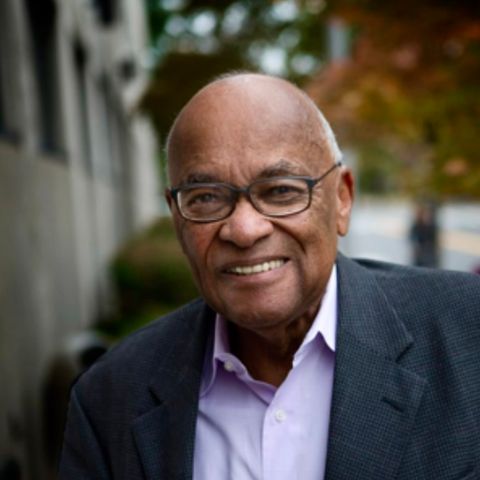
432 – Hubie Jones of Boston, MA A 92 Year Old Father of Eight & Iconic Civil Rights and Disability Advocate
Description
Our guest this week is Hubert Eugene ‘Hubie’ Jones, of Boston, MA. who has shaped and defined the civic and social landscape of Boston for more than forty-five years. He played a leadership role in the formation, building and rebuilding of at least thirty community organizations within Boston’s Black community and across all neighborhoods in the city.
Hubie and his wife, Kathy, have been married for 68 years and are the proud parents of eight accomplished and college educated children and grandparents to 10.
We learn about a handful of organizations that Hubie helped start, shape or was involved in, including: 1964 Roxbury Multiservice Center, Massachusetts Advocates for Children, City To City, Boston Children’s Choir, City Year, and W.K. Kellogg Foundation
Like Warren Buffet is to investments, Hubie is to community service and advocacy. It’s an uplifting story about faith and family as well as advcoacy and service to those marginalized in society, all on this episode of the Special Fathers Network Dad to Dad Podcast.
Show Notes –
Phone – (617) 332-8183
Email – hjones@cityyear.org
Website – https://www.massadvocates.org/
Order your copy of the new 21CD book: Dads Raising Chidlren With Special Needs & Disabilities: A Guide For 21st Century Dads on Amazon: https://amzn.to/4tdvjcv
Join 21CD on the SFN U.S. Tour, a 30 day, 50 state, 60+ stop tour taking place from May 21 to June 21, 2026: to strengthen and grow the Special Fathers Network and distribute 2,000 complimentary copies of our new book.
Transcript:
You have a responsibility to be present with your children, but particularly with your son
Hubie Jones: I would say that you have a responsibility to be present. You have a responsibility to be engaged with your children, but particularly with your son, because sons need this kind of support. Being a black young man in this still racist society, is a difficult thing. And you need help in navigating this. And nobody can do it better than a father who is your life and blood and who cares about you.
David Hirsch: That’s our guest this week, Hubie Jones of Boston, Massachusetts. Hubie is a longtime social worker who has shaped Boston in countless ways. He’s built or shepherded dozens of civic organizations. He is a fascinating figure and we’ll hear from and about him on this Special Fathers Network Dad to Dad Podcast.
David Hirsch: To the dad, you’re not on your own. We walk this road together, hard and home.
David Hirsch: Now say hello to the founder of the Special Fathers Network and host of the Dad to Dad Podcast, David Hirsch.
David Hirsch launches Special Fathers Network US tour on Father’s Day
David Hirsch: Hi, I’m David Hirsch, host of the Special Fathers Network Dad to Dad Podcast. Two brief messages. First, I’m, thrilled to announce our new book, Dads Raising Children with Special Needs and Disabilities. A Guide for 21st Century Dads is now available on, Audible, Amazon, Barnes and Noble and other sites. Second, the Special Fathers Network US tour, a 30 day, 50 state, 66 stop tour taking place from May 21 to June 21, Father’s Day. The tour started yesterday in Maui. Today we’re in Anchorage. Tomorrow we’ll be in Milwaukee, Minneapolis, then all around the US by RV to all 50 states. The purpose of the tour is to strengthen and grow the Special Fathers Network, to provide resources to special needs families, and to distribute 2,000 complimentary copies of my new book. For more information on the Special Fathers Network and all the tour locations, see the show notes or simply go to 21st centurydads.org through every season, in every stride, great dads are present. 247365.
David Hirsch: Now let’s listen into this conversation between Hubie Jones and David Hirsch.
Huey Jones is the father of eight and grandfather of 10
David Hirsch: I’m, thrilled to be talking today with my old friend Huey Jones of Boston, Massachusetts, who’s the father of eight, grandfather of 10. And since the 1960s, Hubie has shaped and defined the civic and social landscape of Boston. For more than six decades, he played a leadership role in the formation, building and rebuilding of more than 30 community organizations within Boston’s black community and all across the neighborhoods in the city. Our friendship dates back to 1993 through the W.K. kellogg Foundation. I was one of 50 Group 13 National Fellows and Hubie was one of the seven advisors. He’s been A mentor and friend for more than 30 years. Hubie, thank you for taking the time to do an interview for the Special Fathers Network Dad to Dad Podcast.
Hubie Jones: My pleasure.
David Hirsch: You and your wife Kath have been married for 68 years and are the proud parents of eight accomplished and college educated children and grandparents to 10. Let’s start with some background. Where did you grow up? Tell me something about your family.
Hubie Jones: I grew up in the South Bronx in New York City. It was a neighborhood that was primarily African American. I have five sisters, two older and three younger. my father was a Pullman boarder working for the New York Central Railroad. My mother at the beginning was, basically a homemaker until she ultimately went back to high school to get an academic degree. At the same time her two youngest children were getting their degree. And then after that happened, she decided to go to Hunter College and she said, I want a bachelor’s degree so I can get out of the kitchen and become a teacher in this daycare center. And after a while she came back to me and said, well, I’m going to go get my master’s degree from Hunter College because I want to become a supervisor of other folks who were taking care of kids. My mother was a very ambitious person. She grew up in Abbeville, South Carolina when she was 16 years of age. And this is important because A black businessman, Mr. Crawford, was being cheated by some white business people. And he pushed back against them and, they grabbed him and
00:05:00
Hubie Jones: put him, tied him to the back of a pickup truck and dragged him through the streets of Abbeville, South Carolina and then lynched him.
David Hirsch: Oh my gosh.
Hubie Jones: And that picture was in my mother’s mind and head for the rest of her life. She died at 95, but that was there all the time. And we’ll talk about when I was getting involved in doing advocacy and taking on governors, taking on mayors and so forth. My mother was upset, thinking I was going to get in trouble taking on white power. Two days after the lynching, she and the family who was left in Abbeville, South Carolina went to Pittsburgh, where there had been a family already established there. She got a secretarial degree, high school degree, and then was shipped to New York for her two older sisters who were already in New York to look after her. And that’s how she ultimately met my father, who was introduced to her by a mutual friend. And that’s how I ended up in New York.
David Hirsch: Yeah, well, I love this story. Would, it be appropriate to say your mom is a late bloomer? From an educational standpoint.
Hubie Jones: Yeah, yeah, absolutely. Absolutely. Yeah.
David Hirsch: And, what a great role model that she was, for you and no doubt your sisters.
Hubie Jones: My father was probably the smartest human being I ever knew. Absolutely brilliant. Went to Lincoln Institute, now Lincoln University in Jefferson City, Missouri. Really wanted to be a doctor. He was a valedictarian of his graduating class. he was an actor in theater, etc. Etc. But when he graduated in 1914, the only jobs really available to black men were to work in the post office or as Pullman porters, where you got a vacation and you got a pension. And he got into the Pullman Company because he substituted for men on vacation to pay for his college education. now the thing that’s interesting about him being in the Pullman Company is that he, being so smart, was a legal advocate for men who were being charged with doing things that could get them fired. And although he wasn’t a lawyer, he took their cases and went before the management and the downtown lawyers for the Pullman Company and basically got them off. And these downtown lawyers could not believe that a non lawyer wrote these briefs. Couldn’t be possible. So he was very active in the union. But being on the road for five days from New York to Chicago and back, he was, missing in action in my life. He was, always seemed to be away when something happened that was traumatic. And it was really on my mother’s shoulders to have to deal with all of this. So my two older sisters, basically played a role in being surrogate parents to support my mother, to make up for my absent father.
David Hirsch: How would you describe your relationship with your dad?
Hubie Jones: I was proud of what he did. In fact, I was really missing him. And one thing that happened when I was three years old, if you can believe this, my father had. When he would leave for work, he would kiss everybody goodbye, pick up his satchel and leave. And I would imitate this, putting newspapers under my arm, kissing everybody goodbye, going to the door and then coming back. But one time I was at, my aunt’s house in a big social gathering, and I did the same thing, but this time I walked out of the door. I’m three years old now. Walked out of the door through the gates and walked for over a mile until I got lost.
00:10:00
Hubie Jones: And when it got dark, I got scared to death. I was up against a building and a police car drove up, found me and took me to the local police station. I called my mother to tell her that I was found. now my father’s not here. Again, there’s another not there. Now I’m three years old, okay? In fact, my mother saved the sun suit that I was wearing that day, and I have it upstairs in my drawer. She gave it to me before she died. She prized it. And I show it to people thinking you were three years old. And you did what? Basically, I was in search of my father. If you boil it down, what was I doing? What was this business of me doing to something like that? It was basically, I was in search of my father.
David Hirsch: Yeah. Very powerful.
Your dad was very clear about why he came to New York
Thank you for sharing. So when you think about your dad, are, there any important lessons, a couple takeaways that come to mind?
Hubie Jones: Well, he was very clear about why he came to New York. He saw New York as an opportunity city. He told me when I was 10 years old, you have a free college education waiting for you at the City College of New York or Hunter College or Brooklyn College. Don’t mess up. this is going to be your ticket to mobility. He also was very impressed with the fact that there were all kinds of programs for young people during the summer that the city provided. And he had this saying, like, free programs and dumb Negroes. Not in my family. And he told my sisters, particularly, you take any course they’re giving, whether it’s sewing, typing, I don’t care what it is. Okay, you should be about learning. This is a tremendous opportunity for you. That’s why he and my mother basically came to New York, because they saw it as an opportunity city and it was excellent. Free colleges and for me, City College was, a giant lift into the middle class ultimately.
David Hirsch: So my recollection was that, you took an undergraduate degree from City College of New York, like you made reference to, and then you took a master’s degree in social work from Boston University.
Hubie Jones: Yes, that is correct.
David Hirsch: Did you meet Kathy before or after you got your master’s degree?
Hubie Jones: I met Kathy at Ethical Culture School Camp in Cooperstown, New York. she was a camper, 15 and a half years of age, a senior camper. I had a job working in the kitchen, and that’s how I, ah, first came to know her. And that’s when the music started.
David Hirsch: Okay. And the rest is history.
Hubie Jones: And the rest is history. And she became the first African American to be elected to the school committee in Newton.
David Hirsch: Very accomplished.
Dr. Kenneth Marshall says childhood tragedy shaped his career in social work
Thank you for sharing. So you know that, the podcast, our primary audience is the dads that are raising kids with special needs and disabilities. And I remember you telling me a story about a young guy when you were 11, maybe you’re both 11. I think his name was Billy Knight.
Hubie Jones: Oh, yes, Billy Knight, lived in the South Bronx, right around the corner from me. He was a little bit older than I was. I was about 11. And he was 15 when he was stabbed to death by a youth gang. He was a very handsome young guy who didn’t want to join the gang. And after a party, they surrounded him and stabbed him to death, suggesting, you think you’re too good for us, we’re going to teach you a lesson. And for some reason, my mother took me to the wake. And here I am seeing a handsome young man in a casket and me trying to make some sense of this now. I guess my mother took me to sort of say, now you got to watch yourself. This is a dangerous community and you can’t take any chances. He had a sister who was, a friend of my older sister. They both went to Hunter College together, so we knew the family. So I was just young enough to miss the gang thing that was going on in my neighborhood.
00:15:00
Hubie Jones: And by the time I became a teenager, the gangs had been pacified by allowing heroin to come into the neighborhoods. And some of these same guys who I was in school with were on the corner dopey eyed, and just say, hey, Hubie, how you doing? They’re gone. But this was. They were being pacified, and that’s how the gangs were put to bed. But I just missed it. I dismissed that period.
David Hirsch: How do you think that situation, Billy’s death, the funeral that you went to, how do you think that shaped your life or impacted your career?
Hubie Jones: First of all, it made me understand that I had to really be very careful and skillful about navigating my neighborhood. I had to know how to navigate the main streets of the South Bronx. I knew that if I could do that, I could get into the public schools that worked. I could get into basketball teams that were run by one of the local churches. I learned that I, had to be careful but not afraid, but smart enough to know how to navigate, and that this could be a very difficult world. I knew also from all that my family said to me was that my way up and my way out was going to be through education. you could get a good education past the Regents Exams. That would get you into one of the free colleges. So that was important. Now, the thing that happened at Morris High School, in fact, Colin Powell came in two years behind me. In fact, he was in classes with my younger sisters, the Great General. So I decided to go to City College. When I first got there, I thought I was going to be a schoolteacher. Of course, my two older sisters were school teachers. I got back my first paper in my English course when I was a freshman, and they said, you don’t know how to write. And I decided that, well, that wasn’t going to be. And ultimately, I moved from thinking about education to thinking about social work. And that basically happened because I took a sociology course. And one of the requirements in the course was that you had to do an internship in a community service organization. I went to the local community center, and my supervisor was a social worker. And she said, you’re very good. You want to think about social work as a career. Have you ever thought about that? And, I said, well, yeah, I said, I. I’ve been a counselor at Ethical Cultural School Camp in Cooperstown. I met a number of social workers there, professional social workers there, who also told me the same thing, that you’re pretty good working with kids. I said, so I’m thinking of social work as a career now. One of the things that happened for me that was, fortuitous is that my psychology teacher was Dr. Kenneth Clark, the great black psychologist. And Dr. Clark, came into class one day and said, you don’t know this, but I’m heading up a team to write a social science brief that we hope will go with the legal brief to the United States Supreme Court. In. In Brown vs. The Board of Education. Thurgood Marshall is nervous about sending the social science brief because the Supreme Court has never accepted a social science brief in all of its history, and they think that’s going to muddy things up. Then he comes back in a couple of weeks later and says, we are going to the court. Christians. We are going to the court. And he said, here’s the brief. Let’s read it. Let’s talk about it. Have we nailed it? Have we made it clear that to separate kids on the basis of race is psychologically damaging to black kids? And so he went to the Supreme Court. He came back and told us. So.
00:20:00
Hubie Jones: I’m coming out of the cafeteria at city College on May 17, 1954, and a young student is holding up a front page of the New York Times that says, supreme Court outlaws segregation in public education. And in the second paragraph, in fact, I have it upstairs in my office here, it talks about the social science brief as the compelling evidence that led to the Supreme Court’s decision. So I saw in Dr. Clark a black intellectual using his intellectual gifts to pursue social change and social justice. He was an enormous figure for me. And the thing he said to us the last day of class was, the City College of New York compels me to give you a grade, which I don’t want to do because it’s irrelevant. The grade I want to give you is five years from now or ten years from now. When I meet you and you tell me how you’ve used your education here to have made a difference in the world. That is the grade that counts. Along the way, along my way. And he would always say, hughby, is the time to grade you. And I’d say, no, I’m not ready yet. I got more to do.
David Hirsch: We’ll be back with more of the conversation on the Special Fathers Network Dad to Dad Podcast in just a few moments. But first, this quick message. Please help 21st Century Dads gather research on families raising children with special needs by having them complete the Special Fathers Network Early Intervention Parents survey. A link to the survey can be found in the show notes. As a token of our appreciation, each person, mom or dad, who completes the survey will receive a great dad coin. Thank you.
The Roxbury Multi Service center came about about 1964
Now back to the conversation.
David Hirsch: Well, let’s segue to talking about the Roxbury Multi Service center, just briefly so our listening audience has an appreciation understanding for sort of where you came from, where you cut your teeth.
Hubie Jones: The Roxbury Multi Service center came about about 1964. The idea was to have in one place all of the services needed by a community of color like Roxbury, North Dorchester, et cetera, so that a client would not have to run all over the place to get everything they needed to lead a good and decent life. So we had casework, clinical services, we had legal services, we had housing services, we had employment services to get people jobs. And it became one of the first multi service centers of note in the country. So much so I was asked by the then HEW to work for them part time and they sent me to Chicago first to talk with them about putting together a major multi service center. They didn’t have one. And so I got a call to go to Chicago. You’re Chicago. So I go to Chicago and they try to impress me by picking me up at the airport with a police escort and driving me into town and bop. It was a lot of nonsense, okay, but when I get into the city hall, they say to me, welcome to Chicago, glad to have you here. But let’s be clear, if we don’t want to do what you suggest we do in order to get the Money to start putting the federal government to start a multi service center in Chicago. We won’t do it. We’ll do what we want because Mayor Daley has a direct line to Lyndon Johnson and we will get our money. Do you understand it now? We’ll show you a good time. And they did, they showed me a good time and they said, no ba ba ba ba. And during this whole thing, the black guy who was leading me around says, hey Hubert, I’ve got to go up and talk to the mayor, but I can’t take you in to see him, you can sit outside. So I went sat outside and I saw some guy coming out, was doing some kind of multi million dollar deal. And then he’s going in to tell him about this little multi service center he’s trying to create. I’m saying,
00:25:00
Hubie Jones: why are you wasting the mayor’s time talking about this little multi service center? I mean, he says, you don’t get it. The mayor in this city decides on everything that’s done, large or small. That’s the way it works. I said, oh, oh, okay. And so I saw firsthand and learned firsthand about how Chicago was in the grips of the mayor. And I learned more about that later on, but in more detail. But the thing that fascinated me was I thought I had wasted my time, you know. So I got back to Boston and a couple of weeks later they called me up and said, look, you told us some very interesting stuff. could I bring a group of our folks to Boston to see the multi service center in action? And they did. And we took, we showed them around, we told them about all the issues about how you do multi service stuff, how you really get integration in a multi service center. It’s not enough to have services in one building, but you have to have a way to integrate those services so that they’re effective and powerful. And so they came to my surprise. And then we had many other groups, group from Pittsburgh, a group from New York that came to learn about the multi service center in Roxburgh. So we were getting known.
David Hirsch: I love it. Thank you for sharing.
The Chicago Children’s Choir came to Boston to give a concert
So what was the backstory on the Boston children’s Choir coming to Boston?
Hubie Jones: I was beginning to do some reading about how the arts, and particularly music was probably the best way to bring young people together across the divides of race, ethnicity and social class and have real social integration of young people. I had tried other means. I had tried camping programs, I had tried after school programs and with limited success. And I was invited to a meeting of City Years in Chicago. So some of my colleagues said, are you going to the City Year, meeting? I said, the, you know, the Chicago Children’s Choir is going to be singing. And I said, oh, really? Well, there was somebody in the Kellogg program who came to me at the end of the program and said, you know, Hubie, I’m going to do something, I’ve always wanted to do, but I was too scared to do. I’m going to leave my tenured position at West Virginia University and make films.
David Hirsch: We’re talking about Bruce Weinstein, right?
Hubie Jones: Yeah, Bruce Weinstein. Yeah, Bruce Weinstein. I said, what kind of films are you going to make? Well, you know, this, chorus in Chicago, Chicago Children’s Choir, they’re pretty good, and I have an agreement with them to go with them on a trip they’re going to take to South Africa. They have agreed that if I can raise the money, then I can make this film. And he said, yeah, but I need some money. So I gave him some money. I gave him $500, and then he would send me clips of the film. I said, oh, wow, this looks interesting. And then he finally finished the film. And so when my colleagues at City Year said they were going to Chicago and that the Chicago Children’s Choir was going to sing, I said, well, count me in, I’m going. And I went. And onto the stage came this very diverse group of young people, mostly high school kids, singing at a level of excellence that blew me away. I was stunned, and I said, this is it. Two weeks later, I flew to Chicago to talk with all of the folks there, and I said, tell me how you put this thing together. How do you know it works? How did you raise the money? Are you in the schools? Yes, we’re in the schools. Take me to the schools and sit and let me see the stuff you’re doing in the schools. they were great. They were wonderful. At lunch, before I was leaving to get on the plane to come back, I said, oh, look, I don’t know if I can get this done in Boston, but we need it. I have a beginning relationship with the Conservatory of Music to get Jordan
00:30:00
Hubie Jones: hall when they’re not using it. And if I can get Jordan hall, would you be willing to come and give a concert in Boston so Boston could see what this thing is? They said, oh, yeah, we could do it, but you got to pay for it. You got to pay for the travel for 50 kids and, you know, back and forth, and you got to put them up in homes. And you got to put, our five staff members, you know, up in hotels. I said, we can do it. I said, we can do all that. Don’t worry. So we did. I worked like hell and I got Jordan hall filled. Then onto the stage came the Chicago Children’s Choir and blew Boston away. And everybody said, I get it now. This is what you’re trying to do. Let’s go. I had foundation people in there. I had philanthropists in there. I had, you know, I had. So Chicago came. They were fabulous. Then we said, what we’re going to do next? So the guy who we had hired to be the conductor and artistic, leader went to New York to see the Young People’s Chorus of New York City to see if they were good enough to follow Chicago. And he came back and said, yeah, they’re good enough. Yeah. And they came and they were fabulous. Then I came up with the idea that this is so good, maybe we could get Channel 5, where I had a relationship for 20 years, I worked for Channel 5, on a program on the weekend discussing the major news events of the week. And so I said. I, went to Channel 5 and said, would you be interested in, doing a live broadcast if I could get Chicago and New York to come back? And they called me and they said, we’re going to do this. We’re going to televise it live, but you got to pay for it. You’ve got to come up with $50,000 because we’re not going to pay for the operating costs. I said, okay, they’ll give me what’s a good reason just to get the corporations come up with some money. And they did. And Chicago came back and, did this thing, together. And it was highly successful. And then the person who was the program director at, WCBBTV said to me, you know, this is good enough. I think it could be syndicated. We can get cable television stations and commercial television stations, stations to take this because they won’t have to pay for it. And so we got it syndicated and it ultimately was seen in 82% of, the television market in the country. In fact, my sister in California was sitting there in LA watching the program. It had a big impact.
David Hirsch: I am alive I am alive I
Hubie Jones: am alive ultimately had a big impact. It had a big impact on Boston. In fact, we had people from Detroit who came to ask us how we had done it. So we went to Detroit to help them start a choir. You know, it just began to multiply.
Hubie Couch offers advice to young fathers on being present with their sons
David Hirsch: So I’m thinking about advice now, and I’m wondering, based on your experience as a father, as a son, as a community organizer, what advice would you offer a young guy, a young dad?
Hubie Jones: I would say that you have a responsibility to be present. You have a responsibility to be engaged with your children, but particularly with your son, because sons need this kind of support. Being a black young man in this still racist society, is a difficult thing. And you need help in navigating this. And nobody can do it better than a father who is your life and blood and who cares about you. And one of the things that happened with my Uncle Sam, who got going crazy when Jackie Robinson came into baseball, he would jump around the dining room acting like Jackie Robinson, stealing bases and all this kind of stuff. But he sat down one time and he looked me dead in the eye. And of course, he saw the coming of
00:35:00
Hubie Jones: Jackie Robinson as a watershed for black people in this country. And he said, you young black guys can do anything now. The dam has been broken. You can do anything now. And unsaid was, don’t disappoint me. He was looking me straight in the eye. You can do anything now. He left the Pittsburgh Pirates and became a Dodger fan. And he was. He was crazy. What did Jackie do today? He go get the newspaper. Where’d Jackie do? Where’d Jackie. He was crazy about Jackie. Okay, well, it was a watershed.
David Hirsch: Yeah.
Hubie Jones: He saw it as a huge thing that was beyond baseball. And it was.
David Hirsch: It was. It was.
Hubie Jones: Yeah, it was.
David Hirsch: I love it. Well, thank you for your insights about the importance being present, being engaged, especially on behalf of our sons. So if somebody wants to contact you, what’s the best way to do so?
Hubie Jones: Hjonescityyear.org home telephone number 617-332-8183. Cell phone 617-818-6699. And I will get back to you.
David Hirsch: Yeah, well, I love your transparency and, being so available. Hubie, thank you for your time and many insights.
Hubie Jones: Well, thank you for who you are and for what you had done. It has been extraordinary. Beyond belief. Beyond belief, yeah.
David Hirsch: Very humbling. Thank you for your time and many insights. As a reminder, the Special Fathers Network is a mentoring program for fathers raising children with special needs. If you’d like to be a mentor father or are seeking advice from a mentor father with a similar situation to your own, please go to 21st centurydads.org thank you for listening to the latest episode of the Special Fathers Network dad of dad podcast. I hope you enjoy the conversation as much as I did. As you probably know, the 21st Century Dad’s foundation is a 501c3 not for profit organization, which means we need your help to keep our content free to all concern. Would you please consider making a tax deductible contribution? I would really appreciate your support, Hubie. Thanks again.
Hubie Jones: thank you. Take care. Be well. Be well, dad to the dead.
David Hirsch: You’re not on your own. We walk this road together, heart and home.
David Hirsch: And thank you for listening to the Special Fathers Network Dad to Dad Podcast. The Special Fathers Network is a dad to dad mentoring program for fathers raising children with special needs. Through our personalized matching process, new fathers with special needs children match up with mentor fathers in a similar situation. It’s a great way for dads to support other dads. To find out more, go to 21st
David Hirsch: centurydads.org and if you’re a dad looking for help or would like to offer help, we would be honored to have you join our closed Facebook group. Please go to facebook.com groups and search dad to dad. Lastly, we’re always looking to share interesting stories. If you’d like to share your story or know of a compelling story, please send an email to david21thcenturydads.org the dad
David Hirsch: to dad Podcast theme was written and performed by Shane Madden. The show was produced by Tom Couch. Tune in again next week for another intriguing conversation on, the Special Fathers Network Dad to Dad Podcast.
David Hirsch: Through every season, in every stride, great dads are present. 247-365-24-7365.
00:38:50