

437 – Damian Buchman of Wauwatosa, WI, Disability Advocate, Cancer Survivor, Father of Three – Part 1
Description
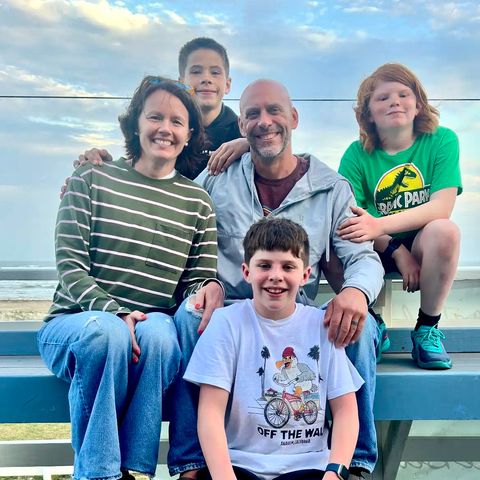
Our guest this week is Damian Buchman of Wauwatosa, WI, disability advocate, cancer survivor and father of three adopted children.
At age 12, Damian was diagnosed with osteosarcoma, a rare and aggressive bone cancer, in his right leg. Seven months later and after undergoing chemotherapy, limb-salvage surgery, and remission, he was also diagnosed with osteosarcoma in his left leg. His physicians believed surviving two primary bilateral osteosarcomas was extraordinarily unlikely. Because of his cancer treatments, he has undergone more than three dozen major knee replacement and revision surgeries over the years and lives with a permanent ambulatory disability.
Damian and his wife, Elizabeth, have been married for 18 years. Unable to have children of their own, due to Damian’s cancer treatments, the couple adopted three children as newborns: Lenon (10), Harrison (12) and Jackson (14), who has ADHD.
Rather than allowing disbility to define him, Damian has dedicated his career to expanding opportunities for people with disabilities. He is the founder of:
- The Ability Center
- Wisconsin Adaptive Sports Association, and
- The Opportunity Center initiative, an ambitious vision for a universally accessible recreation and wellness destination.
We also learn about Damian’s journey as an adaptive athlete.
It’s a remarkable story about beating the odds, overcoming a life-time of obstacles, living a full and meaningful life and creating opportunities for countless others.
Show Notes –
Phone – (262) 385-5738
Email – damian@tacwi.org
LinkedIn – https://www.linkedin.com/in/damianbuchman/
The Ability Center – https://tacwi.org/
Wisconsin Adaptive Sports Assn – https://www.wasa.org/
The Opportunity Center – https://tocwi.org/
Website: https://www.damianbuchman.com
Special thanks to all those who supported the SFN U.S. Tour, a month-long, 50-state, 60+ stop tour that took place from May 21 to June 21, 2026: to strengthen and grow the Special Fathers Network and distribute 1,000+ complimentary copies of our new book: Dads Raising Children With Special Needs & Disabilities: A Guide For 21st Century Dads.
Transcript:
Damian Buchman is a husband, a father and a cancer survivor
Damian Buchman: I’ve been told by surgeons, you know, you can’t have this many surgeries, you’re going to get infection or your wounds aren’t going to heal and eventually you’re going to have to like, you can’t keep doing this. Damien. I would say it wasn’t until 2016 when my surgeon finally looked at me and said, I guess you can keep doing it, so let’s go. It’s told me to keep living my life and being physically active. So I say that to say it is really important to understand, like why I believe anything’s possible.
David Hirsch: That’s our guest this week, Damian Buchman, a husband, a father, a cancer survivor and leader of three disability related organizations including the Ability center in Milwaukee, Wisconsin, giving everybody the ability to play together. Damian’s got quite a story to tell and we’ll hear that story in two segments. Today is part one, dad to the dad.
David Hirsch: You’re not on your own. We walk this road together, hard and home.
David Hirsch: Now say hello to the founder of the Special Fathers Network and host of the Dad to Dad Podcast, David Hirsch.
David Hirsch hosts the Special Fathers Network Dad to Dad Podcast
David Hirsch: Hi, I’m David Hirsch, host of the Special Fathers Network Dad to Dad Podcast. Two brief messages. First, I’m, thrilled to announce our new book Dads Raising Children with Special Needs and Disabilities. A Guide for 21st Century Dads is now available on Audible, Amazon, Barnes and Noble and other sites. Second, the Special Fathers Network US tour, a month long 50 state 60 plus stop tour took place from May 21 to June 21. Mission accomplished. It was quite a journey with hundreds of new connections which will have a ripple effect for months and years to come. Thank you to the following partners, Gigi’s Playhouses, John’s Crazy Socks, Rotary Club of Chicago and Special Olympics. Thanks. Also the 60 plus venue hosts which included 12 Special Olympics state offices and 15 of the 62 Gigi’s playhouses. Special thanks to the RV crew mentioned here in order of appearance. Zane Kooks, Andrew McDowell, Nelson Raskoon, Charlie Hirsch and Steve Harris. You guys were amazing. And special thanks to all those who offered their prayers and provided financial support. This was clearly a team effort.
David Hirsch: Through every season, in every stride. Great dads are present. 247365.
David Hirsch: Now let’s listen into part one of this conversation between Damian Buchman and David Hirsch.
Damian Buchman is a husband and father, cancer survivor and disability leader
David Hirsch: I’m, thrilled to be talking today with Damian Buchman of Wauwatosa, Wisconsin, who is a dedicated husband and father, cancer survivor and leader of three disability related organizations, the Ability center, the Wisconsin Adaptive Sports association and the Opportunity Center. Damian, thank you for taking the time to do a podcast interview with the Special Fathers Network.
Damian Buchman: It’s an, absolute pleasure to be here. Thank you for having me.
David Hirsch: You and your wife Elizabeth have been married for 18 years and are the proud parents of three adopted children, Lennon, 10, Harrison, 12, and Jackson, 14, who has ADHD. Let’s start with some background. Where did you grow up? Tell me something about your family.
Damian Buchman: So I grew up primarily in the Waukesha and Milwaukee county area, here in Wisconsin. Born in Heartland and raised primarily in the Brookfield and Elm Grove area, which we call the Elm Brook area here in the greater Milwaukee metro area. When it comes to my family, I think really the most profound thing is I was primarily raised by a single mother after my father left when I was 2 and they were divorced. but I then was collectively raised, arguably by my middle brother, my older siblings, and my oldest sister, who really took on the primary role as a second mother, if you will, in the house at a tender age of seven.
David Hirsch: Yeah, well, sorry to hear the fact that you didn’t really have a relationship with your biological dad. Did you have any contact with him during the rest of your life?
Damian Buchman: Twice. Once when I was first diagnosed with cancer. The first time, just about 13 years old, he called the house. I happened to pick up the phone, right. This is 1991, when we were still using landlines. I picked up the phone, and on the other side, was my father. And he just said, hi, Damien, this is Gary, your dad. Is your mom there? And that was it. This was within a month of me being diagnosed. He didn’t even ask, how are you feeling? How are you doing? Anything I can do for you? nothing. Zero. Just ask for my mom.
David Hirsch: Wow.
Damian Buchman: And then when I was 15, he was taking my mother to court to not pay child support for my brother any longer who was turning 18. And I said, hey, can I just, you know, come to court with you? Just so I can see him from a distance? I’m just curious. And that was it. Down the hallway, through a glass door, from a distance, coming out of the courtroom was the only other time I saw him.
David Hirsch: Wow. Well, I’m really sorry to hear that. When you were a young guy, if you can remember way back when, you know, like you’re describing, as a 13 and a 15 year old, what.
00:05:00
David Hirsch: What impact did that have on you? What was your thinking?
Damian Buchman: You know, I mean, is there anything other to say than something that sounds harsh, which is unbelievably kind of disgusted and surprised that he knew his son had cancer. While I didn’t know he. He is the only one who moved out of the Milwaukee area. He had 11 siblings. My grandmother, my grandfather. And some of those siblings were already coming to me at the hospital. so they all knew, and they all showed more care than my father did.
David Hirsch: So, it wasn’t lost on me that you just sort of, like, made passing reference to having cancer at age 13. What’s the backstory there?
Damian Buchman: I found my athleticism when I was about 11, in sixth grade. There were stories around here, and I’m not trying to pat my own back like a superhero, but there were stories I heard later going around the Helm Brook area about this guy that can jump out of the roof. And, you know, at 5 foot 7, I could nearly dunk a basketball, literally. So I was on this road in this path to feeling like a pretty premier athlete, wanted to be a pro beach volleyball player. And then three days before my 13th birthday, after two months of pain in my leg and falling every once in a while, not understanding why there was pain or why it would fall or why it would limp, once we saw the swelling happen, we went to an orthopedic surgeon. And within three days of that, I think I had already had a biopsy and was diagnosed with, childhood bone cancer called osteosarcoma.
David Hirsch: And if I remember in a prior conversation, this wasn’t in one leg, but in both legs.
Damian Buchman: That’s right.
David Hirsch: Which is very unusual.
Damian Buchman: Yeah. Extremely. Extremely. I think from what everybody can say, I seem to be patient. One of one that had bone cancer, bilateral osteosarcoma in both legs. They were diagnosed about a year and a half separate of one another. After seven months of remission is when I was rediagnosed in my left leg in September of 1992. So I had just begun my freshman year of high school, and really, one of my favorite kind of stories and oddities of the universe. You know, call it God, call it love, call it the universe, call it whatever you call it. Freshman year, we were supposed to write a paper and give a speech on what we love, hated, or feared. And we could pick any one of those. I chose to write about what I loved and what I feared, and I talked about why I loved life, because I had literally just survived my first bout with bone cancer. But what I actually feared was getting re diagnosed, because likely death becomes you at that point, and ignorance was no longer bliss. So I combined those two things in my speech, and I kid you not, within a week of that speech, I got rediagnosed.
David Hirsch: Yikes.
David Felt was diagnosed with osteosarcoma twice
David Hirsch: Did you think your life expectancy was going to be a lot shorter or what? What was going on at that time?
Damian Buchman: I think in the moment, you know, I remember watching the doctors walk into my room after three days of telling everybody I was okay, I was okay. I was full of hope. I was like, everything’s going to be fine. No one expected this to be cancer going into my next biopsy. No one. And even my oncologist, who’s kind of your traditional elderly physician in a way, if you will, very. He doesn’t say things he doesn’t know. Right. And he doesn’t sugarcoat things because that wasn’t his personality. But he even told my mom, going to the biopsy, like, there’s no way this is cancer, because it wasn’t in my lungs, it wasn’t anywhere else. Nobody thought that this would be cancer. They knew immediately, right in the biopsy. So my family knew, my mom knew, everybody knew. While for three days I was saying, nope, it’s not, I’m fine. But they had to find something to cure me. They had told my mom osteosarcoma is rare. The protocol for it, chemotherapy for it, is as aggressive as the cancer is. And if this survived the first round, nothing’s going to beat it the second time. And so they really told her to just take me home and let me live out my days, you know, happily, peacefully, and as healthily as possible with my friends and my family. And she said, no, you’re going to find something to cure my son. He’s going to be fine. And so about three days in, they found a protocol at a Texas children’s, but also begged her not to do that. They said this treatment will kill him before the cancer does. Which nearly happened. Which I didn’t have my two final doses and rounds of chemo because my kidneys were going to shut down. I think, David, the key was, is ignorance was bliss. The first time, you’re, you know, 12 of just about 13, you don’t know what they’re talking about when they say tumor or cancer or treatment. You just. I just saw the protocol in front of me and said, okay, I’m going to be sick for a year, have surgery, I’ll be fine. Which obviously may not be the case, but in my mind it was. And it turned out to be that for seven months after my, original diagnosis. So the second time, ignorance wasn’t bliss. I could see what I had gone through. I know what I Felt I could hear and see where doctors said you could die, you could lose your leg, the chemo may not work. I could picture it all again. So it wasn’t like in one ear and out in the other. It was trapped in my subconsciousness, but came through in those seven months remission. So when I was re diagnosed, I was scared. I wasn’t focused on death and I think I wasn’t because my mom was smart enough to tell everybody.
00:10:00
Damian Buchman: You don’t tell Damien what you told me, you don’t tell Damien, there’s a zero percent chance. You don’t say, there’s a 10% chance. Everybody says, damien, you’re just going to be just fine. And so I found my positivity again. I found my desire to want to survive. I found my desire to want to win and slog through a second diagnosis. You know, slowly, painfully, all the things, all the pieces, more surgery, but came out on the other end. And here I am a 35 year survivor of, apparently Survivor 1 of 1.
David Hirsch: That’s incredible.
Dad has had 36 knee replacements and revisions since diagnosis with bone cancer
So I know a couple other people that had childhood, bone cancer. I know that there’s a lot of different types, so I don’t mean to compare yours to theirs, but they actually had some surgeries to remove a, segment of the bones that were impacted. And I’m wondering if that was part of the solution in your situation or.
Damian Buchman: Yeah, it was. It’s called a limb salvage. So everything that’s affected by the cancer comes out. I like to kind of describe it as, you know, if you’re getting a typical knee replacement, if you can picture what the joint of a knee looks like, they kind of shave those fittings off and then cap it with metal and plastic, if you will. Right. For us, those who are diagnosed with some kind of bone cancer, everything affected has to come completely out. So my entire joint on my right leg from about mid femur to tibia is all metal and plastic. And then on my left leg from about mid femur all the way through, my tibia is all metal and plastic as well. So there’s no ligaments, no tendons anymore. Muscles were removed or put in different places. So it’s called a limb salvage. So at this point I’ve been blessed to still be walking on my own two feet, have pretty functional limb salvages and have had 36 knee replacements and revisions since I was 13. The most recent one was October of 24. So I would have been, I’m 48 now. I would have been 46. So it’s been ongoing since day of diagnosis.
David Hirsch: And is it possible you’re not going to have to do any more of these? Or is it just sort of like expected that every couple three years you are going to be subject to yet another.
Damian Buchman: Yeah, you know, a little bit of a fun story there. Right. Is, the company that designed my left knee redesigned it because of me because I was wearing the knees out so fast. They said, I don’t understand why. So they literally took my pieces because I always want to keep my pieces. They said, no, we’re going to take those pieces. We’re going to research and figure out how did he wear this thing out in 18 months, you know, because I was literally still playing stand up volleyball at the time. And so I caused a lot of these knee replacements and revisions. Wanting to still live life to the fullest I can, regardless of my ambulatory disability and physical limitations. I found a way, I adapted. I made sure I could still do the things I loved and enjoyed. So I caused a lot of the knee replacements and revisions. But yes, likely because I’m walking on two limb salvage legs, don’t have one to baby the other or support the other. they wear out faster. I’m a pretty active dad with my three boys, as you can imagine. And, and so there’s one of two things that’ll happen. Either I will continue to have those parts and pieces replaced, you know, kind of the tune ups, if you will, or I’ll become a bilateral above knee amputee, which I’ve been waiting for since I was 15 and cannot believe I am not there yet.
David Hirsch: Wow. Well, I’m hoping that you’ve had all the procedures you’re ever going to have on your legs behind you and that, you won’t have to be revisiting this or the consequence of, amputation. But given all the things that you know and do, you know that, hey, life goes on, right?
Damian Buchman: That’s right.
David Hirsch: It is amazing. I’m sure you’ve been compared to the Energizer Bunny and other things that, you know, sometimes.
Damian Buchman: Yes.
David Hirsch: Yeah. Well, thank you for sharing. Very inspiring.
David Hirsch: We’ll be back with more of the conversation on the Special Fathers Network Dad to Dad Podcast in just a few moments. But first, this quick message. Please help 21st Century Dads gather research on families raising children with special needs by having them complete the Special Fathers Network Early Intervention Parents survey. A, link to the survey can be found in the show notes. As a token of our appreciation, each person, mom or dad, who completes the survey will receive a great dad coin. Thank you.
Beau and Elizabeth met in 2004 at childhood cancer camp
Now, back to the conversation.
David Hirsch: So I’m so curious to know, how did you and Elizabeth meet?
Damian Buchman: Oh, boy. Elizabeth and I. who. Affectionately. Via her cousin, when they were both, very young, because they’re only 11 days apart. Goes by Beau. And so Beau and I met in 2004 at childhood cancer camp. Now, she was not a childhood cancer survivor, but at the time, she was a nurse at Children’s Memorial in Chicago. Floated around the whole hospital, but really found that she loved the oncology population and patients and families. I, landed at the camp I had been going to since I was a kid. Since I was 15. I was a. A patient, a camper, then a program, counselor, then a program leader, director, all the things at this point. And so we met there in 2004 and were married four years later in 2008.
David Hirsch: That’s
00:15:00
David Hirsch: amazing.
Damian Buchman: Yeah. And, I mean, the. The. Really, the kind of. The miracle around all of it is not only do we do that, but then she moved up here to Milwaukee with me, where she was a nurse in the clinic of the physician that saved my life. So Dr. David Margolis is the man I credit to saving my life. So she worked with my old oncologist. She worked with him. She’s worked with my surgeon floating around the oncology unit here. and so we get, you know, pretty often reminders of how blessed my life is and a clear understanding of how arguably I’ve come out of this experience relatively unscathed.
David Hirsch: Yeah, well, you would be a poster child if there was a poster hanging in Dr. Margolis’s office. This is possible, right? Not probable, but this is possible. Yeah. Yeah. Well, thanks for sharing.
David and Jasmine have three healthy sons through adoption
So, I know that you’re parents, but I also know that you’re, unable to have children of your own because of all the, treatments that you underwent as a youth and as a young adult.
Damian Buchman: That’s right.
David Hirsch: What’s the backstory on adopting these, three boys?
Damian Buchman: So backstory is, you know, like you said, we knew that adoption would be a part of our family building process. Knowing that I couldn’t have children, my wife attempted through IUI to get pregnant nine times with donor sperm, unsuccessfully. And so when you run the process with an adoption agency, you know that they don’t really let anybody adopt till you’ve been married for two years at least. Least. Which makes sense, right? About 50% of marriages end up in, you know, divorce. So makes sense for them to put that, Starting line at that point. So I will never forget. And I think it’s such an important story. The day I walked into the bathroom after this ninth time and she’s just crying over the shower. And I looked at her and I said, we’ve hit our two year mark. It’s time now. It’s time to start the adoption process. And so we did. And David, what, what I tell, when I tell everybody this story, I tell them like we never waited longer than a gestation period to have a brand new baby newborn right from the hospital in our house. It was pretty incredible. Very, for me, very clearly God’s plan, you know, that that is how we are meant to raise and build a family is through adoption. and now we have, you know, as you said in the beginning, we have three healthy boys that are, you know, 10, 12 and 14 and thriving. It’s pretty amazing. And there was three boys under four in my house, you know, within just under four years. That’s pretty. I know people and friends who’ve adopted that have waited four years for just a match.
David Hirsch: Yeah. Well, thanks for sharing. Very inspiring. And what a blessing it is that you can have one, not just one, but three, like you said, as newborns as well.
Damian Buchman: And if I may, I’m sorry to interrupt, but one of the most amazing miracles in that story is it’s our first. Jackson was born on the day I was diagnosed with my cancer 21 years later. So it has reinvented that day that March 7th used to be. Well, this is the day you got sick. Now, March 7th is the day that I adopted my son and my son was born. It’s pretty incredible miracle to see that come full cycle.
David Hirsch: Yeah, well, there are no coincidences, right? No, this is just way of reminding you that, this is your destiny. And did I remember that your two younger boys, Harry and Lennon, are half brothers as well.
Damian Buchman: They are half brothers. So I joke to say that Lennon, our third, is our oops, baby. So the story goes. My wife said, hey, I won a third. I think it’s time to adopt again. And I said, no, I don’t think I want to adopt again. And she said her comment was, well, you know, I always wanted four, so three is a compromise. And I said, you know, I said I could do none, so two’s a compromise. But I said, if it’s God’s plan, we’ll keep all the social media up, we’ll keep our website up, you know, for looking to adopt. But we’re not going to pursue if It’s God’s plan that we have a third, then so be it. The third will come. I kid you not. It was two or three months after that conversation, we got a call from the adoption agency and said, jasmine, who’s their birth mother, is pregnant again. Would you like to adopt? And I was like, okay, yes, here we go. So that’s how Lennon came about. So they are indeed half siblings and all wonderful. And, you know, we’re blessed to have them.
David Hirsch: Yeah.
Are open adoptions where you’ve been in contact with birth parents or closed
Well, this is not an adoption, podcast. But out of curiosity, are these open adoptions where you’ve been in contact with, birth parents or closed?
Damian Buchman: Yeah, that’s a fair question. And while I appreciate it’s not an adoption story or podcast, it is interesting to know that now pretty much every adoption is open because we’ve learned that it’s better for kids to be able to know and find that future family in the future, should you need to, so that things aren’t actually closed and really hard to figure out. But then the degree of open is what matters in America now. So that becomes a comfort level between you and the birth mother or birth parents. And so we know her, she knows us, we know Jack’s mom, she knows who we are, we know their names.
00:20:00
Damian Buchman: So in the future, if the boys ever want to look them up and meet their other family, it’s not hard to do or hard to find. So it’s open in that manner.
David Hirsch: Yeah. Well, thank you for the transparency about that.
Did you or Beau have any connection directly, indirectly to disability before becoming parents
So I’m sort of curious to know, did you or Beau have any connection directly, indirectly, to the disability community, before you became parents?
Damian Buchman: just my own. Right. My own physical, ambulatory disability was our primary connection, and actually shouldn’t say just our own. So, you know, at childhood cancer camp, as counselors, as staff members, et cetera, you see the gamut of disability. You see the breadth, the depth, the spectrum, if you will, because kids with autism get childhood cancer, kids with down syndrome get childhood cancer, and cancer often causes some level of disability, like it did for me. So, you know, think brain tumors. You walk away with a lot of intellectual or developmental disabilities and sometimes physical limitations. I saw, you know, amputations, blindness, paralysis, limb salvages like myself. It really run the spectrum. So we had experience there. But then, of course, I also have my own experience, and I also happen to have a niece and nephew who are on the autism spectrum, too. So I’ve had a really. Since I was 13 years old, I’ve been connected to that spectrum of disability, both growing through it functionally as a child, a teenager, and an adult.
David Hirsch: Yeah. Well, thank you for the emphasis.
Jackson was diagnosed with adhd when he was 10 years old
So, back to your boys. My recollection was that, Jackson has adhd. And I’m wondering, how did that come about and what impact has that had?
Damian Buchman: It’s a real interesting world, right? We know that ADHD is on the autism spectrum and comes in all kinds of different shapes and forms for each individual. And so for him, we didn’t realize it until his fifth grade teacher, he was 10, who was kind of in this space, actually, during a parent teacher conference, she kept using the word inattentive. Jack is very inattentive. And I finally said to her, I go, are you trying to tell me my kid has add? And she goes, well, I can’t diagnosis. You know, that’s not my expertise. But she was leaning into it for us. And she ultimately, we became pretty close to her, and she became Jack’s tutor. And she ultimately, you know, just said it. His, behaviors are just like my ADHD behaviors. So for years, we always heard, Jackson is so special. If he just wanted to be, he could be so special. And that’s the how they saw it in elementary school. And it’s probably because, you know, I actually was like, is there, you know, in adhd, isn’t there also just add? And at this point, they just say it’s all adhd. But he didn’t really have that hyperactivity, if you will, disruptionary behavior, if that’s even a word. So he was always kind, always respectful, you know. But what she said, she’s like, he’ll just get up in the class and walk back and forth and then sit down. Or she’s like, he has to spin everywhere he goes, or he’ll just come up to me and say something. But he was never collectively disruptive to a class. Right. He was pretty respectful of everybody else. So I think he got away with it until he was 10. But then when you started looking at it, and she started talking about it, I was like, oh, yeah, yeah, I see all of it. This all makes a ton of sense. And ultimately, I think what’s hardest is expectations, right? Which I think whenever you have a child with special needs in any capacity at any level, you know, you don’t know what you’re navigating with, but, you know, what you ideally expect, what you would see. And so I think what I. Where I’m going with this is, on average, kids with ADHD are 30% behind their typically developing peers socially, emotionally. And so when you’re looking at this point, I’m looking at a 14 year old. And I’m thinking you should be behaving in this way, you know, according to your typical age development. And it’s kind of hard to understand why he isn’t. Because it isn’t an outwardly. Right. Very clear, very apparent disability. It isn’t autism, it isn’t down syndrome, it isn’t, you know, whatever it might be. And so you still look at him and expect that he should behave in a certain way. And sometimes it’s hard to connect to the weight he’s behind. Adhd, et cetera. So certainly not difficult to navigate in the world of special needs. Without a doubt, but definitely for all the parents out there who have a kid with adhd, you know, it’s pretty hard and it’s pretty frustrating. It’s pretty. Remember to cool your jets, to calm yourself before you react kind of loud, angrily, vocally, etc.
David Hirsch: Yeah, well, thank you for the insights. do you think it helped that he was your oldest and he didn’t really have a measuring stick. Right. With, like an older sibling. So you’re a little bit more accepting of the delays. Is that possible?
Damian Buchman: Yeah, I think once you start to understand why the delay, that’s where it becomes more acceptable. But it also goes back to what I just said previously is it’s sometimes hard to remember. You know, you feel like you’re. You’re speaking to a typically developing person that should understand everything you’re saying and everything you’re asking them to do, who’s, about to be a freshman in high school, and you think, I should be able to tell you three simple things. You should be able to complete that list. Right. And he literally cannot. And if
00:25:00
Damian Buchman: you tell him too much, his brain just goes bananas and haywire and then he just loses it. Right. So just remembering that I can just say, go, do this thing first. And then once that’s done, I can say, do that thing now. And. And also for my wife and I to try to do our best to be in synergy with that, in sync with that, because if she sells him one thing and I told him another, those two things get crossed and now he has no idea what direction to go. And because we didn’t know those interactions happened, then we’re both mad at him for not doing the thing we told him to do. So he can’t prioritize it in his brain. Right. So it’s a family dynamic that to get the best results, which again, is not Extreme by any means. But to get better results, it needs to be collective conversation and communication, ideally in the same room at the same time.
David Hirsch: Yeah, it sounds like he does better when he’s working on things sequentially, as opposed to what you and I might refer to as multitasking.
Damian Buchman: Yeah, right. That’s right. Yep. And he, definitely, you know, like a lot of kids, I think, listens to dad better. You know, so oftentimes it’s my wife, Beau is asking me, hey, can you tell Jack to do that thing? And so I’m m. Often intervening in the guy. And also, David, because I was a stay at home dad with all of my boys. I’m their person, you know, Oftentimes you’re going to mom for things. Well, dad was the stay at home dad from day one. And so I am the person they look to for everything first.
David Hirsch: Yeah, well, thanks for making that point as well. Is it medication that, he takes?
Damian Buchman: Yeah, he takes your typical Ritalin. And, and what was really interesting in the beginning of that was the pediatrician telling us, like a lot of parents, you know, and kids will just take it during the week, during school, and they may not take it on the weekends and they don’t. May not take it in the summer. And so we left that up to him. And I think what was really powerful, because he was only 10, 10, 11, he realized I’m better on this medication because we gave him that option. If you don’t want to take it on the weekend, you don’t want to take it in the summer, don’t take it. And he chooses to.
David Hirsch: Yeah, well, thanks for the insights. We could probably do a whole podcast on adhd. There’s so much there to talk about. But, I think you’ve gone into enough depth to put that, parental challenge into perspective.
David Hirsch: Damien Buchman overcame childhood cancer and multiple surgeries
So when I think about you and what little I know, because we’ve just met more recently, I think that, you are this super ambitious, grab the tiger by the tail type of person. And we’ve already documented that with overcoming this childhood cancer and all these surgeries and, you know, you’re like a miracle person.
Damian Buchman: But that’s a really important statement though, right? Because I, I really am from a teenager during your very formative years. I, you know, I wear this shirt all the time that says unstoppable. And we focus on the ability and the unstoppable. But I, I’ve been told you’re not going to survive or you could lose your legs or all of these things that are supposedly impossible to do. I’ve done. I’ve been told by surgeons, you know, you can’t have this many surgeries. You’re going to get infection or your wounds aren’t going to heal. And eventually you’re going to have to like, you can’t keep doing this. Damien I would say it wasn’t, it wasn’t until 2016 when my surgeon finally looked at me and said, I guess you can keep doing it, so let’s go. It’s told me to keep living my life and being physically active. So I say that to say it is really important to understand, like, why I believe anything’s possible, because my life was built on impossible, supposedly the bhag. I have a lot of bhags. Big, hairy, audacious goals. I have a lot of them because that’s what my whole life is built on.
David Hirsch: Dad to the dead. You’re not on your own. We walk this road together.
David Hirsch: And that concludes the first part of David Hirsch‘s conversation with Damien Buchman. Tune in next week when we’ll hear the conclusion on the Special Fathers Network Dad to Dad Podcast. The Special Fathers Network is a dad to dad mentoring program for fathers raising children with special needs. Through our personalized matching process, new fathers with special needs children match up with mentor father in a similar situation. It’s a great way for dads to support other dads. To find out more, go to 21st
David Hirsch: centurydads.org and if you’re a dad looking for help or would like to offer help, we would be honored to have you join our closed Facebook group. Please go to facebook.com groups and search dad to dad. Lastly, we’re always looking to share interesting stories. If you’d like to share your story or or know of a compelling story, please send an email to david21stcenturydads.org the
David Hirsch: Dad to Dad Podcast theme was written and performed by Shane Madden. The show was produced by me, Tom Couch. Tune in again next week for another intriguing conversation on the Special Fathers Network Dad to Dad Podcast.
David Hirsch: Through every season, in every stride, great dads are present. 247-365-24-7365.
00:29:53