

438 – Damian Buchman of Wauwatosa, WI, Disability Advocate, Cancer Survivor, Father of Three – Part 2
Description
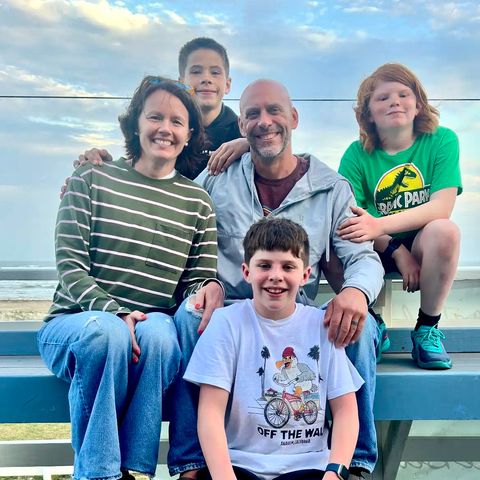
Our guest this week is Damian Buchman of Wauwatosa, WI, disability advocate, cancer survivor and father of three adopted children. This is Part 2 of the interview with Damian.
At age 12, Damian was diagnosed with osteosarcoma, a rare and aggressive bone cancer, in his right leg. Seven months later and after undergoing chemotherapy, limb-salvage surgery, and remission, he was also diagnosed with osteosarcoma in his left leg. His physicians believed surviving two primary bilateral osteosarcomas was extraordinarily unlikely. Because of his cancer treatments, he has undergone more than three dozen major knee replacement and revision surgeries over the years and lives with a permanent ambulatory disability.
Damian and his wife, Elizabeth, have been married for 18 years. Unable to have children of their own, due to Damian’s cancer treatments, the couple adopted three children as newborns: Lenon (10), Harrison (12) and Jackson (14), who has ADHD.
Rather than allowing disbility to define him, Damian has dedicated his career to expanding opportunities for people with disabilities. He is the founder of:
- The Ability Center
- Wisconsin Adaptive Sports Association, and
- The Opportunity Center initiative, an ambitious vision for a universally accessible recreation and wellness destination.
We also learn about Damian’s journey as an adaptive athlete.
This is the concluding segment of this two-part interview.
It’s a remarkable story about beating the odds, overcoming a life-time of obstacles, living a full and meaningful life and creating opportunities for countless others.
Show Notes –
Phone – (262) 385-5738
Email – damian@tacwi.org
LinkedIn – https://www.linkedin.com/in/damianbuchman/
The Ability Center – https://tacwi.org/
Wisconsin Adaptive Sports Assn – https://www.wasa.org/
The Opportunity Center – https://tocwi.org/
Website: https://www.damianbuchman.com
Special thanks to all those who supported the SFN U.S. Tour, a month-long, 50-state, 60+ stop tour that took place from May 21 to June 21, 2026: to strengthen and grow the Special Fathers Network and distribute 1,000+ complimentary copies of our new book: Dads Raising Children With Special Needs & Disabilities: A Guide For 21st Century Dads.
Transcript:
Don’t worry about everything that they can’t do. It is defied all the time
Damian Buchman: Don’t worry about everything that they can’t do. Don’t worry about what the doctors tell you statistically of what they can’t do or won’t do. It is defied all the time. And if you harness the can, they’ll surprise you every time.
David Hirsch: That’s our guest this week, Damian Buchman, a husband, a father, a, cancer survivor, and leader of three disability related organizations including the Ability center in Milwaukee, Wisconsin, giving everybody the ability to play together. Damian’s got quite a story to tell and we’ll hear that story in two segments. This is the final segment.
David Hirsch: Dad to the dead. You’re not on your own. We walk this road together, hard and whole.
David Hirsch: Now say hello to the founder of the Special Fathers Network and host of the Dad to Dad Podcast, David Hirsch.
David Hirsch hosts the Special Fathers Network Dad to Dad Podcast
David Hirsch: Hi, I’m David Hirsch, host of the Special Fathers Network Dad to Dad Podcast. Two brief messages. First, I’m thrilled to announce our new book, Dads Raising Children with Special Needs and Disabilities. A Guide for 21st Century Dads is now available on Audible, Amazon, Barnes and Noble and other sites. Second, the Special Fathers Network US tour, a month long 50 state 60 plus stop tour, took place from May 21 to June 21. Mission accomplished. It was quite a journey with hundreds of new connections which will have a ripple effect for months and years to come. Thank you to the following partners, GT’s playhouses, John’s crazy Socks, Rotary Club of Chicago and Special Olympics. Thanks also to the the 60 plus venue hosts, which included 12 Special Olympic State offices and 15 of the 62 Gigi’s playhouses. Special thanks to the RV crew mentioned here in order of appearance. Zane Kooks, Andrew McDowell, Nelson Raskoon, Charlie Hirsch and Steve Harris. You guys were amazing. And special thanks to all those who offered their prayers and provided financial support. This was clearly a team effort.
David Hirsch: Through every season, in every stride, great dads are present. 247365.
David Hirsch: Now let’s listen in to the conclusion of this conversation between Damien Buchman and David Hirsch.
Damian Buchman is the founder of three disability related organizations
David Hirsch: I’m, thrilled to be talking today with Damian Buchman of Wauwatosa, Wisconsin, who is a dedicated husband and father, cancer survivor and leader of three disability related organizations, the Ability center, the Wisconsin Adaptive Sports association and the Opportunity Center. Damian, thank you for taking the time to do a podcast interview with the Special Fathers Network.
Damian Buchman: It’s an, absolute pleasure to be here. Thank you for having me.
David Hirsch: So when I think about you and what little I know because we’ve just met more recently, I think that, you are this super ambitious, grab the tiger by the tail type of person. And we’ve already documented that with overcoming this childhood cancer and all these surgeries. And you’re like a miracle person. let’s talk about the organizations that you’ve, led and grown in chronological order, starting with the Ability center, back, I think, about 20 years ago now, almost, whose mission to provide people impacted by disabilities with a daily opportunity to be fit, active, healthy, and to play. So what was it that motivated you to create that? What were you doing at that time that said, hey, I think we need to do something different here?
David Hirsch: Yeah.
Damian Buchman: So thanks for the question. I find myself to be, and kind of pride myself sometimes on being a problem solver. And I didn’t grow up, even though I did. Right. I grew up with an ambulatory disability, but I didn’t grow up in youth and adaptive sports. and so I didn’t have a vision of what it’s supposed to be or supposed to look like. But what I did realize when I did finally get involved is that it’s too darn competitive adaptive sports for people with physical disabilities. I’m a super competitive human. I’m very competitive. But I realized what we were doing in adaptive sports is more often than not, we were pushing people out of gyms with the competitive mentality that these practices run. I will say that we will always share the ball, include you in the game. We don’t put you on the sidelines. You’re not the last person picked. But what nobody does is slow down. So it quickly becomes a very embarrassing space to be that unless you are uber competitive, you’re not coming back to it. And in my 15 years now of competitive wheelchair basketball, through our practices, we’ve converted one athlete. It was before 15 years of realizing that. But that’s the data in our competitive wheelchair basketball practices, in our open gyms through the Ability center, where we do focus on fun, we focus on play. You know, we actually say no disability required to play. With the Ability center, we have all the assets, all the needs, all the adapted things for everyone to play together in. What we just, you know, deem a different pair of shoes is the way we introduce the sport wheelchair when it comes to wheelchair sports that we play.
00:05:00
Damian Buchman: And so people get to come together and play with the people they love most. And that’s what we make possible. We start with play. It’s really kind of deploying the success Special Olympics has. The success Special Olympics has is because they start with play, they don’t start with competition. Most people don’t realize that you can be an elite national champion in Special Olympics and you can indeed be a global champion. What we know is of the community recreation play standpoint of a Special Olympics in adaptive sports, that’s flipped so we don’t welcome enough people into the gyms that feel what we say, welcome, wanted and comfortable. So the Ability center has filled as an organization in our programs really two holes. That idea of play and recreation, what if that’s just what I want to do? What if I don’t want to compete? What if I don’t want to travel? What if I don’t want to be competitive on a team? What if I simply just want to play in a park, at the beach, on a bike? Those are the kind of opportunities in that space of play and recreation that we’ve mobilized for people with disabilities.
David Hirsch: Yeah, well, thank you for emphasizing that. So the Ability center focuses heavily on inclusion and empowerment. How do you help shift the conversation from limitations to possibilities for individuals and families?
Damian Buchman: I mean, I think the biggest thing is in redefining what that wheelchair is. Right. Society sees a wheelchair as a limiting device, but arguably a lot of people still use the term wheelchair bound. Nobody is wheelchair boundaries. You use a wheelchair to be able to get out of your house. So it actually creates independence. You use your wheelchair to navigate the world, not to stay stuck in bed. Right. So it gives you those legs, if you will. And so that’s the way we introduce it to kids and to and to people in the community is this is just a different pair of shoes. These are your Jordans for the day. These are your cleats. If you were to play baseball, you’re going to play in this device. It’s not disabled sport, it’s wheelchair sport. It’s not disabled sport, it’s adaptive sport. And you can get in a chair and play with me, but like with my boys, I can’t run up and down a court physically to play basketball or anything with them. Right. But they can get in a chair. And now we’re in an equal playing space. So we really have bridged the gap, bridged the exclusion by welcoming people into an adaptive world versus saying I have to fit in an able bodied world.
David Hirsch: Yeah, great point.
So can you share a, um, anecdotal story of a family or a person impacted
So can you share a, anecdotal story of a family or a person who’s been impacted through the Ability Center’s programs?
Damian Buchman: Yeah, absolutely. The first story, there’s two key stories that always come to me. One is of two young girls who were congenital amputees. One is a Bilateral above knee amputee. One is a single amputee. And I met them when they were three and four and they happily, either three or four or four or five, they happily came to our open gym and played with their mom, and then their dad came and played with their dad. And then they started bringing friends, just able bodied friends from school and their neighbors, and everybody was playing together and that’s exactly what we wanted to create. Where they also proved kind of that problem with competitive adaptive sports model is then they went to play competitive adaptive sports with the local organization and they were scared, they were intimidated. at their first practice at this point, they were probably five and six or six and seven and they left like a lot of people do. But the beautiful part was that they had the ability center to still come back to and just play for fun. And until they got a little older and a little more competitive and a little more comfortable with that level of competition, then they still went back. They didn’t leave adaptive sports from a competitive standpoint as a whole. So that’s one. The other story I really like as a gentleman who was a quadriplegic and the doctor told him he would never push a manual chair. So he was always in his power chair. And there’s a program for people with disabilities, at least in Wisconsin, called Iris. And Iris supplies you with a consultant, as an individual with a disability, to learn where you can spend your benefits and how and give you a few more resources. Well, this gentleman’s consultant was another quadriplegic who played quad rugby, right? And he tried to keep asking him, you should come to our, quad rugby practice. You should come play quad rugby for two and a half years. David, he was encouraging this other guy to come to quad rugby. And this is a peer, right? One quadriplegic to another quadriplegic, and he would never show up at those. Why? Probably because a doctor told him he’ll never push a manual chair. So why would I show up to somewhere where everyone knows what they’re doing and how to do it? And I don’t even know if I can push that chair. That’s embarrassing. Well, the ability center hosted, an open gym specifically geared towards quad rugby. This gentleman came and played with his caretaker, with his girlfriend, with his mother, so people he’s comfortable with and realized, I can push a manual chair, I can play this sport. And immediately started going to practices. So those two moments, it probably not only changed his athletic career, but his daily life. Realizing the doctor was wrong. You absolutely can push A manual chair.
David Hirsch: Yeah. Well, those are two amazing stories. Thank you for sharing.
How is the ability center helping address barriers for families with disabilities today
What do you think the biggest barriers are for families or children with disabilities today? And how is the ability center helping address that?
Damian Buchman: I think the biggest challenge societally still remains the same. We’re getting better with kids primarily through elementary school. By being kind, by being inclusive, by welcoming everybody, you can no longer, at least in our schools, you can no longer deliver an invitation to a birthday party unless every child, the class, gets that invitation. So we’re creating a more inclusive and welcoming world in that way in the elementary space, but largely out in society, we still have parents who are telling their kids, don’t point, don’t stare, don’t ask, don’t, don’t, don’t. Versus allowing those relationships that kids just want to be friends with other people. They just want to know what’s going on. But we were raised by parents who did that. And so we are largely still doing that with children unless you’re in a world, like ours. And so again for the ability center, by creating those spaces where no disability required, everybody plays together. It gives that opportunity to equalize the abilities. And actually the person without the disability becomes, if you will, if the ability is only the function of being able to do something well, well then that means if this is your first time playing wheelchair basketball or getting in a chair, you’re going to be, as I put in air quotes, the disabled wheelchair basketball player. Right. And I’m going to be the very abled wheelchair basketball player. So now what you did was equalize an experience. Able bodied human can actually see your abilities. We too often see disability as can’t versus can. And we will focus on what someone can’t do, not what they can do. And when we put people in chairs together, they realize, wow, not only can I not push as fast as that person, I may not be able to shoot a ball. I can’t keep up with them. They’re running circles around me. And then you’re also, David, seeing people eye to eye. Like if someone’s a wheelchair user, you’re not looking down on them. Now I’m level with you. And that in and of self is an entirely different action.
David Hirsch: Yeah, beautifully stated. I would go as far as to say that, when you put, people from the able bodied world into the ones that have these different challenges, that there’s a bunch of empathy training going on as well.
Damian Buchman: Yeah.
David Hirsch: When you’re in that chair and you’re not a disabled person now, you have a better understanding about what this is all about. How could you not feel compassionate?
Damian Buchman: That’s right. And, and the beauty of what we do is that we do that through play. Everybody likes to play. It’s not this kind of gimmicky thing of like, hey, get in this chair, push a wheelchair around your community for the day and see how hard it is. And tomorrow you’ll still get out of the chair. This is a come and play alongside me and do the same thing as I’m doing and experience it with me. So now not only am I getting that empathy through play, but I’m also again, seeing what you’re actually capable of. And now all those ideas of what you can’t do have escaped my mind. And I see you as a human as opposed to someone with a disability. So we open worlds for those conversations, for those connections, and for all of it to happen organically.
David Hirsch: Yeah, I love it. So if you had to look down the road five or ten years, where do you see this ability center going?
Damian Buchman: Oh, so we are, about to embark on building the country’s first universal park, we call it. So five to 10 years down the road, I see universal parks around the country.
David Hirsch: Okay, let’s switch gears and talk about the Wisconsin Adaptive Sports association, whose mission is to improve the quality of life for individuals with physical disabilities or visual impairments through the power of adaptive sport, recreation, fitness, and education. So where does this fit in to what we were just talking about with the ability center, or what’s different about it?
Damian Buchman: Yeah, so this is your traditional adaptive sports model that people are familiar with around the country. This is where I saw that there was a problem, this idea that the only way to participate in adaptive sport is to do it competitively. The story, David, across the country as I talked to people, was the same. I invite somebody to our, our wheelchair basketball practice, our quad rugby, basket practice, whatever, adaptive sport, and I put a chair in front of them and say, here, you can get in this and play with, us. In a lot of cases, people are not daily wheelchair users, so they actually like myself. So they, they’re afraid to get in it, they don’t want to be in it, they don’t want to feel embarrassed. and again, everyone around knows what you’re doing, but there is a space for that, There is a need for that. But what we don’t do in the physically disabled world is graduate people into. We jump right to it. I saw a lot of people kind of jump down kids throats or jump down a veteran’s throat. And be like, oh my gosh, you have a disability. You could be a Paralympian. And it’s like, wait, time out. I don’t even know if I like this. What do you mean? So it’s a very aggressive approach. It is not this welcome, wanted, comfortable kind of slow play approach that the Ability center created. But in my market here in Wisconsin, all of those teams that were involved were separate. Separate, right. So there was a wheelchair basketball team, There were actually
00:15:00
Damian Buchman: three. We’re all parts of different clubs and teams. There was a quad rugby team, a sled hockey team, wheelchair lacrosse, getting developed, et cetera. And I brought them all to the table and said, why are we separate and why are we not one where we can give people more opportunity to choose, click, play as many different sports and practices that they can go to. And so that was the idea, is that something needed to be organized there with everybody so that we could serve, you know, not just 12 dudes who want to play wheelchair basketball, but we could serve kids to veterans from, you know, 8 to 80, you know, and younger and older even, and give them multiple different sports to compete and play in if that’s what they want to do.
So let’s switch gears one more time and talk about the Opportunity Center
David Hirsch: So let’s switch gears one more time and talk about the Opportunity Center. My understanding is that there’s two of you and this Frank Cumberbatch, who’s the vice president of engagement at Batter Philanthropies. How did the two of you connect and what’s the vision behind this, Opportunity Center?
Damian Buchman: So, if you could imagine, I’ve been at it all for this long. You mentioned earlier that I founded the ability center about 20 years ago, which is true, but in 2012, about 2011, 12, I couldn’t grow our mission, I couldn’t serve our mission. I couldn’t even complete the goals or objectives because there weren’t places that were affordable or they weren’t accessible. They didn’t have availability for us to do programming. More often than not, it was a combination of all three of those things. Right? It wasn’t accessible, wasn’t affordable, wasn’t available. We couldn’t do programming. In my earlier career, I had run a sports facility and said, well, no one’s going to let me in. I guess we’re going to have to build our own complex. At that time, being my bhag kind of human aspect in my nothing’s impossible, I wrote grants to local foundations and I said, why don’t we have this? I can’t meet my mission. Nobody will let people with disabilities in the doors, I can get zero consistency. We need to create a facility that works for everybody, right? So this wasn’t just about serving the disabled, but it was about putting those impacted by disabilities first and then everybody else would get secondary access. It was about inviting people into an accessible environment, not making people with disabilities fit into an able bodied world. And so it would work for everybody. So, I wrote that grant to Bader Philanthropies on top of many others. It wasn’t until Covid that Frank actually picked that up. He had a vision for a, rec complex, really a track and field complex for inner city youth. And so he called me and said, you know, we shouldn’t do these things separate, we should do them together. Which made so much sense. The cross sectionality between inner city and urban youth versus those with disabilities is hand in hand really. And so bringing those visions together because the ability center was also for everybody. That building was supposed to be for everybody made a ton of sense. And he identified a great site and so we secured that site in 2021. And we’ve been navigating the idea of building what I call an intentional community center to the scale of a sports tourism venue.
David Hirsch: We’ll be back with more of the conversation on the Special Fathers Network Dad to Dad Podcast in just a few. But first, this quick message. Please help 21st Century Dads gather research on families raising children with special needs by having them complete the Special Fathers Network early intervention parents survey. A link to the survey can be found in the show notes. As a token of our appreciation, each person, mom or dad, who completes the survey will receive a great dad coin. Thank you.
The opportunity center focuses on inclusion, accessibility and human potential
Now, now back to the conversation.
David Hirsch: So when people walk into the opportunity center for the first time, what do you hope they immediately feel or understand about inclusion, accessibility and human potential?
Damian Buchman: I think for me, everything resonates in this space. Of those three words I’ve been using, it’s how do we make people feel welcome, wanted and comfortable? How do you meet people, where they’re at when they come through the doors, regardless of their socioeconomic status, racial identity, ability, identity, that’s really what it’s about. So that’s why I say it’s an intentional community center first. But it’s built to the scale of the sports tourism venue so that it can be ongoing, sustainable. That’s the sustainable revenue model of this that allows us to be that community center minimum Monday through Thursday, but in many cases in spaces throughout it, Monday through Sunday, seven days a week.
David Hirsch: Is it possible that this could become a blueprint or a template for other complexes of this type.
Damian Buchman: 100%. If this is what we see value in investing in as a nation, there’s no reason it shouldn’t. One of my most illuminated and hopeful conversations was with actually an, individual in Major League Baseball’s office of the Commissioner, who handles everything, Urban Baseball Academy and more for youth programming that is, you know, supported by or sustained by or run
00:20:00
Damian Buchman: by Major League Baseball. And what he said to me is he goes, and he’s a former athlete himself, has a brother and sister who are the best. Were. Were historically the best basketball players professionally in the world during their time. and he said, this is a model for the entire country. He said, I know current and former athletes that would be all about this. And he said, not only does Major League Baseball have enough money, but we all do. We just don’t know what to do with it. And so that was. And he was, as we were to talk through the financial model and sustainability of this, he was very much in the space of. I don’t want to talk about it. No kid should have to pay. They should all have access, period, End of story. And so there, there is an option here. And again, I, I talked earlier with sports facilities companies of how do we develop that model and what does that look like to scale around the country? It sure should be because we know statistically for scratch disabilities or abilities, period. We know that millions of children are sidelined just by the cost of pay to play sports in America these days. And so we have to find a new model to give kids more opportunity.
David Hirsch: I love it.
Without a doubt, God spared my life for all this work
I’m sort of curious to know what role spirituality has played on your journey.
David Hirsch: Yeah.
Damian Buchman: without a doubt, God spared my life for all this work. That’s what it’s played. I was never, You’re gonna get me in tears. I was never a big churchgoer, wasn’t a big Bible reader, but always a believer. And if it wasn’t for God, there’s no reason I should be here. I mean, I still get David Doctors from. It can go back to my early days. From Sloan County Memorial to Children’s of Wisconsin. Everybody told my mom, your son’s not going to make it. And at that cancer camp we talked about where I met my wife earlier. I was probably there for 15 years. A little bit less, let’s say a decade. I was probably there a decade that a nurse practitioner there knew me who treated kids at Children’s Memorial in Chicago. And she asked me, she saw the Scars on both my legs. And she goes, what happened over there on that one? I said, jackie, I had cancer there too. She was like, wait, no, what? At this point, she’s at least a 20 year nurse practitioner at, Children’s Memorial in Chicago in the oncology space. And she goes, I didn’t even know that that’s possible. And she called me within a week after leaving camp. She’s like, I talked to this doctor, that doctor and this doctor and that doctor, and nobody can believe that you’re here. Nobody can believe that you’re alive and that you survived. Nobody’s even heard that this is possible. So to not believe in God, how can you not? And again, from my son being born on the day I was diagnosed, it’s like one thing after meeting my wife at childhood cancer camp, Are you kidding me? Who works in oncology and understands I should be dead. Like, what other wife would allow me to guide the life that I’ve been guiding, Chasing a vision and a passion and a dream based on my survivorship. She gets it. She understands it. She hears the unlikelihood from my, my doctors and surgeons too. So, yeah, God has played a significant role in my faith and my belief and my concept that nothing is impossible with him, through him and together, I love it.
David Hirsch: Thank you.
David Frum offers advice to parents of children with disabilities
So I’m thinking about advice now, and I’m wondering what advice you can share with parents, specifically dads, who have just learned perhaps that their son or daughter has, you know, one of these diagnoses, whether it’s an, intellectual disability or physical disability or both. What words of encouragement can you offer?
Damian Buchman: The best words of encouragement I can offer is always to focus on what your child can do. Don’t worry about everything that they can’t do. Don’t worry about what the doctors tell you statistically of what they can’t do or won’t do. It is defied all the time. And if you harness the can, they’ll surprise you every time. And David, I’ve watched this in my life through that cancer camp. I’ll share two quick stories. Two kids with brain tumors. And I will do this very quickly shortly. Two kids who had brain tumors, one mom who let her child do whatever he wanted and never told them no. And one, one who was always in a space of saying, nope, you know, because she didn’t think he could do it. And the one who was always told he can and was always, like, putting baseball or putting programs put in activities, is excelling and has friendships and has a job and has, you know, all the things. And the other one didn’t really learn that and find that and figure that out till he was 30, you know, so that was one on the blind side. I watched one individual who was completely in the dark, blind, former camper of mine. His name is Tommy. So he’s got prosthetic eyes from retinoblastoma. And then the other who had retinoblastoma but was legally blind. And one mom, same thing. Tommy would say, hey, mom, can I skate? And she’s like, sure, as long as you wear pads and helmet. You know, he can’t see anything. Sure, of course. And then the other mom was like, I’ll never forget. She pounced on me once and was like, kyle’s blind, and you can’t this or don’t do that or be careful for this. And I’m like, he looks fine to me. He looks just fine.
00:25:00
Damian Buchman: Kyle was doing a lot less than Tommy was ever doing, but Tommy was fully blind. So this is the difference between if you harness what your child can do and focus there, they’ll surprise you every time versus what you think society says they can’t do or what the doctors tell you they won’t do because they’re never right.
David Hirsch: Yeah, well, I think it’s, It goes beyond the world of disability. if we’re talking about parenting now, and if we do things for our kids or protect them, overprotect them. Right. We are further handicapping them from what they’re capable of doing. And I think that’s what I heard you saying, is that err on the side of engaging, err on the side of inclusion. Hey, it’s okay if they fall. They bump themselves, they scrape a knee or cut themselves. You know, these things will heal. And you’re better off to do that than, you know, prevent your kids from falling or, you know, having experiences that are going to help them develop to their full human potential.
Damian Buchman: That’s right.
Damien Bookman is part of the Special Fathers Network helping fathers with special needs
David Hirsch: So why is it you’ve agreed to be a mentor father as part of the Special Fathers Network?
Damian Buchman: Why is it I have agreed for. I mean, hands down, because I didn’t have a father.
David Hirsch: Right.
Damian Buchman: There’s, you know, an interesting story here in our community is there was a program for dads at school, and I think I’m going to fail to remember what it was called. Watchdogs. Dad’s on guard.
David Hirsch: That’s, it.
Damian Buchman: Yeah. So our school canceled it because not every child has a father. And I thought, boy, is that really the response, or could it be that you reach out to the kids who do have fathers, and I come as a mentor for that child that day. I would have done that in a heartbeat and give them a father figure, a male figure in support, supported them. If the school would have approached it in that way versus saying we’re going to cancel it because not everybody has a father and that’s not inclusive. A really backwards way to see it. So even thinking back to that, I was willing to be that mentor and thought there’s a different way, a better way to solve this perceived problem than to just cancel the program altogether.
David Hirsch: I don’t know why it took us so long to meet, but, let’s give a shout out to, Roger Nordhaus at Let us Ride for helping connect us.
Damian Buchman: Absolutely. Thank you, Roger.
David Hirsch: If somebody wants to, learn more about one of these programs or to contact you, what’s the best way to do so?
Damian Buchman: We are on, online. Our website is tac, like the ability center, wi like Wisconsin. So just t a c w I.org real easy to find. Also, I mean, if you were to Google my name, Damien with an A and, and it’s actually Bookman and it goes B u c H M a N. There’s only one. There’s not a lot of Damiens to start with and there’s certainly not a lot of Damien Bookman. So you Google that and you find me easily, extremely approachable human being. Always happy to help anybody I can, whether that’s, you know, childhood cancer or disability or adaptive sports or otherwise inclusive recreation in your community. It’s just my purpose. It’s what God saved me to do. So I will take that Call everybody time.
David Hirsch: Yeah, well, be sure to include all that information and then some in the show notes, so I’ll make it as easy as possible for somebody to reach you. Damian, thank you for your time and many insights. As a reminder, Damian is just one of the dads who’s part of the Special Fathers Network, a mentoring program for fathers raising a child with special needs. If you’d like to be a mentor father or are seeking advice from a mentor father with a similar situation to your own, please go to 21st centurydads.org thank you for listening to the latest episodes of the Special Fathers Network Data dad podcast. I hope you enjoyed the conversation as much as I did. As you probably know, 21st Century Dad’s foundation is a 501c3 not for profit organization, which means we need your help to keep our content free to all concern. Would you please consider making a tad contribution. I would really appreciate your support. Damien, thanks again.
Damian Buchman: Thank you so much. It’s been a pleasure to be with you today.
David Hirsch: Dad to the dead. You’re not on your own. We walk this road together, hard and home.
David Hirsch: And thank you for listening to the Special Fathers Network Dad to Dad Podcast. The Special Fathers Network is a dad to dad mentoring program for fathers raising children with special needs. Through our personalized matching process, new fathers with special needs children match up with mentor father in a similar situation. It’s a great way for dads to support other dads. To find out more, go to 21st
David Hirsch: centurydads.org and if you’re a dad, looking for help or would like to offer help, we would be honored to
David Hirsch: have you join our closed Facebook group.
David Hirsch: Please go to facebook.com groups and search dad to dad. Lastly, we’re always looking to share interesting stories. If you’d like to share your story or or know of a compelling story, please send an email to david01stcenturydads.org the
David Hirsch: Dad to Dad Podcast theme was written and performed by Shane Madden. The show was produced by me, Tom Couch. Tune in again next week for another intriguing conversation
00:30:00
David Hirsch: on the Special Fathers Network Dad to Dad Podcast.
David Hirsch: Through every season, in every stride, great dads are present. 247-365-24-7365.
00:30:15